Explore the latest insights, postmortems, and success stories to strengthen your Web3 deployments.
About 90% of exploited contracts were audited. Olympix runs continuous pre-deployment security that finds what AI and audits miss, and proves it.
Mutation testing is a critical component of smart contract security, ensuring that vulnerabilities are detected before deployment. Olympix Mutation Testing outperforms its competitors—Slither and Vertigo-rs—across three key areas: mutant operator effectiveness, runtime & cost, and continuous development.
Olympix outperforms Slither with 3 true positives vs. 0, and 23 false positives vs. 150 in EigenLayer analysis. See why institutions choose Olympix for Web3 security.
We're excited to announce a significant milestone in decentralized finance security: Olympix has been selected as a provider of the Uniswap Foundation Security Fund (UFSF), managed by Areta.
Blockaid's CEO spent years in Unit 8200. He explains why the exploit is the last step of an operation that started months earlier, and what that costs defenders.
AI now writes exploits at scale. The same probability that makes it a weapon on offense makes it a liability on defense. Why the fix is deterministic tooling.
Shift-left is standard in every other kind of software. Here is why smart contract development should meet the same bar and catch issues before the audit.
zeroShadow co-founder Colin Graham on why crypto laundering patterns have stayed the same since Ronin, and why faster, trusted, human-backed threat intelligence is what actually closes the gap.
Tamas Henning on building security culture in DeFi: why automation, practical threat models, and the human layer matter more than chasing new tools.
AI agents are already on chain. The audit-only model failed for 90% of exploited contracts and will fail harder for agents. Why deterministic verification is the only model that holds.
Microsoft Blockchain co-founder Yorke Rhodes on AI agents, governance gaps, and why deterministic verifiability is the only durable foundation for Web3 security.
Shift left security is standard practice in traditional software engineering. Here's what it actually looks like inside a smart contract CI/CD pipeline, and why most Web3 teams aren't doing it yet.
Smart contract audits are expensive—but the amount you spend is controllable. Learn how to empower your team, produce cleaner reports, and reduce the need for multiple audit rounds.
Agora CTO and co-founder Drake Evans joins The Security Table to discuss why security is culture, not a checklist — covering oracle design trade-offs, game-theoretic threat modeling, and why smart contract complexity is the industry's biggest unsolved problem.
AI-powered smart contract auditors are proliferating fast, but probabilistic tools cannot provide the correctness guarantees that on-chain finance demands. Here is why deterministic security is the only standard that counts.
Before you go from testnet to mainnet, use this founder-level security checklist to catch vulnerabilities, prep for audits, and ship with confidence.
The next billion Web3 users are arriving before security infrastructure is ready. Point-in-time audits and bug bounties cannot protect protocols built on composability and permissionless code. Here is what continuous, proactive security actually looks like.
90% of exploited smart contracts had already been audited. The audit was never the problem. Developer-first security is the only strategy that scales.
Most teams find out they've been hacked from a tweet. A veteran crypto investigator explains why, and what a real security posture actually looks like.
Audits are point-in-time. Your codebase is not. Learn why the best Web3 teams are shifting to continuous security pipelines and what that means for how they build.
Web3 protocols are losing billions despite passing audits. Here is why checkbox security fails and what a real layered security stack actually looks like.
DeFi's next major exploit won't just drain funds. It will drain institutional confidence. Here's why proactive security infrastructure can't wait.
Why AI alone can never guarantee smart contract security — and why any system that tries will ultimately rely on deterministic execution infrastructure like Olympix.
AI won't replace smart contract auditors. But it will replace the ones coasting on checklists. Here's what the future of Web3 security actually looks like, and why formal verification isn't optional.
90% of exploited smart contracts were audited before they were breached. Here is why the audit-and-deploy model cannot protect DeFi protocols on its own, and what proactive, developer-first security actually looks like.
When AI writes 20% of your code, point-in-time audits become mathematically impossible. Web3 protocols need deterministic security infrastructure running on every commit, not every quarter.
Most 2025 smart contract exploits were preventable. Discover what the data reveals about security maturity and how enterprises must change.
Gauntlet's Tarun Chitra explains why code audits alone can't protect DeFi protocols anymore. From oracle vulnerabilities to AI-powered security tools, discover what's changing in smart contract security and why the "lone wolf auditor" era is ending.
Institutions are betting on crypto's future. To scale, security must be provable, not probabilistic. Why formal methods are the only path forward.
Cybersecurity expert David Schwed explains why smart contract security requires both LLMs and formal verification, not audits alone. The future is proactive.
Learn why smart contract audits alone aren't enough. Discover the proactive security tools and testing methodologies that prevent Web3 exploits before they happen.
Learn the top 15 smart contract security best practices Solidity developers need to prevent exploits. Protect your DeFi protocol with proven security patterns.
Complete guide to smart contract audits: preparation steps, audit process, limitations, and proactive security tools. Essential reading before your first audit.
Balancer did everything right and still lost $121M. The exploit that proves DeFi security is broken—and what protocols need to do differently.
Writing audit-ready smart contract tests that map to real threat scenarios reduces findings by 30-80%. Learn how to structure security tests that auditors need and shift security left in Web3 development.
Examine 6 major DeFi hacks in 2025 that occurred despite external audits. Learn how static analysis, mutation testing, and formal verification could have prevented each exploit and why audits alone are insufficient for Web3 security.
Learn the key differences between fuzzing and formal verification for smart contract security. Discover when to use each technique to catch vulnerabilities early.
Smart contract security testing tools use static analysis, fuzzing, and automated testing to detect vulnerabilities before deployment. Learn how proactive security prevents exploits that audits miss in 90% of hacked contracts.
Learn how explicit trust boundary architecture prevents the vulnerabilities audits miss. Discover patterns for enforcing security properties at every external call, user input, and state transition in your protocol.
90% of exploited smart contracts were previously audited. Learn what auditors actually check, how to prepare your code for review, and why continuous automated testing is essential beyond traditional audits.
Reentrancy attacks cost Web3 projects hundreds of millions in losses. Learn how comprehensive automated testing with Olympix detects reentrancy vulnerabilities before deployment and prevents costly exploits in your smart contracts.
Master Solidity security with this comprehensive guide covering the 10 most critical smart contract vulnerabilities and proven prevention strategies for DeFi protocols.
Master smart contract security training with frameworks covering reentrancy, oracle manipulation, MEV, and composability attacks. Includes CTF challenges, mutation testing, and integration of proactive security tools into development workflows.
Most Web3 founders wish they'd prioritized smart contract security from day one. Learn why "security later" costs millions and how proactive security tools prevent exploits before deployment.
Learn how to prevent reentrancy attacks in smart contracts. Proven methods, code examples, and tools to protect your DeFi protocol from exploits.
Discover how to improve smart contract security during development with static analysis, automated testing, mutation testing, and fuzzing. Learn why 90% of exploited contracts passed audits and how to shift security left in your development workflow.
Learn how continuous invariant testing in CI/CD pipelines transforms smart contract security from one-time audits to continuous protection, preventing exploits before deployment.
Learn how to audit smart contract code effectively with this pre-deployment checklist. Reduce audit costs by 50% and catch vulnerabilities before review.
Learn why smart contract auditing should start with internal testing. Discover cost-effective security strategies before engaging external auditors.
Learn how to build audit checklists that mirror real auditor workflows. Discover risk-based strategies to improve compliance and reduce audit findings.
Learn how to get maximum value from your blockchain audit firm. Discover pre-audit testing strategies that reduce findings by 80% and cut audit costs by 50%.
Discover which smart contract security tools actually find real bugs before audit. Learn why 90% of exploited contracts were audited and how proactive testing with static analysis, automated unit testing, and mutation testing can reduce audit findings by 30-80%.
As crypto reaches $4T and institutions move on-chain, traditional audits fail to prevent exploits. Olympix's formal methods caught 71% of 2025's hacks pre-deployment.
Learn how to transform from security champion dependency to organization-wide security culture. Discover strategies, tools, and practical steps to scale security expectations across all teams.
Discover the most common Solidity pitfalls that lead to smart contract exploits. Learn how reentrancy, access control, and oracle vulnerabilities cause billions in losses - and how proactive security tools can prevent them.
Discover how Olympix is revolutionizing blockchain security with AI-powered developer tools. Learn why 90% of exploited smart contracts were audited and how automated security is changing Web3.
Learn how integrating proactive security analysis into smart contract development workflows reduces vulnerabilities, cuts audit costs, and prevents exploits before deployment.
Learn the 8 most critical smart contract vulnerabilities behind costly DeFi exploits, and how proactive security during development reduces that risk.
Learn how to build secure smart contracts and prevent DeFi exploits. Discover shift-left security practices, vulnerability prevention, and proactive testing tools.
Sam from Guardrail and Channi from Olympix discuss the evolution of web3 security, from design partnerships to AI integration. Learn why layered security beats single solutions, how composability creates new risks, and what founders should prioritize in 2026.Retry
Billions lost in 2024 from audited smart contracts. Discover why traditional Web3 security approaches fail and what's changing in 2025.
Discover why traditional fuzzing fails for DeFi protocols and how economic invariant fuzzing tests system behavior to catch billion-dollar exploits before they happen.
Reactive security approaches cost DeFi projects millions in exploits, audit cycles, and lost trust. Learn why proactive smart contract security delivers better ROI.
Role drift silently undermines Web3 security as organizations evolve but on-chain permissions stay static. Learn how to detect and prevent this hidden risk.
Smart contract audits catch what you give them. If your codebase is bloated, disorganized, or full of irrelevant logic, your audit report will reflect it. Expect missed vulnerabilities, vague findings, and inflated timelines that can cost your project weeks of delays and thousands in additional fees.
Stop relying on failed audit-first security models. Learn how leading development teams implement proactive smart contract security with static analysis, mutation testing, and continuous validation for bulletproof DeFi protocols.
Learn how mutation-based chaos testing detects silent failures in upgradeable smart contracts that traditional testing and audits miss. Prevent costly bugs before deployment.
Learn how to identify, measure, and systematically manage security debt in Web3 protocols. A practical framework for moving from audit-dependent to continuous security validation, with tactical steps teams can implement immediately to prevent exploits.
How pre-audit security tooling catches smart contract vulnerabilities before deployment, and how proactive tools reduce risk while cutting audit costs.
Learn how to prevent smart contract exploits with proven 2025 security strategies. Discover static analysis, mutation testing, and continuous security pipelines that stop vulnerabilities before deployment. Protect your DeFi protocol from billions in preventable annual losses.
Learn advanced techniques for mapping EVM bytecode vulnerabilities back to precise source code locations. Complete implementation guide covering AST analysis, source map enhancement, data flow tracking, and production-grade mapping systems for smart contract security tools.
Discover why audit coverage gaps cause $1B+ in Web3 losses annually. Complete guide to identifying, preventing, and closing audit coverage gaps with proven tools and strategies for Web3 developers.
Learn to identify and fix smart contract security debt before it costs millions. Proven strategies from DAO and bZx hacks, plus tools to protect your DeFi protocol.
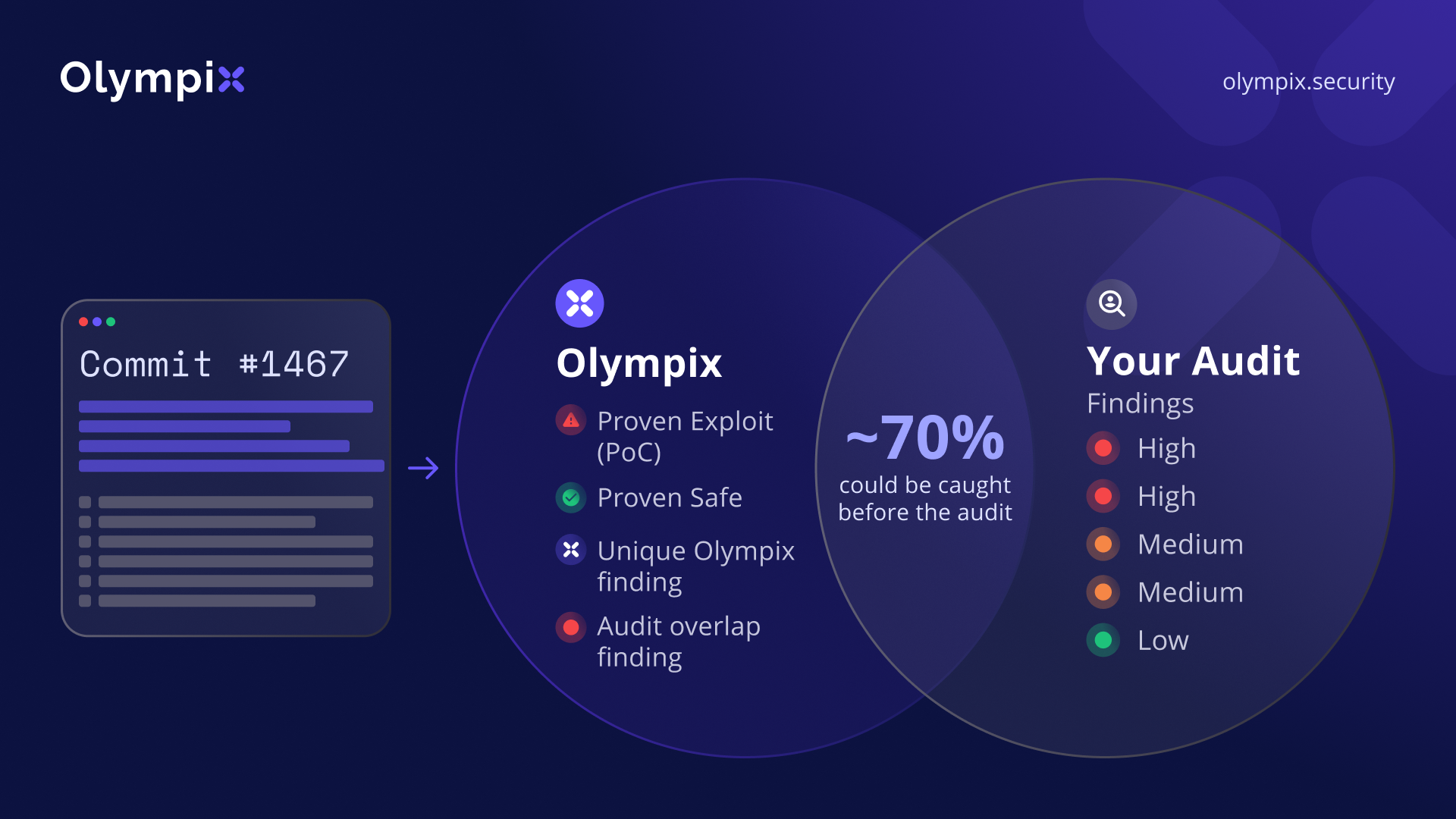
Discover why Olympix is the leading Slither alternative in 2025. Get 5x better vulnerability detection (75% vs 15% accuracy), real-time IDE integration, and comprehensive DeFi security coverage. See why teams are switching from Slither to Olympix for modern Web3 protection.
Smart contract audit limitations exposed: Why $1B+ was stolen from audited DeFi protocols in 2024. Learn the gaps audits miss and how to build secure code.
Smart contract audits have become the gold standard for blockchain security, but they're creating a dangerous illusion of safety. Here's why your audit isn't enough, and what you need to build instead.
Most smart contract exploits are merged, not discovered. This article breaks down how developers can prevent 85% of vulnerabilities before audit using mutation testing, static analysis, and CI-enforced threat ownership.
Implementing proper web3 security best practices requires treating security as a continuous development methodology, not a one-time audit milestone. Every line of code, every architectural decision, every integration point must be evaluated through a security lens from conception to deployment and beyond.
Learn writing secure smart contracts with adversarial-first development. Discover threat modeling, mutation testing, and tools like Olympix to prevent DeFi exploits. Complete guide for developers.
Learn why smart contract vulnerabilities cause billions in losses despite audits. Discover proven methods to detect and prevent DeFi exploits.
Learn how 60% of DeFi exploits stem from broken assumptions, not bugs. Master invariant design to build mathematically secure smart contracts that survive real-world attacks.
Learn everything about DeFi decentralized exchanges (DEXs) - how they work, risks vs centralized exchanges, security considerations, and what to know before trading.
After a sophisticated exploit, Hedgey Finance rebuilt their security with a comprehensive five-layer defense architecture featuring AI-powered analysis, adversarial fuzzing, and continuous monitoring. Their proactive approach demonstrates how superior security becomes a competitive advantage and sets the new standard for enterprise Web3 protection.
DeFi DAOs control billions in crypto assets through automated governance, but hidden security risks make them prime targets for exploitation. This guide reveals how governance attacks succeed and what developers need to know to build secure DAO systems.
A $44M exploit revealed how function interactions can slip past even top-tier audits. This postmortem shows why analyzing behavior over time is critical to smart contract security.
Security doesn't start at audit, it starts at the pull request. This article breaks down how PR-scoped risk summaries and mutation testing turn every commit into a security checkpoint, directly in your Git workflow.
Web3 coding languages aren’t just about syntax; they’re also about security decisions. This guide breaks down how Solidity, Rust, Move, and Cairo shape your threat model, tooling limits, and exploit exposure. Build smarter by understanding what your language makes easy to get wrong.
Smart contract security best practices won’t protect you. This piece breaks down how real exploits bypass the checklists and how to build security that actually holds up using intent-aware analysis, mutation testing, and state-bound validation. Stop following rules. Start enforcing invariants.
Code coverage tells you what ran. Mutation testing tells you what broke. In this piece, we break down why 100% test coverage means nothing if your tests don’t catch logic failures and how mutation testing exposes the blind spots that lead to real exploits.
Most teams treat audits like insurance. In reality, they’re just a snapshot. This beginner’s guide breaks down what a Web3 security audit really covers, why so many fail, and how to build real security into your development lifecycle. If you’re launching smart contracts, read this before you trust an audit to protect you.
DeFi aggregators route trades across DEXes to optimize execution, but they also introduce new attack surfaces and trust assumptions. This guide breaks down how they work, where they fail, and what developers must do to integrate them securely.
A practical guide for newcomers to Web3 development. Learn how to set up your environment, write and test your first smart contract, deploy to a testnet, and build a simple dApp interface. Perfect for developers who want to go from zero to on-chain fast, without fluff.
Codify security where exploits begin—Git. This article breaks down how to embed static analysis, mutation testing, and threat modeling directly into your version control workflows. No fluff, just tactical enforcement.
Web3 coding challenges should train for failure, not cleverness. This post shows how to redesign them around real exploits, threat models, and adversarial thinking to actually prepare developers for mainnet.
Most blockchain development frameworks optimize for speed, not security. This post breaks down how popular tools miss critical bugs, why tests pass but code fails, and what builders need to demand from their stack to ship safely.
A head-to-head benchmark of Olympix vs. Slither on the EigenLayer codebase. See how enterprise-grade static analysis stacks up against open-source tools in high-stakes DeFi security.
Most proof markets sacrifice privacy to scale. Fermah encrypts the pipeline with Confidential Proof Dispatch. =Nil; makes external data trustless. Together, they’re building the secure ZK stack DeFi needs next.
A technical breakdown of what it actually takes to become a Web3 developer. This guide outlines a real Web3 coding roadmap—covering adversarial thinking, EVM mastery, protocol design, testing tools, and security practices every serious builder needs.
Smart contracts, the backbone of Web3 applications, are vulnerable to exploits due to their unchangeable nature. This article examines common vulnerabilities and how to enhance smart contract security.
Discover how Decentralized Finance (DeFi) is revolutionizing finance by replacing intermediaries with blockchain technology. From its Bitcoin roots to today’s cutting-edge trends like tokenized assets and AI integration, this guide explores DeFi’s evolution, key players, challenges, and expert predictions shaping its future. Dive in to grasp the full potential of DeFi!



.png)