Architectural Security: Why Smart Contracts Need Explicit Trust Boundary Design
Making Trust Boundaries First-Class Citizens in Protocol Architecture
The most catastrophic smart contract exploits share a common root cause: protocols treat trust boundaries as an afterthought rather than a fundamental architectural constraint. When the Ronin Bridge lost $624 million in 2022, the failure point was not a coding error but a fundamental misunderstanding of where trust boundaries existed in the validator architecture. Modern protocol design requires elevating trust boundaries from implicit assumptions to explicit, enforceable architectural elements.
Understanding Trust Boundaries in Decentralized Systems
A trust boundary represents the point at which a protocol stops relying on cryptographic guarantees and begins depending on assumptions about actor behavior. In traditional software architecture, these boundaries exist at network perimeters or authentication layers. In Web3 protocols, trust boundaries manifest wherever:
External data enters the protocol without cryptographic verification
Multi-signature schemes assume honest majority among keyholders
The critical insight is that trust boundaries are not bugs to be eliminated but architectural realities to be managed. Protocols that acknowledge and formalize these boundaries build more resilient systems than those that attempt to obscure them through complexity.
The Cost of Implicit Trust Assumptions
The Wormhole bridge exploit in February 2022 demonstrates how implicit trust boundaries create systemic vulnerabilities. Attackers exploited a signature verification flaw that existed because the protocol's architecture did not explicitly model the trust relationship between validators and the core bridging logic. The protocol assumed validators would only sign valid state transitions, but this assumption existed in documentation rather than code.
When trust boundaries remain implicit, several failure modes emerge:
Assumption drift occurs when developers modify code without recognizing that their changes affect trust assumptions. A seemingly minor optimization in a validation function can inadvertently widen a trust boundary, creating new attack vectors.
Composition failures happen when protocols integrate with external systems without explicitly mapping where trust boundaries intersect. The Nomad bridge exploit cost $190 million because an upgrade changed how the protocol verified message authenticity, effectively moving a trust boundary without updating dependent components.
Testing gaps emerge because implicit trust boundaries are not captured in test suites. Security audits focus on explicit code paths but miss architectural assumptions that are never formalized in the implementation.
Architectural Patterns for Explicit Trust Boundaries
Leading protocols now implement trust boundaries as first-class architectural elements through several concrete patterns.
Trust Boundary Decorators
Instead of scattering validation logic throughout a codebase, protocols can use explicit boundary markers that enforce validation requirements at trust transition points:
This pattern makes trust boundaries visible in the code structure while creating an audit trail of all boundary crossings. Security teams can analyze these transition points independently from business logic.
Capability-Based Access Control
Rather than role-based permissions that assume certain actors are trustworthy, capability-based systems grant specific, revocable permissions for individual actions. Uniswap v4's hook system exemplifies this approach by explicitly defining what capabilities hooks receive rather than granting broad access categories.
Each capability grant represents a trust boundary. The protocol makes explicit statements about what untrusted code can access and enforces these boundaries through the type system and runtime checks.
Zero-Knowledge Trust Minimization
Protocols increasingly use zero-knowledge proofs to eliminate trust boundaries entirely at critical transition points. Rather than trusting that off-chain computations executed correctly, protocols can verify cryptographic proofs of correct execution.
This approach does not eliminate all trust boundaries but moves them to more defensible positions. Instead of trusting that a complex computation ran correctly, the protocol only needs to trust the soundness of the proof system itself, a much smaller trust surface.
Formalizing Trust Boundaries in Development Workflows
Making trust boundaries first-class citizens requires integrating them into the entire development lifecycle, not just final implementation.
Specification-Level Modeling
Before writing implementation code, protocol architects should explicitly document trust boundaries in formal specifications. This documentation should identify:
Every point where the protocol accepts external input
The validation requirements for each boundary crossing
The consequences of a boundary violation
The economic assumptions that underpin each trust relationship
Tools like TLA+ and Alloy allow teams to model these boundaries formally and verify that the specification maintains safety properties even when adversarial actors exploit trust assumptions.
Automated Boundary Detection
Static analysis tools can identify potential trust boundaries by detecting patterns like external calls, signature verifications, and access control checks. Olympix's static analysis platform identifies trust boundary violations by tracking data flow from untrusted sources to sensitive operations, flagging cases where validation logic is missing or insufficient.
This automated detection catches cases where developers inadvertently create new trust boundaries through code changes. The analysis runs on every commit, preventing trust boundary drift before it reaches production.
Mutation Testing for Trust Assumptions
Traditional testing validates that code works correctly under expected conditions. Mutation testing for trust boundaries validates that code fails safely when trust assumptions are violated.
By systematically mutating trust-related code, teams can verify that removing a signature check actually causes transactions to revert, or that bypassing an access control modifier triggers safety mechanisms. This testing approach surfaces cases where trust boundaries exist in comments but not in enforceable code.
Economic Security Models and Trust Boundaries
Trust boundaries have economic dimensions that pure cryptographic analysis cannot capture. The Mango Markets exploit demonstrated this when an attacker manipulated oracle prices through economic means rather than technical vulnerabilities.
Protocols must model trust boundaries with explicit economic assumptions:
Collateralization requirements create economic trust boundaries by requiring actors to post stake that exceeds potential gains from malicious behavior. The trust boundary shifts from "we trust validators to behave honestly" to "we trust that validators value their collateral more than attack profits."
Time locks and delays create trust boundaries around governance changes by ensuring that users can exit before malicious updates take effect. The boundary becomes temporal rather than purely access-based.
Fraud proofs and optimistic systems accept that trust boundaries will occasionally be violated but create economic incentives for detecting and proving violations. The architecture explicitly acknowledges that some transactions may be invalid while ensuring that invalid state cannot persist.
Cross-Chain Trust Boundary Challenges
Interoperability protocols face unique trust boundary challenges because they must reconcile different security models across chains. The Multichain bridge collapse illustrated how complex trust boundaries become when spanning multiple consensus systems.
Effective cross-chain architectures make several trust boundaries explicit:
Consensus finality boundaries acknowledge that different chains have different finality guarantees. A transaction confirmed on one chain may still be revertible while the receiving chain treats it as final. This timing mismatch creates a trust boundary that must be explicitly managed through confirmation delays or economic guarantees.
Validator set overlap creates trust boundaries around the assumption that validators on different chains do not collude. Protocols should model the economic cost of corrupting validator sets and ensure that attacking multiple chains simultaneously exceeds any potential profit.
Emergency intervention mechanisms represent trust boundaries where protocols explicitly grant certain actors extraordinary powers during crisis situations. Rather than hiding these powers, mature protocols document exactly when and how they can be exercised, making the trust boundary transparent to users.
Implementing Trust Boundaries in Smart Contract Code
Protocol developers can implement several concrete patterns to make trust boundaries explicit in their codebases.
Separation of Trusted and Untrusted Code Paths
Rather than mixing trusted and untrusted logic, protocols should maintain clear architectural separation:
contract TrustBoundaryExample {
    // Trusted internal state transitions
    function _updateState(uint256 newValue) internal {
        state = newValue;
    }

    // Explicit trust boundary with external validation
    function updateFromExternal(uint256 value, bytes calldata proof)
        external
        crossesTrustBoundary(proof)
    {
        _updateState(value);
    }
}
This separation makes trust boundaries visible in the code structure and allows security auditors to focus review efforts on boundary-crossing functions.
Explicit Invariant Checking at Boundaries
Every trust boundary should enforce protocol invariants explicitly rather than assuming that external inputs will maintain system constraints:
These events enable off-chain monitoring systems to detect unusual patterns in trust boundary usage and alert operators to potential attacks in progress.
Governance and Trust Boundary Evolution
Protocol governance introduces particularly complex trust boundaries because it explicitly grants certain actors the power to modify protocol rules. The Tornado Cash governance attack demonstrated how attackers could exploit governance mechanisms to manipulate trust boundaries themselves.
Mature governance systems make trust boundaries around protocol changes explicit through:
Time locks that prevent immediate execution of governance proposals, creating a trust boundary where users can verify changes before they take effect.
Guardian mechanisms that grant specific actors veto power over governance decisions, explicitly acknowledging that pure token-based voting has trust assumptions around voter rationality and participation.
Upgrade transparency that requires governance changes to go through formal specification processes before implementation, ensuring that trust boundary modifications are intentional rather than accidental.
Measuring Trust Boundary Security
Protocols need quantitative methods for assessing trust boundary security beyond subjective code review.
Trust surface metrics measure the number and complexity of trust boundaries in a protocol. Protocols with fewer, simpler trust boundaries generally have smaller attack surfaces than those with many complex boundary conditions.
Validator corruption cost estimates the economic resources required to compromise each trust boundary. Higher corruption costs indicate more robust trust boundaries.
Boundary violation detection time measures how quickly a protocol can detect and respond to trust boundary violations through monitoring and alerting systems.
Integration with Security Tooling
Modern security tools increasingly recognize trust boundaries as first-class architectural elements requiring specialized analysis.
Olympix's mutation testing platform specifically targets trust boundary code by systematically removing or bypassing validation logic to verify that safety mechanisms actually prevent boundary violations. This approach catches cases where developers implemented trust boundaries in comments or documentation but not in enforceable code.
Static analysis tools track data flow across trust boundaries, flagging cases where untrusted external data reaches sensitive operations without proper validation. This analysis runs automatically on every code change, preventing new trust boundary violations from entering the codebase.
Fuzzing tools now generate inputs specifically designed to violate trust assumptions, testing whether boundary enforcement mechanisms work correctly under adversarial conditions rather than just expected usage patterns.
The Future of Trust-Aware Protocol Design
As the Web3 ecosystem matures, protocols will increasingly adopt trust boundaries as fundamental architectural primitives rather than implementation details.
Future development frameworks will likely include:
Type systems that encode trust levels directly in the programming language, making it impossible to pass untrusted data to functions expecting validated inputs without explicit boundary crossing.
Formal verification tools that prove protocols maintain safety properties even when adversaries exploit all explicitly modeled trust assumptions.
Standardized trust boundary patterns that protocols can implement consistently, making security properties composable across different systems.
The protocols that survive long-term will be those that acknowledge trust boundaries as architectural realities to be managed rather than problems to be obscured. By making trust boundaries first-class citizens in protocol architecture, developers can build systems that fail safely when trust assumptions are violated rather than catastrophically when implicit boundaries are breached.
Conclusion
Every major smart contract exploit reveals that the failure point was not a missing security check but an unmodeled trust boundary. Protocols that elevate trust boundaries from implicit assumptions to explicit architectural elements create more transparent, auditable, and resilient systems.
The shift from audit-centric security to proactive security tools reflects this architectural evolution. Static analysis, mutation testing, and automated validation can only protect protocols whose trust boundaries are explicitly defined in code rather than buried in documentation. As the ecosystem continues to mature, protocols that formalize trust boundaries as first-class architectural citizens will demonstrate superior security properties compared to those that treat them as implementation details.
What’s a Rich Text element?
The rich text element allows you to create and format headings, paragraphs, blockquotes, images, and video all in one place instead of having to add and format them individually. Just double-click and easily create content.
A rich text element can be used with static or dynamic content. For static content, just drop it into any page and begin editing. For dynamic content, add a rich text field to any collection and then connect a rich text element to that field in the settings panel. Voila!
Headings, paragraphs, blockquotes, figures, images, and figure captions can all be styled after a class is added to the rich text element using the "When inside of" nested selector system.
Follow-up: Conduct a follow-up review to ensure that the remediation steps were effective and that the smart contract is now secure.
Follow-up: Conduct a follow-up review to ensure that the remediation steps were effective and that the smart contract is now secure.
In Brief
Remitano suffered a $2.7M loss due to a private key compromise.
GAMBL’s recommendation system was exploited.
DAppSocial lost $530K due to a logic vulnerability.
Rocketswap’s private keys were inadvertently deployed on the server.
Hacks
Hacks Analysis
Huobi | Amount Lost: $8M
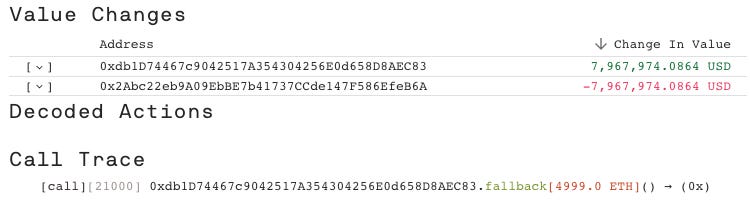
On September 24th, the Huobi Global exploit on the Ethereum Mainnet resulted in a $8 million loss due to the compromise of private keys. The attacker executed the attack in a single transaction by sending 4,999 ETH to a malicious contract. The attacker then created a second malicious contract and transferred 1,001 ETH to this new contract. Huobi has since confirmed that they have identified the attacker and has extended an offer of a 5% white hat bounty reward if the funds are returned to the exchange.