The Audit Is Dead: Why Web3 Needs Continuous Security
Audits were a reasonable starting point. They are no longer sufficient. Here is what the next generation of smart contract security actually looks like.
Every week, another protocol loses millions. The post-mortem drops. The community does its forensics. And somewhere near the top of every incident report, you find the same sentence: the contract had been audited.
This is not a coincidence. It is a structural problem. Web3 built its entire security posture around a process designed for a moment in time, then kept shipping code and calling it covered. The audit is not failing because auditors are bad at their jobs. It is failing because the model itself cannot keep up with how software actually gets built.
Ninety percent of exploited contracts in 2025 had been audited. That number does not indict auditors. It indicts an industry that treats a one-time review as a permanent guarantee.
What an Audit Actually Is (and Is Not)
A smart contract audit is a point-in-time review. A team of security researchers reads your code, looks for known vulnerability classes, and produces a report. That report reflects the state of your codebase on the day the audit ended.
Then you merge a PR. Then your integrations change. Then a dependency gets updated. Then your protocol adds a new feature three weeks before launch. The audit report still says "low risk." The codebase no longer matches the document.
This is not hypothetical. It is how most exploits happen. The vulnerability was not present during the audit. It was introduced afterward, during the normal course of development, by developers who had no automated signal telling them something had gone wrong.
The audit gave teams confidence. The confidence was not updated when the code was.
The Case for Shifting Left
"Shifting left" is borrowed from traditional software engineering, and it means exactly what it sounds like: move security earlier in the development process. Stop treating it as a gate at the end of the pipeline and start treating it as a property of the pipeline itself.
In Web3, this means tools that run in your CI/CD workflow, that flag vulnerabilities at the PR level, that catch issues before they ever reach staging. Not a report that arrives six weeks after code freeze. Automated analysis that runs every time code changes.
The math on this is straightforward. Fixing a bug in development costs almost nothing. Fixing it post-audit costs a re-audit. Fixing it post-deployment costs your users their funds and your protocol its reputation.
Teams that integrate security into their dev workflow are not just finding bugs earlier. They are changing how their engineers think about code. When a developer gets a security flag on a PR the same way they get a failing test, security stops being someone else's job.
What Continuous Security Actually Looks Like
A continuous security pipeline is not one tool. It is a layered system of deterministic checks that runs alongside your code at every stage.
Static Analysis
Static analysis scans your code without executing it, looking for known vulnerability patterns: reentrancy, integer overflow, access control issues, and more. Modern static analyzers built specifically for Solidity can cover upward of 98% of common EVM vulnerability classes with detection accuracy that legacy tools cannot approach. The difference is not marginal. Tools trained on real exploit patterns catch what generic analyzers miss.
Fuzzing
Fuzzing throws thousands of pseudo-random inputs at your contract to find edge cases that static analysis cannot see. Where static analysis reads code, fuzzing runs it. The two approaches catch fundamentally different classes of bugs. Running both is not redundant. It is the point.
Mutation Testing
Mutation testing evaluates the quality of your test suite by intentionally introducing small errors into your code and checking whether your tests catch them. A test suite that passes against a mutated contract is a test suite you cannot trust. Most teams discover, through this process, that their coverage numbers were lying to them.
Formal Verification
Formal verification uses mathematical proofs to confirm that your contract behaves correctly across all possible states. It is the highest bar in smart contract security and, historically, the most expensive to reach. Integrating formal verification into a CI pipeline makes that guarantee continuous rather than ceremonial.
Audits Are Not the Enemy
This is worth saying plainly, because the argument is sometimes misread. Manual audits are not worthless. Experienced auditors find things that automated tools miss. Business logic errors, complex economic attack vectors, subtle interaction bugs between protocol components: these require human judgment and context that no static analyzer can replicate today.
The problem is not the audit. The problem is treating the audit as the whole strategy.
When teams run continuous security tooling throughout development, something useful happens on the way to their audit: the low and medium severity findings that would have filled half the report are already resolved. Auditors spend their time on the hard problems. The audit becomes more focused, more valuable, and typically less expensive because the scope is cleaner.
Teams using this approach are seeing audit finding reductions of 65% or more. That is not a marginal improvement. That is a fundamentally different starting point for the audit conversation.
Developer-First, Not Security-First
Security tooling has a long history of being built for security teams and then handed to developers with the expectation that they will figure it out. This is how you get tools that are technically sophisticated and practically ignored.
The best continuous security tools are built the other way around. They integrate directly into the workflows developers already use. They surface findings in the PR review, not in a separate dashboard that requires a separate login. They explain what is wrong and why it matters, not just where the flag is in the code.
When security lives where development lives, adoption is not a change management problem. It is just part of how the team works.
What the Best Teams Are Actually Doing
The protocols that have avoided major exploits are not the ones with the most expensive audits. They are the ones that treat security as an operational discipline rather than a pre-launch checklist.
That looks like:
Static analysis running on every commit, not just before the audit
Fuzzing integrated into the CI pipeline so edge cases are caught before staging
Mutation testing as a quality gate on the test suite itself
Formal verification applied to the highest-risk components
Audits scoped to the hard problems, not the whole codebase from scratch
This is not a more expensive version of what teams are already doing. In many cases it is cheaper: fewer audit findings means fewer revision cycles, shorter audit timelines, and faster time to launch. Some teams are hitting 20% faster launch cycles alongside the security improvements.
The Cost of Waiting
The exploits are not getting less sophisticated. Attack surfaces are expanding faster than audit cycles can track them. Cross-chain interactions, complex DeFi composability, protocol upgrades applied to live contracts: every layer of complexity that gets added is a potential attack vector that did not exist when the last audit report was filed.
The pattern is consistent enough to be predictable. A protocol ships, audited and approved. Development continues. Months later, something breaks in a way the audit never anticipated, because the audit never saw that version of the code.
Waiting for a better audit to solve this is waiting for the wrong thing. The audit is not the bottleneck. The gap between when code changes and when anyone checks it for vulnerabilities is.
What This Requires
Continuous security is not a tool purchase. It is a decision about how a team thinks about risk. It requires accepting that security is not a deliverable you get from a vendor and file away. It is a property of your codebase that has to be maintained alongside the codebase itself.
That shift in thinking is more important than any specific tool. The tooling exists. The integrations exist. The question is whether teams are willing to treat security as infrastructure rather than a checkbox.
The protocols that get exploited are overwhelmingly the ones that treated it as a checkbox. The ones that have stayed safe are the ones that built security into how they operate.
Build Like the Exploit Is Already Written
Web3 will keep building. Codebases will keep changing. The threat landscape will keep evolving. A security model that produces a static report and then goes silent is not matched to that reality.
The teams that will define the next era of secure protocols treat audits as one layer in a larger system: automated checks running continuously, security living in the dev workflow, vulnerabilities caught before they compound into something irreversible.
That is what it means to shift left. Not to skip the audit. To make sure the audit is never the last line of defense.
Olympix provides proactive smart contract security infrastructure, including static analysis, fuzzing, mutation testing, and formal verification integrated directly into CI/CD pipelines. Built for teams that cannot afford to treat security as an afterthought. Request a free demo!
What’s a Rich Text element?
The rich text element allows you to create and format headings, paragraphs, blockquotes, images, and video all in one place instead of having to add and format them individually. Just double-click and easily create content.
A rich text element can be used with static or dynamic content. For static content, just drop it into any page and begin editing. For dynamic content, add a rich text field to any collection and then connect a rich text element to that field in the settings panel. Voila!
Headings, paragraphs, blockquotes, figures, images, and figure captions can all be styled after a class is added to the rich text element using the "When inside of" nested selector system.
Follow-up: Conduct a follow-up review to ensure that the remediation steps were effective and that the smart contract is now secure.
Follow-up: Conduct a follow-up review to ensure that the remediation steps were effective and that the smart contract is now secure.
In Brief
Remitano suffered a $2.7M loss due to a private key compromise.
GAMBL’s recommendation system was exploited.
DAppSocial lost $530K due to a logic vulnerability.
Rocketswap’s private keys were inadvertently deployed on the server.
Hacks
Hacks Analysis
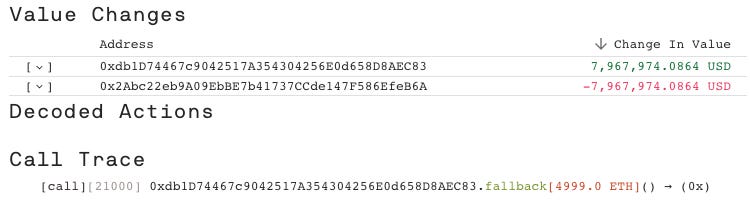
Huobi | Amount Lost: $8M
On September 24th, the Huobi Global exploit on the Ethereum Mainnet resulted in a $8 million loss due to the compromise of private keys. The attacker executed the attack in a single transaction by sending 4,999 ETH to a malicious contract. The attacker then created a second malicious contract and transferred 1,001 ETH to this new contract. Huobi has since confirmed that they have identified the attacker and has extended an offer of a 5% white hat bounty reward if the funds are returned to the exchange.