Smart Contract Security in CI/CD: Shifting Left Without Slowing Down
In traditional software engineering, "shift left" has been the dominant security philosophy for the better part of a decade. The idea is straightforward: the earlier in the development cycle you find a bug, the cheaper and faster it is to fix. A vulnerability caught in a pull request takes minutes to resolve. The same vulnerability caught in QA takes hours. Caught in production, it takes weeks, public incident reports, and sometimes significant financial damage. Moving security earlier in the pipeline is not a philosophical stance. It's an economics argument, and it won.
Web3 hasn't fully made that transition yet. Smart contract development still runs on a model where security is largely a terminal activity: write the code, prepare for deployment, send it to an audit firm, remediate the findings, and ship. The audit is treated as the security layer, and everything before it is treated as the development layer. These two phases are kept deliberately separate.
That model made sense in the early days of the ecosystem, when the tooling for earlier-stage security analysis barely existed and audit firms were the only credible option. It doesn't make sense now. The tooling has matured, the financial stakes have grown, and the development cycles have accelerated to the point where a terminal security review creates a genuine bottleneck. Engineering leads at serious protocols are increasingly aware of this tension. The question isn't whether to shift security left in the smart contract development cycle. It's how to do it without introducing friction that kills the team's velocity.
What Shift Left Means in Practice and What It Doesn't
Shifting security left doesn't mean turning developers into security engineers. That framing has caused real resistance to the concept in both traditional software and Web3 contexts, because it sounds like it's asking developers to take on a discipline that took specialists years to develop. It isn't.
What it actually means is embedding security feedback into the environments and workflows developers already operate in, at the moments when that feedback is most actionable. A developer who gets a security finding in the same pull request review where they get a code review comment doesn't need to become a security expert. They need to understand the finding well enough to fix it, and the tooling needs to explain it clearly enough to make that possible. The expertise lives in the tool. The developer acts on the output.
This distinction matters because the failure mode of poorly implemented shift-left programs is exactly that misunderstanding. Teams install a static analysis tool, run it once, get two hundred findings across a codebase that's been in development for months, and conclude that the tool creates more work than it saves. The tool didn't fail. The implementation did. Security tooling that runs continuously from the start of a project surfaces findings incrementally, one PR at a time, in the context of the specific code change that introduced the issue. That's a completely different experience from a retroactive sweep of an existing codebase.
For smart contract teams specifically, the implementation question comes down to what gets integrated into the pipeline, at what stage, and with what level of automation. The answer isn't to run every available analysis tool on every commit. It's to match the right tool to the right stage of the development cycle, so that the feedback is timely, relevant, and actionable without becoming noise.
Why Smart Contract Development Resists This Transition
The audit-centric security model is deeply embedded in Web3 culture, and it resists change for a few structural reasons that are worth naming directly before talking about how to work around them.
The first is credibility signaling. Audit reports from recognized firms are legible to the market in a way that internal security tooling isn't. Investors, exchange listing teams, and users understand what "audited by Firm X" means. They don't have a comparable framework for evaluating "we run continuous static analysis and invariant testing in our CI/CD pipeline." The external audit produces a PDF with a logo. Internal security tooling produces better code and fewer findings, which are harder to point to in a fundraising deck. This creates an incentive to prioritize the visible checkpoint over the substantive practice, even when the substantive practice provides more actual security.
The second is process inertia. Most smart contract teams developed their workflows before mature CI/CD-native security tooling existed for Solidity. Foundry, Hardhat, and the tooling ecosystem around them have improved dramatically, but the security layer of that ecosystem lagged behind the development layer. Teams built processes without a meaningful security integration step because there wasn't one worth integrating. Retrofitting that step into established workflows takes deliberate effort, and engineering leads are already managing a long list of competing priorities.
The third is a genuine concern about velocity. Security analysis takes time. If every pull request triggers a lengthy analysis run that blocks merge, developers will route around it. They'll merge without waiting for results, or they'll disable the check, or they'll start treating security findings as a separate queue to be addressed later — which is exactly the pattern that shift-left is designed to avoid. The concern is legitimate. The solution is tooling that's fast enough and well-integrated enough that it doesn't interrupt the development loop, not the absence of tooling.
What a Smart Contract Security Pipeline Actually Looks Like
A well-structured smart contract CI/CD security pipeline isn't a single tool. It's a sequence of different analysis approaches matched to different development stages, each calibrated to provide feedback at the right level of depth without blocking the workflow.
Static analysis belongs at the pull request stage. When a developer opens a PR, static analysis should run automatically and surface findings before the code review begins. This means the reviewer and the author are looking at security context alongside functional context, in the same review cycle. Static analysis at this stage is optimized for speed and specificity. It's not trying to provide comprehensive security coverage. It's trying to catch the well-understood, pattern-based vulnerability classes that have no business reaching a code review: reentrancy, unchecked return values, dangerous delegatecall usage, improper access control patterns, integer overflow risks. These are the findings that show up in audit reports not because they require deep expertise to identify, but because nobody ran a scanner before the code reached the auditor. Static analysis in the PR pipeline eliminates that entire category of audit findings, consistently, without requiring any additional developer action beyond reviewing the output.
Mutation testing belongs at the milestone stage, run before major releases, before external audit, and periodically during active development. Its purpose is different from static analysis. Rather than identifying specific vulnerability patterns in the code, mutation testing validates whether the test suite itself would catch vulnerabilities if they existed. It does this by introducing deliberate, small defects into the codebase and checking whether any test detects the change. A test suite with strong mutation coverage is one that has been verified to catch real bugs. A test suite with weak mutation coverage is one that creates a false sense of security. This isn't a theoretical distinction. Auditors who encounter projects with low mutation scores spend significant time writing their own tests before they can begin their actual analysis. Projects that arrive with high mutation scores compress that phase of the engagement and redirect auditor time toward the issues that require genuine expertise.
Invariant testing is the continuous layer, running on every code change and providing the ongoing assurance that core protocol properties hold true regardless of what's been changed. An invariant is a condition that must always be true: total supply equals the sum of all balances, debt can never exceed collateral, the reserve ratio stays within defined bounds. These are the properties whose violation would represent a catastrophic failure of the protocol, not just a bug. Invariant testing generates thousands of transaction sequences and input combinations automatically and checks whether any of them produce a state where an invariant doesn't hold. When it runs continuously in CI/CD, it means that every code change is automatically checked against the protocol's fundamental safety guarantees, not just its functional behavior. This is what makes it possible to keep developing after the initial audit without treating every change as potentially requiring a new external review.
Fuzzing completes the automated analysis layer by exploring the state space that unit tests don't reach. Where unit tests check specific inputs against expected outputs, fuzzing generates inputs that no human would have thought to test and looks for unexpected behavior. It's particularly effective at finding edge cases in complex mathematical operations, boundary conditions in financial calculations, and interaction effects between different protocol components. Integrated into the CI/CD pipeline, fuzzing runs against the current state of the codebase and surfaces anomalies automatically, without requiring a developer to anticipate which inputs might be dangerous.
But automated analysis tools all share the same limitation: they flag what might be wrong. They don't prove it. A finding from a static analyzer tells you there's a potential vulnerability. It doesn't tell you whether it's actually exploitable, how severe the impact would be, or what an attacker would need to do to trigger it. That validation step is where most teams stall. The developer who receives a finding has to either have the security expertise to assess it themselves, or wait for an external reviewer to do it. Neither is fast, and neither scales.
This is where internal audit automation closes the loop. Olympix's BugPOCer is an internal audit agent that takes flagged vulnerabilities and automatically generates executable proof of concept exploits for them. When a finding surfaces in the pipeline, BugPOCer produces the concrete demonstration of what that vulnerability actually enables: the exact sequence of calls, the conditions required to trigger it, and the outcome in a live environment. A theoretical finding becomes an unambiguous fact. Severity is no longer a judgment call. The development team knows exactly what they're dealing with, can prioritize remediation accurately, and can fix it with full context rather than working from a description of what might be wrong.
The downstream effect on external audits is significant. When findings that the pipeline surfaced have already been validated with PoC exploits and resolved, the auditor isn't starting from scratch on those issues. They're reviewing a codebase where the team has already done the hard work of proving what was vulnerable, documenting it precisely, and demonstrating how it was fixed. The auditor's time goes toward what it should go toward: the complex, logic-level vulnerabilities that require deep expertise to surface, not the validation work your own pipeline should have completed internally.
Together, these layers form a pipeline that doesn't just run security checks. It runs the full internal security workflow: continuous detection, automated validation, and documented remediation, before a single line of code reaches an external reviewer.
The Developer Experience Problem
All of this only works if the security tooling is designed around the developer's workflow rather than the security analyst's workflow. This is where most enterprise security tools fail in traditional software engineering, and where most smart contract security tooling has historically fallen short as well.
Security tools designed for analysts are built to produce comprehensive reports. They surface every finding, flag every potential issue, and leave prioritization to the human reviewing the output. That's appropriate for a point-in-time audit engagement. It's completely inappropriate for a CI/CD integration, where the developer needs to understand one specific finding in the context of the specific code they just wrote, fix it quickly, and move on.
Smart contract security tooling designed for CI/CD needs to do several things differently. Findings need to be scoped to the current change, not the entire codebase. Severity needs to be communicated clearly enough that a developer without security expertise can make an informed decision about how urgently to act. False positive rates need to be low enough that developers don't start ignoring findings. And the overall experience needs to fit within the development loop rather than interrupting it.
This is a harder product problem than it looks. It requires not just building an analysis engine but building the developer-facing layer that makes the output of that engine actionable in context. Most tools have invested heavily in the analysis side and underinvested in the experience side. The gap shows up in adoption rates and in the workarounds teams build to route around tooling that technically works but creates too much friction to use consistently.
How Olympix Fits Into the Pipeline
Olympix is built specifically for the CI/CD security workflow, not adapted from a tool that was originally designed for something else. Static analysis, mutation testing, invariant inference, and fuzz test generation all integrate directly into the development pipeline through the environments Solidity teams already use. Findings surface at the PR stage, scoped to the specific change that introduced them. Tests are generated automatically rather than requiring manual specification. Invariants are inferred from the codebase rather than requiring a security engineer to define them from scratch.
The practical effect is that security runs continuously without requiring a security engineer to operate it. Engineering leads can enforce security standards at the pipeline level, the same way they enforce code style or test coverage thresholds, without adding headcount or creating a separate security workflow. The development team gets feedback in the environment they already work in, at the moment it's most useful, without context-switching into a separate tool or waiting for a scheduled review.
The audit still happens. Olympix isn't positioned as an alternative to external audit, and no internal tooling should be. But the audit becomes a faster, more focused engagement because the codebase that arrives has already been through systematic screening. Finding density is lower. Test coverage is higher and demonstrably validated. Invariant coverage exists and is documented. The auditor's time goes toward the complex, logic-level vulnerabilities that require their expertise rather than the pattern-based issues that a pipeline integration would have caught weeks earlier.
For engineering leads evaluating how to build a security program that scales with their development velocity, this is the architecture worth building toward. Security embedded in the pipeline, running continuously, surfacing findings at the point where they're cheapest to fix, and producing a codebase that gets more from every external review.
The Teams That Get This Right
The smart contract teams that have adopted continuous, pipeline-integrated security share a few characteristics. They made the decision early, before their codebase was large and their workflows were fixed. They chose tooling designed for developer experience rather than analyst experience. And they stopped treating the audit as the start of their security process and started treating it as the final checkpoint of one that had been running all along.
The result isn't a slower development cycle. It's a development cycle where security findings are smaller, more isolated, and easier to fix because they're caught closer to when they were introduced. Audit timelines compress because the codebase arrives prepared. Re-audit frequency drops because the continuous invariant coverage catches the issues that incremental changes introduce. And the team ships with higher confidence because the security baseline has been maintained throughout the build, not applied at the end.
That's what shifting left actually delivers. Not more process, not more friction, not more headcount. A fundamentally different relationship between the development cycle and the security practice, where the two reinforce each other rather than competing for time.
Wrapping Up
The argument for shift-left security in smart contract development is the same argument that won in traditional software engineering: finding vulnerabilities earlier is faster, cheaper, and more effective than finding them later. The tooling to act on that argument now exists, and it's mature enough to integrate without disrupting the development workflow.
The teams that build this into their CI/CD pipeline now are establishing a security posture that scales with their codebase, rather than one that requires a paid external engagement every time the protocol evolves. That's not just a better security outcome. It's a better engineering outcome. [See how Olympix integrates into your existing pipeline →]
What’s a Rich Text element?
The rich text element allows you to create and format headings, paragraphs, blockquotes, images, and video all in one place instead of having to add and format them individually. Just double-click and easily create content.
A rich text element can be used with static or dynamic content. For static content, just drop it into any page and begin editing. For dynamic content, add a rich text field to any collection and then connect a rich text element to that field in the settings panel. Voila!
Headings, paragraphs, blockquotes, figures, images, and figure captions can all be styled after a class is added to the rich text element using the "When inside of" nested selector system.
Follow-up: Conduct a follow-up review to ensure that the remediation steps were effective and that the smart contract is now secure.
Follow-up: Conduct a follow-up review to ensure that the remediation steps were effective and that the smart contract is now secure.
In Brief
Remitano suffered a $2.7M loss due to a private key compromise.
GAMBL’s recommendation system was exploited.
DAppSocial lost $530K due to a logic vulnerability.
Rocketswap’s private keys were inadvertently deployed on the server.
Hacks
Hacks Analysis
Huobi | Amount Lost: $8M
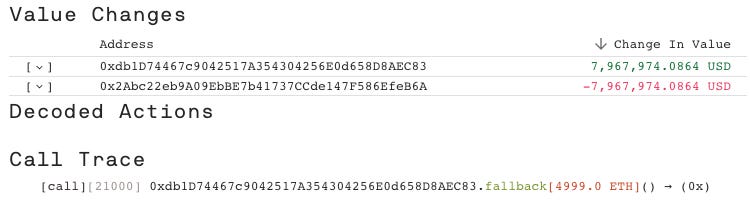
On September 24th, the Huobi Global exploit on the Ethereum Mainnet resulted in a $8 million loss due to the compromise of private keys. The attacker executed the attack in a single transaction by sending 4,999 ETH to a malicious contract. The attacker then created a second malicious contract and transferred 1,001 ETH to this new contract. Huobi has since confirmed that they have identified the attacker and has extended an offer of a 5% white hat bounty reward if the funds are returned to the exchange.