
Why $60M in Q3 2024 losses came from audited contracts that failed basic developer security checks
The smart contract security stack today is structured for plausible deniability. When a protocol gets hacked, postmortems point fingers in three directions: the dev who wrote the bug, the auditor who missed it, or the security lead who didn't catch it in review.
But in most cases, the truth is simpler: the person who introduced the bug had no systematic way to detect it before it went live. The tooling wasn't there. The accountability wasn't either.
Web3 security has been over-rotated on auditors and under-invested in developer responsibility. And the exploit data proves it. $60M in losses in Q3 2024 came from contracts that passed audit but wouldn't have passed a robust mutation test.
We don't need more auditors. We need a culture where every developer treats their commit as a threat model. This isn't about training devs to think like attackers; it's about making them own the security implications of every line they ship.
Because if your developer can ship an exploit, so can an attacker.
"Shared responsibility" is a polite way to say no one's responsible.
In most protocols, the boundary between dev and security roles is vague by design. Engineers write the code, security teams sign off on it, and auditors do the final sweep. But when things break, everyone claims they didn't own the outcome. That's why postmortems read like whodunits.
But attackers don't care who owned the checklist. They only care who left the door open.
Penpie Exploit (2024): $27M Loss
LI.FI Bridge: $600K Loss
These weren't zero-days. These were errors in shipping logic, introduced by developers, and merged with full CI green lights.
Security teams didn't catch them. Auditors missed them. But the real problem is structural: the people writing the most critical code aren't systematically accountable for its threat surface.
Every line of code is a security boundary. Every commit is a potential exploit vector.
Smart contract systems don't get hacked in abstract; they get hacked at specific lines, written by specific developers, merged at specific times. Trace almost any major exploit and you'll find the origin in a commit that looked innocuous at review.
You can't abstract accountability when the attack surface is concrete.
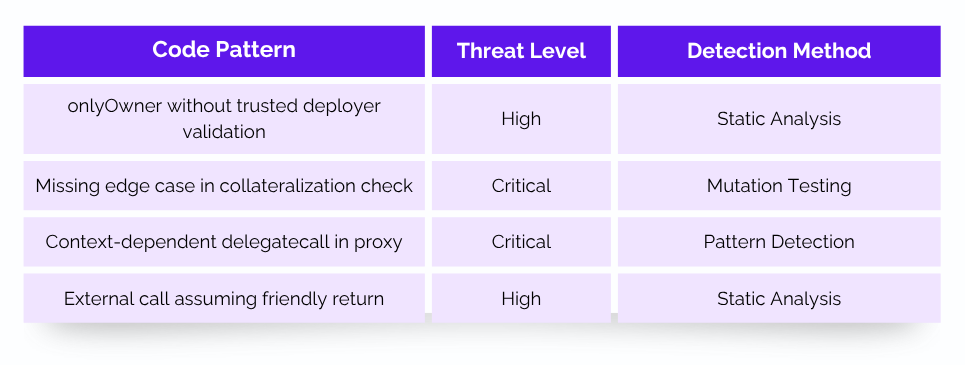
What makes these dangerous isn't just the presence of risk. It's that they passed through the same developer-controlled test suite and CI pipeline as every other change. They were shipped as normal.
And that's the failure pattern.
If your developers can't detect the vulnerability they introduced, they don't just own the code; they own the threat it created.
"Shift left" sounds good until you realize most teams just shifted the checkbox, not the accountability.
Static analysis gets run. Slither warnings get filed. Maybe there's a secure coding doc floating in Notion. But if the pipeline doesn't enforce security guarantees and the devs don't feel the consequences, then shift-left is theater.
The real test isn't whether you have a linter. It's whether it would've caught the bug that drained $20M from your vault.
Mutation testing introduces synthetic bugs—"mutants"—into your code and checks whether your test suite detects them. If your tests pass when the code is maliciously altered, your coverage is a lie. And that lie ships to mainnet every day.
Most exploits aren't from sophisticated adversaries. They're from developers who accidentally implemented exploitable behavior—and from systems that couldn't catch it.
Implementation Strategy:
If you run it on every PR, every dev sees their threat surface before the attacker does.
That's not shift-left. That's threat accountability embedded in the CI.
You can't expect developers to own security if they don't own the tools that enforce it.
Threat ownership starts by embedding security into the developer workflow—not bolting it on after code is written. That means every tool in the CI pipeline needs to answer one question: Would this have prevented the last exploit?
Security isn't a checklist. It's a set of enforced invariants at the commit level.
Static Analysis (Blocking, Not Advisory):
Mutation Testing (95%+ Kill Rate Required):
Unit Test Validation:
Pre-Commit Security Hooks:
IDE Integration:
When developers can see the exploit risk of their code, and the tools surface it before merge, they stop shipping bugs they don't understand.
Security becomes not just their problem, but their platform.
Security teams don't scale by reviewing every PR. They scale by hardening the development environment itself.
The old model casts security as the final gatekeeper. But in high-velocity teams, that role breaks. Either they become a bottleneck—or they get bypassed. Either way, it doesn't work.
The better model is platform security: codify security policy as code, embed it in the toolchain, and let devs self-enforce. That's how you scale threat modeling across every merge.
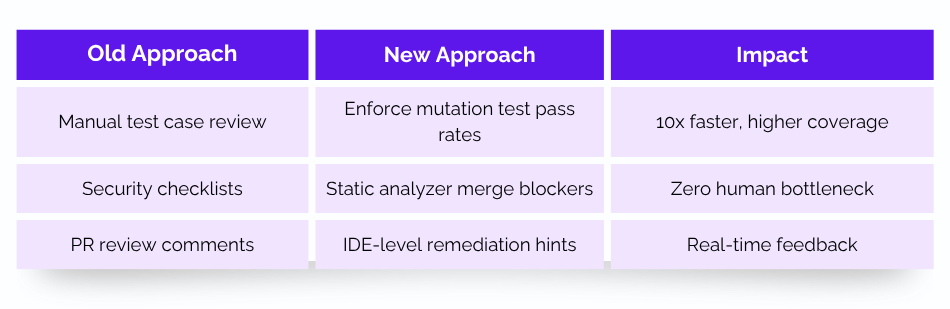
Security teams should be building the rails that keep developers from going off the cliff. That means:
Stop reviewing code after the fact. Start building systems that make unsafe code impossible to merge.
Attackers don't have special knowledge. They have your Git history and more discipline than your test suite.
The hardest part of writing an exploit is understanding what the code assumes. And no one understands your code's assumptions better than the person who wrote it.
Which is why exploit paths often look like feature branches.
Pattern 1: Safety Check Removal
Pattern 2: Unsafe Dependencies
Pattern 3: Storage Layout Changes
Pattern 4: Access Control Bypass
None of these are novel. They're just unvalidated.
The developer who introduced the risk had all the context to prevent it, but no mechanism to see that they'd created it. Meanwhile, the attacker did. That's the real asymmetry.
If you can write a vulnerable feature, you're halfway to exploiting it. And if your pipeline doesn't make that risk visible before merge, the attacker wins by default.
Shipping secure code isn't about paranoia. It's about feedback loops. Tight ones.
Objective: Operationalize Olympix across developer workflows and create baseline threat visibility.
Developers:
Security Teams:
Objective: Codify threat detection, integrate Olympix into CI, and enforce coverage gates.
Developers:
Security Teams:
Objective: Transition from reactive reviews to proactive threat prevention via embedded intelligence.
Developers:
Security Teams:
Security culture doesn't come from training. It comes from tools that enforce responsibility where it matters: at the commit, not the postmortem.
The real security gap isn't in sophisticated attack vectors; it's in basic development hygiene. Access control errors and logic flaws caused over $1 billion in losses in 2024, yet these are exactly the categories where developer tools show their highest detection rates.
The problem isn't that security is hard. It's that we're not using the tools we have where they work best.
Every major exploit traces back to a developer who introduced risk without seeing it. The code passed tests. CI was green. Reviews looked fine. But the tools that could have caught the vulnerability weren't running at commit time, weren't blocking the merge, or weren't configured to detect the specific pattern.
Consider the typical scenario: A developer writes a function with a missing access control check. Static analysis tools like Slither can flag this pattern in seconds. But if Slither isn't running in CI, configured to only warn instead of block, or ignored due to false positives, the vulnerability ships to mainnet. The exploit happens months later, and the postmortem blames "insufficient security review," but we had the technology to catch it.
This isn't about perfect security; it's about preventing preventable losses.
Current tools won't stop novel economic attacks or complex business logic flaws. But they don't need to. The majority of value at risk comes from mundane vulnerabilities we already know how to detect.
The path forward isn't perfect tools; it's better integration of imperfect ones.
When security tools run at commit time, feedback shrinks from weeks to seconds. The developer sees the issue while context is fresh. The fix is a one-line change instead of a system redesign. The vulnerability never makes it to audit, let alone mainnet.
Three Key Takeaways:
The industry doesn't need revolutionary approaches. It needs disciplined application of existing ones.