Smart Contract Audits: How to Prepare and What to Expect
Smart contract audits have become a critical checkpoint in blockchain development, yet they're often misunderstood. While audits are valuable, recent data reveals a sobering reality: approximately 90% of exploited smart contracts were previously audited. This statistic doesn't diminish the importance of audits; it highlights the need to understand what they can and cannot achieve.
If you're preparing for your first smart contract audit or reassessing your security strategy, this guide will walk you through the audit process, preparation requirements, realistic expectations, and the critical security gaps that audits alone cannot fill.
What Is a Smart Contract Audit?
A smart contract audit is a comprehensive security review conducted by specialized firms or independent security researchers. Auditors manually examine your code to identify vulnerabilities, logic errors, and deviations from best practices that could lead to exploits, fund loss, or operational failures.
Unlike traditional software, smart contracts are immutable once deployed. A single vulnerability can result in millions of dollars in losses, with no ability to patch or roll back changes. This permanence makes pre-deployment security reviews essential.
Smart contract audits typically focus on:
Vulnerability identification: Finding exploitable weaknesses like reentrancy attacks, integer overflows, access control issues, and front-running vulnerabilities
Logic verification: Ensuring the contract behaves as intended across all edge cases and user interactions
Gas optimization: Identifying opportunities to reduce transaction costs without compromising security
Code quality assessment: Reviewing code structure, documentation, and adherence to established patterns and standards
Compliance checks: Verifying alignment with relevant standards like ERC-20, ERC-721, or protocol-specific requirements
How to Prepare for a Smart Contract Audit
Preparation significantly impacts audit effectiveness and cost. Well-prepared projects receive deeper scrutiny on complex logic rather than wasting auditor time on basic issues.
1. Freeze Your Code
Lock your codebase before the audit begins. Changes during the audit process invalidate previous work and increase costs. Most audit firms charge additional fees for reviewing modified code.
Establish a clear commit hash that defines the audit scope. Any changes after this point should trigger a new audit cycle or a focused re-audit of modified components.
2. Implement Comprehensive Testing
Before engaging auditors, your code should have extensive test coverage. Aim for at least 90% code coverage, with particular focus on:
Edge cases and boundary conditions
Access control mechanisms
Mathematical operations that could overflow or underflow
State transitions and multi-step processes
Integration points with external contracts or oracles
Provide auditors with your test suite. Tests serve as executable documentation of expected behavior and help auditors understand your security assumptions.
3. Document Your Architecture and Intentions
Create clear documentation that explains:
System architecture: How contracts interact, data flows, and dependencies
Business logic: What the contract is designed to accomplish and why specific design decisions were made
Known limitations: Areas where you've accepted tradeoffs or identified potential concerns
Assumptions: External dependencies, oracle behavior, admin privileges, or user behavior assumptions
Documentation reduces misunderstandings and allows auditors to focus on substantive security analysis rather than reverse-engineering your intentions.
4. Conduct Internal Security Reviews
Run automated security analysis tools before the audit. Static analysis tools can identify common vulnerabilities quickly. Address obvious issues before paying for professional review.
Consider implementing internal code reviews or engaging junior security researchers for preliminary assessment. This layered approach catches low-hanging fruit and allows professional auditors to focus on complex vulnerabilities.
5. Run Proactive Security Tools
Before submitting your code for audit, leverage proactive security tools that catch issues auditors would otherwise find. Platforms like Olympix provide multiple security testing capabilities that strengthen your codebase before the audit begins:
Static Analysis automatically scans your code for common vulnerability patterns, identifying issues like reentrancy risks, access control flaws, and unsafe external calls. Running static analysis before your audit eliminates basic vulnerabilities and demonstrates code maturity to auditors.
Mutation Testing validates the quality of your test suite by deliberately introducing bugs into your code. If your tests still pass with these intentional errors, you've identified gaps in your testing strategy. This ensures your test coverage actually verifies security properties rather than just checking that code executes without reverting.
Automated Unit Test Generation creates comprehensive test cases that exercise edge cases and boundary conditions developers might overlook. These generated tests complement your manual test suite, increasing confidence that all code paths are validated before auditors review your contracts.
Fuzzing generates millions of random inputs to discover unexpected behavior and edge cases that manual testing would never encounter. Fuzzing is particularly valuable for finding complex vulnerabilities in mathematical operations, state transitions, and integration points that might not be obvious during code review.
Using these proactive tools before your audit serves two purposes. First, it catches and fixes vulnerabilities early when changes are cheapest and easiest to implement. Second, it allows auditors to spend their limited time on sophisticated logic analysis rather than identifying issues that automated tools would have caught.
Admin key management and multisignature requirements
Timelock implementations for sensitive operations
Emergency pause or circuit breaker functionality
Auditors need to understand not just the code, but how it will be deployed and managed in production. Deployment processes introduce their own security considerations.
7. Budget Appropriately
Smart contract audits typically cost between $5,000 and $250,000+, depending on:
Code complexity and lines of code
Number of contracts in scope
Auditor reputation and demand
Timeline urgency
Protocol type (DeFi protocols often require specialized expertise)
Most projects need multiple weeks for a thorough audit. Rush jobs cost more and may sacrifice quality. Budget for potential re-audits after addressing identified issues.
What Happens During a Smart Contract Audit
Understanding the audit process helps set realistic expectations and facilitates productive collaboration with auditors.
Initial Scoping and Kickoff
Auditors review your documentation, codebase scope, and timeline requirements. You'll typically have a kickoff call to discuss:
Project objectives and unique features
Areas of particular concern
Timeline and deliverable expectations
Communication protocols during the audit
This conversation helps auditors prioritize their efforts and understand context that might not be obvious from code alone.
Automated Analysis
Auditors begin with automated tools to identify common vulnerability patterns. While you should have already run these tools, professional auditors use commercial-grade tools and proprietary detection systems that may catch additional issues.
Automated analysis typically identifies:
Reentrancy vulnerabilities
Integer overflow/underflow (pre-Solidity 0.8.0)
Unprotected functions or missing access controls
Unsafe external calls
Gas optimization opportunities
Manual Code Review
The most valuable part of any audit is manual review by experienced security researchers. Auditors examine:
Business logic vulnerabilities: Flaws in how contract functionality is implemented that could be exploited even if individual functions appear secure
Economic attack vectors: Ways to manipulate incentive structures, oracle prices, or governance mechanisms for profit
Composability risks: How interactions with other protocols or contracts could create unexpected vulnerabilities
Centralization concerns: Admin privileges that could be abused or become targets for attackers
Expert auditors think like attackers, attempting to find ways to extract value, manipulate state, or cause operational failures.
Testing and Validation
Auditors develop proof-of-concept exploits for identified vulnerabilities. These demonstrations:
Confirm the vulnerability is exploitable, not just theoretical
Help developers understand the attack vector
Provide test cases for validating fixes
Some audit firms perform additional fuzzing or invariant testing to discover edge cases your test suite may have missed.
Report Generation
Auditors compile findings into a comprehensive report categorizing issues by severity:
Critical: Immediate risk of fund loss or contract failure requiring urgent fixes before deployment
High: Significant vulnerabilities that could be exploited under certain conditions
Medium: Security concerns that increase risk but may not be immediately exploitable
Low: Minor issues or deviations from best practices
Informational: Code quality suggestions and gas optimizations
Quality audit reports provide:
Clear vulnerability descriptions
Step-by-step reproduction instructions
Potential impact assessment
Recommended remediation approaches
Remediation and Re-Review
After receiving the audit report, you'll fix identified issues. Most audit firms offer limited re-review of your fixes as part of the initial engagement.
This remediation phase is crucial. Introducing new code to fix one vulnerability can create new issues. Ensure fixes are minimal, well-tested, and don't alter unrelated functionality.
What Smart Contract Audits Cannot Do
Understanding audit limitations is essential for building comprehensive security strategies.
Audits Are Point-in-Time Assessments
An audit evaluates your code at a specific moment. Any changes after the audit (even seemingly minor modifications) can introduce vulnerabilities. Many exploits occur in code that was changed after the audit without subsequent review.
The Paxos PYUSD incident illustrates this risk. A proxy implementation upgrade that had been audited was deployed with a critical modification that hadn't undergone security review, resulting in an accidental $300 trillion token mint (though it was caught and fixed before exploitation).
Audits Don't Guarantee Security
No audit can guarantee that code is vulnerability-free. Auditing is inherently limited by:
Time constraints: Even extensive audits can't explore every possible code path or interaction
Novel attack vectors: New exploitation techniques emerge constantly
Human limitation: Auditors, like all security professionals, can miss subtle vulnerabilities
Scope boundaries: Audits typically don't cover deployment scripts, frontend code, or operational security
The statistic that 90% of exploited smart contracts were previously audited demonstrates that audits alone are insufficient. Recent examples include:
Balancer (August 2024): $121 million exploited through a vulnerability in a previously audited protocol
Abracadabra Money (January 2024): $1.8 million lost despite multiple audits
BetterBank (December 2023): $5 million exploit in audited code
Audits Don't Provide Ongoing Protection
Smart contracts exist in a dynamic environment. Protocol integrations change, economic conditions shift, and new attack techniques emerge. An audit provides no protection against:
Composability vulnerabilities: Issues arising from interactions with newly deployed protocols
Economic exploits: Market manipulation or oracle attacks that exploit changing conditions
Governance attacks: Malicious proposals or admin key compromises after deployment
Emergent vulnerabilities: Attack patterns discovered after your audit was completed
Audits May Miss Complex Logic Errors
Auditors can verify that code does what it appears to do, but may not catch subtle logic errors if they don't fully understand your protocol's economic model or intended behavior. Flawed assumptions about user behavior, market conditions, or integration points can create exploitable conditions that auditors won't identify.
Building Comprehensive Security Beyond Audits
Given these limitations, smart contract security requires a layered approach that extends before, during, and after audits.
Continuous Static Analysis
Implement automated security tools in your development pipeline. Static analysis catches common vulnerabilities immediately, allowing developers to fix issues before they reach production or auditors.
Unlike audits, static analysis can run continuously on every code commit, catching regressions and new issues introduced during development. This creates a security feedback loop where developers learn secure coding patterns and receive immediate notification when they introduce risks.
Mutation Testing for Test Validation
Mutation testing deliberately introduces small bugs into your code to verify that your test suite catches them. If your tests pass with mutated (buggy) code, your tests are inadequate.
This technique helps identify gaps in test coverage and validates that your tests actually verify security properties rather than just checking that code runs without reverting. Strong mutation testing scores give auditors (and users) confidence that your test suite provides meaningful security validation.
Automated Unit Test Generation
Comprehensive test coverage is time-consuming to write manually. Automated test generation tools can create unit tests that exercise edge cases and boundary conditions developers might not consider.
These generated tests complement human-written tests, increasing confidence that all code paths are validated. They're particularly valuable for mathematical operations, state transitions, and access control logic where edge cases might not be immediately obvious.
Fuzzing and Invariant Testing
Fuzzing tools generate random inputs to discover unexpected behavior. These tools can run millions of test cases, finding edge cases that manual testing would never encounter.
Invariant testing is particularly valuable for DeFi protocols, verifying that critical properties (like token conservation or collateralization ratios) hold under all conditions. If an invariant is violated during fuzzing, you've discovered a potential vulnerability before deployment.
Platforms like Olympix provide integrated fuzzing capabilities that work alongside static analysis and mutation testing, creating a comprehensive pre-audit security pipeline.
Bug Bounty Programs
Post-deployment, bug bounty programs incentivize ongoing security research. Security researchers worldwide continuously probe your contracts for vulnerabilities, providing coverage long after audits conclude.
Platforms like Immunefi and HackenProof specialize in blockchain bug bounties, connecting projects with experienced security researchers. Well-structured bounty programs often identify vulnerabilities that audits missed.
Real-Time Monitoring
Deploy monitoring systems that detect unusual transactions, unexpected state changes, or suspicious patterns. Early detection allows you to respond to attacks in progress rather than discovering exploits after funds are gone.
Monitoring should include:
Transaction pattern analysis
Economic anomaly detection
Access control event tracking
Integration health checks for external dependencies
Choosing the Right Audit Firm
Not all audit firms offer equivalent quality. When selecting auditors, consider:
Reputation and Track Record
Research the firm's history. Have they audited similar protocols? Have any of their previously audited projects been exploited? While exploits aren't necessarily the auditor's fault, patterns of missed vulnerabilities suggest insufficient rigor.
Leading audit firms include Trail of Bits, OpenZeppelin, ConsenSys Diligence, Sigma Prime, and Halborn, among others. Each has different specialties and strengths.
Auditor Expertise
Ensure auditors have deep experience with:
Your specific protocol type (DeFi, NFT, governance, etc.)
Your blockchain platform (Ethereum, Solana, Cosmos, etc.)
Relevant standards and common patterns
Economic and game-theoretic attack vectors
A generalist security firm may miss protocol-specific vulnerabilities that specialized blockchain auditors would catch immediately.
Methodology and Tools
Ask about the firm's audit methodology. Do they use proprietary tools? How much emphasis do they place on manual review versus automated analysis? What is their process for validating findings?
Quality firms combine automated tools with deep manual analysis and often develop proof-of-concept exploits to validate vulnerabilities.
Communication and Availability
You'll need to communicate with auditors throughout the process. Ensure the firm is responsive and willing to explain findings clearly. Some firms provide ongoing advisory support beyond the formal audit period.
Timeline Realism
Be cautious of firms promising unrealistically fast turnaround times. Quality audits require time for thorough analysis. Rushed audits sacrifice depth for speed.
After the Audit: Maintaining Security
Receiving a clean audit report isn't the end of your security journey. It's just one milestone.
Implement All Recommended Fixes
Address every identified issue, even low-severity findings. Small vulnerabilities can sometimes be chained together to create exploitable attack paths.
Don't deploy until critical and high-severity issues are resolved and re-reviewed.
Publish Your Audit Report
Transparency builds trust. Make your audit report publicly available. This demonstrates commitment to security and allows the community to assess risks.
Many projects publish audit reports on their websites or GitHub repositories. Some protocols even incentivize community members to review reports and identify additional concerns.
Plan for Upgrades Carefully
If your contracts are upgradeable, treat every upgrade as a new deployment requiring security review. Upgrades often introduce the exact vulnerabilities that initial audits successfully identified and removed.
Implement timelocks on upgrades to give users notice of changes and time to withdraw funds if they disagree with modifications.
Establish Incident Response Procedures
Despite all precautions, be prepared for security incidents. Establish:
Emergency communication channels
Pause mechanisms and circuit breakers
Multisignature requirements for emergency actions
Clear roles and responsibilities for incident response
Fast response can mean the difference between containing a small issue and losing millions.
Continue Security Investment
Security isn't a one-time expense. Budget for:
Ongoing monitoring and alerting systems
Bug bounty programs
Re-audits after significant upgrades
Security retainers with audit firms for quick consultation
Training for your development team on secure coding practices
The most secure protocols implement continuous security pipelines that combine proactive tools like static analysis, mutation testing, and fuzzing with traditional audits and post-deployment monitoring.
The Reality of Smart Contract Security
Smart contract audits are essential but insufficient. They provide valuable expert review at a specific point in time but cannot guarantee security or provide ongoing protection.
The fact that 90% of exploited smart contracts were previously audited should inform how we approach security. Audits must be part of a comprehensive security strategy that includes:
Proactive automated analysis during development
Extensive testing including fuzzing and invariant checks
Ongoing monitoring and community bug bounties
Careful upgrade management with re-audits
Realistic expectations about what audits can achieve
The most secure protocols treat security as a continuous process, not a checkbox to complete before launch. They combine multiple defensive layers, assume that vulnerabilities exist despite best efforts, and build systems to detect and respond to attacks quickly.
Before your next audit, prepare thoroughly using proactive security tools to catch obvious issues. During the audit, engage actively with auditors and ask questions. After the audit, implement findings diligently and continue investing in security. Most importantly, understand that the audit is one critical component of security, not the entirety of it.
The blockchain industry is still learning how to build secure systems in an adversarial environment where every vulnerability is potentially catastrophic. By combining professional audits with proactive security tools, comprehensive testing, and ongoing vigilance, you'll be better positioned to protect your protocol and your users.
What’s a Rich Text element?
The rich text element allows you to create and format headings, paragraphs, blockquotes, images, and video all in one place instead of having to add and format them individually. Just double-click and easily create content.
A rich text element can be used with static or dynamic content. For static content, just drop it into any page and begin editing. For dynamic content, add a rich text field to any collection and then connect a rich text element to that field in the settings panel. Voila!
Headings, paragraphs, blockquotes, figures, images, and figure captions can all be styled after a class is added to the rich text element using the "When inside of" nested selector system.
Follow-up: Conduct a follow-up review to ensure that the remediation steps were effective and that the smart contract is now secure.
Follow-up: Conduct a follow-up review to ensure that the remediation steps were effective and that the smart contract is now secure.
In Brief
Remitano suffered a $2.7M loss due to a private key compromise.
GAMBL’s recommendation system was exploited.
DAppSocial lost $530K due to a logic vulnerability.
Rocketswap’s private keys were inadvertently deployed on the server.
Hacks
Hacks Analysis
Huobi | Amount Lost: $8M
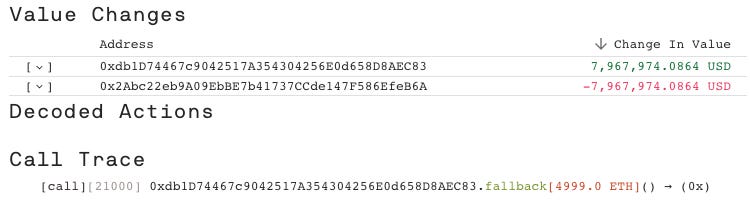
On September 24th, the Huobi Global exploit on the Ethereum Mainnet resulted in a $8 million loss due to the compromise of private keys. The attacker executed the attack in a single transaction by sending 4,999 ETH to a malicious contract. The attacker then created a second malicious contract and transferred 1,001 ETH to this new contract. Huobi has since confirmed that they have identified the attacker and has extended an offer of a 5% white hat bounty reward if the funds are returned to the exchange.