Trust Boundaries in Smart Contract Architecture: From Implicit Assumptions to Explicit Enforcement
How explicit trust boundary design prevents the vulnerabilities that audits miss
The DeFi security crisis isn’t a failure of auditing. It’s a failure of architecture. When 90% of exploited smart contracts were previously audited, the problem isn’t what auditors are missing. The problem is that protocols are being built without explicit trust boundaries, leaving critical security assumptions implicit, undocumented, and unenforceable.
Trust boundaries define where your protocol stops trusting input, stops trusting external contracts, and starts enforcing invariants. When these boundaries are implicit rather than first-class architectural elements, you’re not building secure protocols. You’re building exploits waiting to be discovered.
The Trust Boundary Problem in Web3
Traditional software architecture treats trust boundaries as explicit design elements. Operating systems enforce boundaries between user space and kernel space. Web applications enforce boundaries between client input and database operations. These boundaries aren’t suggestions. They’re enforced by the architecture itself.
Smart contract protocols rarely follow this pattern. Trust assumptions exist, but they’re scattered across documentation, comments, and developer understanding. The Balancer hack that drained $121 million didn’t exploit a coding error. It exploited the gap between what developers assumed was safe and what the architecture actually enforced.
The vulnerability emerged at an implicit trust boundary: the point where Balancer’s protocol assumed external rate providers would return accurate values. That assumption wasn’t encoded in the architecture. It wasn’t enforced by invariants. It was just assumed, and that assumption cost $121 million.
What Makes Trust Boundaries First-Class
A first-class trust boundary isn’t documentation. It’s not a comment explaining what you expect. It’s architectural enforcement of security properties at the exact points where trust assumptions change.
Explicit boundary definitions mark every point where your protocol transitions from trusted to untrusted code. This includes external contract calls, user inputs, oracle data, and cross-chain messages. These aren’t marked with comments. They’re marked with architectural patterns that enforce validation.
Invariant enforcement at boundaries means your architecture validates security properties before trust transitions occur. If your protocol assumes a price feed returns values within a specific range, that assumption becomes an enforced invariant at the boundary, not a documented expectation.
Boundary visibility in code structure makes trust transitions obvious. Developers reading your code should immediately identify where trust boundaries exist without hunting through documentation or reverse-engineering intent from implementation.
Architectural Patterns for Explicit Trust Boundaries
The Adapter Pattern for External Calls
Every external contract interaction goes through an adapter that enforces boundary invariants. Instead of calling external contracts directly, your core protocol calls adapters that validate responses before returning them to trusted code.
The validator pattern centralizes boundary enforcement. Security requirements live in one place, not distributed across every function that handles user input.
The Isolation Pattern for Critical Operations
Critical state transitions happen in isolated contexts that enforce pre-conditions and post-conditions at their boundaries. These contexts validate assumptions on entry and verify invariants on exit.
Isolation patterns prevent vulnerabilities that emerge from unexpected state changes during execution. The boundaries enforce that the system state matches expectations before and after critical operations.
Trust Boundary Documentation as Code
Documentation that lives separately from code becomes outdated. Trust boundary documentation needs to be executable and enforced by the architecture itself.
Boundary contracts as interfaces define exactly what security properties external code must satisfy. These aren’t informal specifications. They’re executable contracts that fail if security properties aren’t met.
solidity
interface ITrustedPriceSource { /// @notice Returns validated price within acceptable bounds /// @dev MUST revert if price is stale or out of bounds /// @return price Validated price in base currency function getValidatedPrice() external view returns (uint256 price); /// @notice Returns timestamp of last price update /// @dev MUST be updated atomically with price function lastUpdateTime() external view returns (uint256);}
Boundary invariants as tests verify that security properties hold at trust transitions. These tests don’t check implementation details. They verify that boundary contracts are honored.
These tests document boundary requirements while verifying they’re enforced. When requirements change, tests fail if the architecture doesn’t enforce new requirements.
Finding Trust Boundaries in Existing Protocols
Most protocols already have trust boundaries. They’re just implicit. Making them explicit starts with identifying where trust assumptions exist.
External contract calls are trust boundaries. Every time your protocol calls external code, you’re trusting something about its behavior. These assumptions need explicit enforcement at the boundary where the call occurs.
State transitions that depend on external data are trust boundaries. When your protocol changes state based on oracle prices, user input, or cross-chain messages, you’re transitioning from untrusted data to trusted state. The boundary is where validation must occur.
Operations that assume system invariants are trust boundaries. When your protocol assumes total supply equals the sum of all balances, or that reserves always exceed liabilities, those assumptions need enforcement at the boundaries where they could be violated.
Static analysis tools can identify implicit trust boundaries by finding where external calls occur, where user input flows into state changes, and where invariants could be violated. But identification is just the first step. The architecture must enforce security properties at these boundaries.
The Cost of Implicit Trust Boundaries
The $121 million Balancer exploit isn’t unique. The Nomad bridge hack ($190 million), the Ronin bridge exploit ($625 million), and countless smaller exploits share a common pattern: they exploit gaps between assumed trust boundaries and architecturally enforced boundaries.
Audits can’t fix this problem because audits evaluate implementation against specification. When specifications don’t explicitly define trust boundaries, auditors validate code that implements implicit assumptions. The code is correct according to specification. The architecture is still vulnerable.
Traditional audits examine code at a single point in time. Trust boundaries need continuous verification because they depend on external systems that change. Oracle providers update their APIs. External protocols modify their contracts. Cross-chain bridges change their validation logic. When trust boundaries aren’t first-class architectural elements, these changes introduce vulnerabilities that weren’t present when the audit occurred.
Making Trust Boundaries Enforceable
Explicit trust boundaries enable automated verification. When boundaries are first-class architectural elements, tools can verify that security properties hold at every boundary without understanding entire protocol logic.
Mutation testing at boundaries verifies that boundary validations actually prevent invalid states. By mutating inputs to violate boundary requirements, mutation testing confirms that validations enforce what they claim to enforce.
Continuous boundary verification tests that external dependencies still satisfy boundary requirements. When oracle contracts update or external protocols change, automated testing verifies that boundary assumptions still hold.
Formal verification of boundary properties proves that security properties can’t be violated at trust boundaries. For critical boundaries, formal verification provides mathematical certainty that invariants hold.
These techniques require boundaries to be explicit. You can’t automatically verify implicit assumptions scattered through documentation and developer understanding.
Implementation Strategy
Making trust boundaries first-class doesn’t require rewriting protocols from scratch. It requires systematic identification and explicit enforcement of existing implicit boundaries.
Start with external dependencies. Identify every external contract your protocol calls. Define exactly what security properties you assume about each dependency. Create adapters that enforce these properties before returning data to trusted code.
Document boundaries as interfaces. Convert implicit assumptions into explicit interface requirements. These interfaces define the contracts external code must satisfy, making requirements explicit and testable.
Test boundary violations. Write tests that verify boundary validations actually prevent invalid states. These tests confirm that architecture enforces what documentation claims.
Iterate based on findings. Static analysis tools identify where implicit boundaries exist. As you make boundaries explicit, analysis reveals additional boundaries that need architectural enforcement.
This approach doesn’t eliminate all vulnerabilities. It eliminates the class of vulnerabilities that emerge from implicit trust assumptions: the vulnerabilities that audits consistently miss because they’re not implementation bugs. They’re architectural gaps.
Why This Matters for Protocol Security
The distinction between audited and secure has never been clearer. Audits verify implementation correctness. They don’t verify architectural soundness. When 90% of exploited contracts were previously audited, the problem isn’t audit quality. The problem is that audits can’t fix architectural problems.
Making trust boundaries first-class architectural elements changes the security model. Instead of hoping auditors catch every place where implicit assumptions could be violated, the architecture enforces boundary requirements automatically. Instead of documentation describing what should be validated, interfaces define what must be validated.
This shift moves security from review-time to design-time. Trust boundaries become part of the architecture developers interact with every day, not special considerations for security reviews. Boundary violations become compiler errors, not production exploits.
Beyond Audits: Architectural Security
The Web3 security crisis won’t be solved by better audits. It will be solved by better architecture. Protocols that make trust boundaries first-class architectural elements don’t just pass audits. They make entire classes of vulnerabilities impossible by design.
Audited means someone reviewed your code and found it correct. Secure means your architecture makes certain vulnerabilities impossible. When trust boundaries are first-class citizens in your protocol architecture, the boundaries auditors try to verify in reviews are enforced by the system itself.
Every protocol has trust boundaries. The critical factor is whether those boundaries are implicit assumptions waiting to be exploited or explicit architectural elements that enforce security properties automatically.
Ready to make trust boundaries first-class in your protocol architecture? Olympix's static analysis and mutation testing tools identify implicit trust boundaries in existing code and verify that boundary validations actually enforce security properties. Start continuous security testing before implicit assumptions become production exploits.
What’s a Rich Text element?
The rich text element allows you to create and format headings, paragraphs, blockquotes, images, and video all in one place instead of having to add and format them individually. Just double-click and easily create content.
A rich text element can be used with static or dynamic content. For static content, just drop it into any page and begin editing. For dynamic content, add a rich text field to any collection and then connect a rich text element to that field in the settings panel. Voila!
Headings, paragraphs, blockquotes, figures, images, and figure captions can all be styled after a class is added to the rich text element using the "When inside of" nested selector system.
Follow-up: Conduct a follow-up review to ensure that the remediation steps were effective and that the smart contract is now secure.
Follow-up: Conduct a follow-up review to ensure that the remediation steps were effective and that the smart contract is now secure.
In Brief
Remitano suffered a $2.7M loss due to a private key compromise.
GAMBL’s recommendation system was exploited.
DAppSocial lost $530K due to a logic vulnerability.
Rocketswap’s private keys were inadvertently deployed on the server.
Hacks
Hacks Analysis
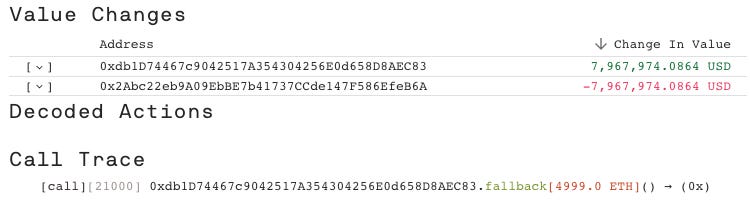
Huobi | Amount Lost: $8M
On September 24th, the Huobi Global exploit on the Ethereum Mainnet resulted in a $8 million loss due to the compromise of private keys. The attacker executed the attack in a single transaction by sending 4,999 ETH to a malicious contract. The attacker then created a second malicious contract and transferred 1,001 ETH to this new contract. Huobi has since confirmed that they have identified the attacker and has extended an offer of a 5% white hat bounty reward if the funds are returned to the exchange.