
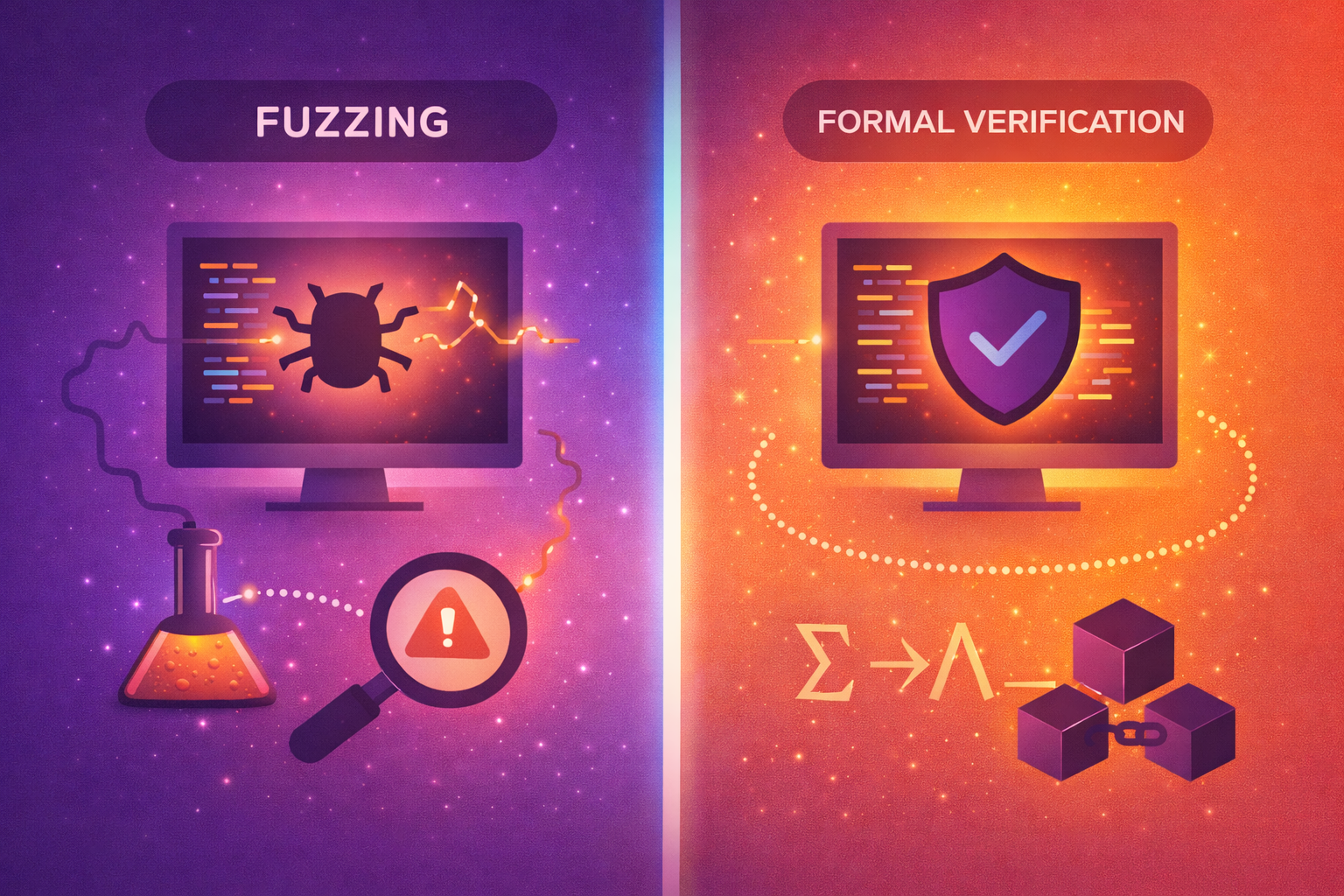
Smart contract security requires more than traditional testing. With over $3.1 billion lost to exploits in the first half of 2025 alone, developers need advanced techniques to catch vulnerabilities before deployment. Two powerful approaches stand out: fuzzing and formal verification.
Both methods go beyond standard unit tests to uncover edge cases and prove contract correctness. But they work in fundamentally different ways, serve different purposes, and catch different types of bugs. Understanding when to use each technique can mean the difference between shipping secure code and becoming another exploit statistic.
Fuzzing, or fuzz testing, is an automated testing technique that feeds random or semi-random inputs into your smart contract to find unexpected behavior. Think of it as stress-testing your code with thousands of unpredictable scenarios.
A fuzzer generates inputs automatically, executing your contract functions repeatedly with different parameters:
Modern fuzzers have evolved beyond pure randomness. They use techniques like:
Fuzzing excels at discovering:
Consider a simple token transfer function:
solidity
function transfer(address to, uint256 amount) public {
    require(balances[msg.sender] >= amount, "Insufficient balance");
    balances[msg.sender] -= amount;
    balances[to] += amount;
}
```

A fuzzer might discover that transferring `type(uint256).max` to an address that already has a balance causes an overflow, even though individual checks pass.

### Fuzzing Limitations

Fuzzing is probabilistic, not exhaustive. It can:

- Miss rare edge cases that require very specific input combinations
- Struggle with complex state dependencies
- Take significant time to explore large input spaces
- Only find bugs, not prove their absence

The longer fuzzing runs, the more likely it finds issues. But you can never be certain it has found every vulnerability.

## What is Formal Verification?

Formal verification uses mathematical techniques to prove that your smart contract behaves correctly under all possible conditions. Rather than testing with examples, it provides mathematical certainty.

### How Formal Verification Works

Formal verification analyzes your code symbolically rather than executing it:

1. **Specification**: You define properties your contract must satisfy (invariants, preconditions, postconditions)
2. **Modeling**: The verifier represents your contract as mathematical logic
3. **Proof**: The verifier attempts to prove or disprove each property mathematically
4. **Results**: You get either a proof of correctness or a counterexample showing how the property can be violated

Common formal methods include:

- **Symbolic execution**: Explores all possible execution paths simultaneously
- **Model checking**: Systematically checks all reachable states
- **Theorem proving**: Uses mathematical logic to prove properties
- **Abstract interpretation**: Analyzes program behavior at a higher level

### What Formal Verification Proves

Formal verification can guarantee:

- **Invariants hold under all conditions**
- **Access control logic is sound**
- **No integer overflow/underflow is possible**
- **State transitions follow specified rules**
- **Critical properties hold for all inputs**
- **Certain vulnerabilities are impossible**

### Formal Verification Example

For the same transfer function, formal verification could prove:
```
Property: ∀ transfers, sum of all balances remains constant
Proof: For any transfer(to, amount):
  - balances[sender] decreases by amount
  - balances[to] increases by amount
  - No other balances change
  - Therefore: total supply is preserved
If this property fails, the verifier provides a concrete counterexample showing exactly how it can be violated.
Formal verification is powerful but has constraints:
Formal verification proves what you ask it to prove. Writing comprehensive specifications requires deep understanding of your contract's security requirements.

Fuzzing: Empirical testing with generated inputs. Executes your contract thousands of times with different parameters.
Formal Verification: Mathematical proof. Analyzes all possible executions symbolically without running the contract.
Fuzzing: Probabilistic coverage. Tests many scenarios but cannot guarantee it has tested everything.
Formal Verification: Complete coverage for specified properties. Considers all possible inputs and states.
Fuzzing: Finds bugs through examples. Shows you a specific input that breaks your contract.
Formal Verification: Proves properties or provides counterexamples. Shows whether a property holds universally or gives a specific case where it fails.
Fuzzing: Runs continuously. The longer it runs, the more confident you can be, but never with certainty.
Formal Verification: Fixed time per property. Once proven, the property holds with mathematical certainty.
Fuzzing: Relatively easy to set up. Works with existing test frameworks and requires minimal additional knowledge.
Formal Verification: Steeper learning curve. Requires understanding of formal specifications and contract properties.
Fuzzing: Low computational cost. Can run on standard development machines.
Formal Verification: Higher computational cost for complex properties. May require significant processing time.
Fuzzing:
Formal Verification:
You need to discover unknown vulnerabilities through exploration. Fuzzing is ideal for:
Fuzzing fits naturally into continuous integration pipelines and provides ongoing security feedback throughout development.
You need mathematical certainty about specific properties. Formal verification is essential for:
Formal verification is typically applied after fuzzing has found and fixed the more obvious issues.
The most effective security programs use both fuzzing and formal verification as complementary techniques.
Start with Fuzzing:
Apply Formal Verification to Critical Components:
This layered approach provides both breadth (fuzzing explores widely) and depth (formal verification proves specific guarantees).
The Kame Aggregator exploit in September 2025 cost $1.3 million due to a vulnerability in the swap function. Fuzzing with extreme values would have caught this issue during development. The exploit involved an arbitrary executor call that could be manipulated with specific input combinations, exactly the type of edge case fuzzing excels at finding.
Access control vulnerabilities accounted for $953 million in losses during 2025, the single largest category. Formal verification can mathematically prove that access control logic is sound, ensuring that only authorized addresses can call privileged functions under any circumstances. This level of certainty is impossible to achieve through testing alone.
Modern fuzzing tools for smart contracts include:
Property-Based Fuzzing:
Stateful Fuzzing:
Coverage-Guided Fuzzing:
Effective fuzzing requires:
Different formal methods suit different verification needs:
Symbolic Execution:
Model Checking:
Theorem Proving:
Choosing the right approach depends on your contract's complexity, the properties you need to verify, and your team's expertise.
Integrate fuzzing into your development process:
Apply formal verification to critical components:
Maintain security throughout the contract lifecycle:
Fuzzing Costs:
Fuzzing Benefits:
Formal Verification Costs:
Formal Verification Benefits:
For most projects, fuzzing provides the best return on investment during development. Formal verification becomes worthwhile when:
Olympix integrates both fuzzing and formal verification into a comprehensive proactive security platform.
Olympix's fuzzing tools provide:
Protocols using Olympix's fuzzing tools discover vulnerabilities early, when they're cheapest to fix.
Olympix's formal methods provide mathematical proof of correctness:
With 75% detection accuracy compared to 15% for traditional approaches, Olympix's combination of fuzzing and formal verification helps protocols like the Uniswap Foundation and Cork Protocol ship secure code faster.
Olympix also provides mutation testing to ensure your tests and properties are comprehensive. By introducing deliberate bugs, mutation testing verifies that your fuzzing campaigns and formal properties actually catch real vulnerabilities.
Teams using Olympix's layered approach achieve a 70% reduction in audit findings by catching vulnerabilities during development rather than during expensive audit remediation.
Misconception 1: "Fuzzing finds all bugs given enough time"
Reality: Fuzzing is probabilistic. Some bugs require extremely specific conditions that random testing is unlikely to hit.
Misconception 2: "Formal verification proves a contract is secure"
Reality: Formal verification proves the properties you specify. Missing a critical property means the vulnerability remains undetected.
Misconception 3: "You only need one approach"
Reality: The most secure protocols use both. Fuzzing catches the broad range of issues, formal verification provides certainty about critical properties.
Misconception 4: "Formal verification is only for academics"
Reality: Modern formal verification tools are increasingly accessible. Many production protocols now use formal methods for critical components.
Misconception 5: "These replace audits"
Reality: Fuzzing and formal verification complement audits by reducing findings and providing documented security guarantees. Auditors can focus on higher-level logic and business requirements.
Fuzzing:
Formal Verification:
Best Practice:
Fuzzing and formal verification serve different but complementary roles in smart contract security. Fuzzing explores your contract's behavior empirically, finding bugs through thousands of test cases. Formal verification proves properties mathematically, providing certainty about critical invariants.
The protocols that survived 2025 without major incidents used both techniques as part of a comprehensive security strategy. They fuzzed continuously during development to catch obvious issues early. They formally verified critical properties to provide mathematical guarantees about core logic. They entered audits with far fewer findings and deployed with confidence.
With access control flaws alone causing $953 million in losses during 2025, and reentrancy attacks accounting for another $300 million, the importance of rigorous testing and verification cannot be overstated. Both fuzzing and formal verification would have caught these vulnerabilities before deployment.
Start integrating both techniques into your development workflow today. Begin with fuzzing for immediate security feedback. Add formal verification for your most critical components. Layer these techniques with static analysis, comprehensive testing, and professional audits.
Your users deserve contracts that have been both thoroughly tested and mathematically proven. Give them that confidence.
Ready to implement fuzzing and formal verification in your workflow? Olympix provides comprehensive tools for both techniques, helping you catch vulnerabilities during development. Book a free demo!