
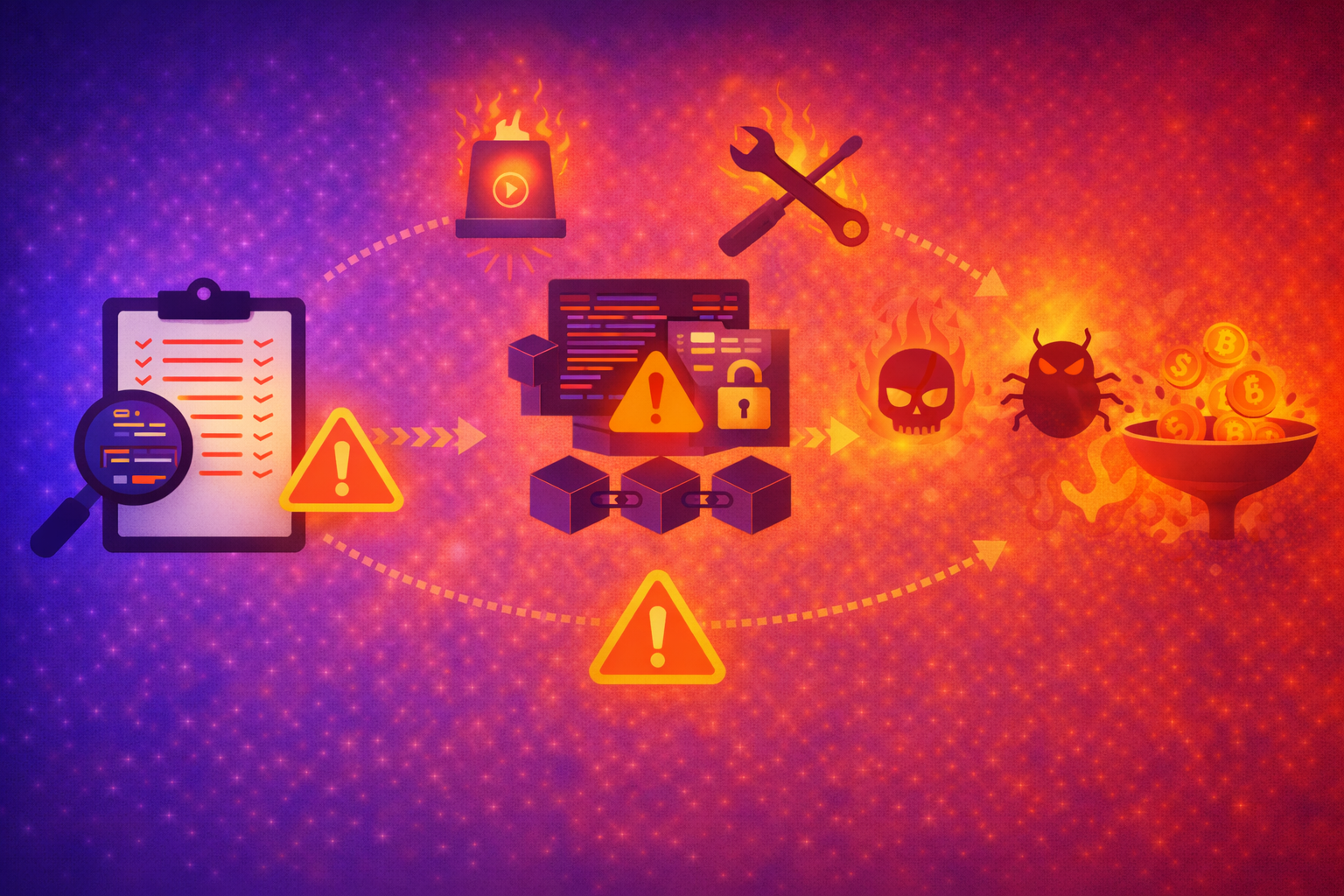
Web3 security model is broken. Traditional smart contract audits, once considered the gold standard for blockchain security, have become a dangerous false sense of protection that costs the industry billions in preventable exploits.
Every few weeks, another major protocol suffers a critical exploit. The pattern is predictable: millions drain from a smart contract, users lose funds, and the inevitable post-mortem reveals the same uncomfortable truth. The exploited contract was audited.
The explanations follow a familiar script. Auditors missed an edge case. The vulnerability emerged from cross-protocol integration. The logic flaw only manifested in production conditions. These aren't exceptions anymore. They're the norm.
The fundamental problem is structural, not procedural. Treating security as a final checkpoint before deployment was never adequate for the complexity of modern decentralized finance.
The conventional audit model operates on a flawed premise: that security can be validated through a time-boxed review after development concludes. Teams spend months building complex protocols, then ship their code to auditors for a two to four week assessment. The auditors return a PDF report, developers patch the findings, and everyone assumes the contract is now secure.
This approach made sense in simpler blockchain environments. Early smart contracts were relatively straightforward, with limited composability and clear attack surfaces. A thorough code review could reasonably identify most vulnerabilities.
Modern DeFi protocols operate in a completely different environment. Contracts compose across multiple chains. They integrate with bridges, oracles, and lending protocols. They implement upgradeable patterns and complex governance mechanisms. The attack surface expands exponentially with each integration point.
Auditors reviewing this code face an impossible task. They must understand not just the protocol's internal logic, but how it interacts with dozens of external dependencies. They must anticipate edge cases that only emerge when multiple protocols interact under specific market conditions. They must do all of this in a few weeks, while the protocol continues evolving.

The audit-centric model creates perverse incentives throughout the development lifecycle. Teams defer security considerations until the audit phase, making architectural decisions without fully understanding their security implications. Critical vulnerabilities get baked into the design before security experts ever see the code.
The financial impact extends beyond direct exploit losses. Protocols pay premium rates for audits from reputable firms, often waiting months for scheduling availability. Development timelines stretch as teams wait for audit reports. Competitive advantages erode while protocols sit in security queues.
The reputational damage compounds the problem. Users lose trust not just in exploited protocols, but in the entire DeFi ecosystem. Every major hack pushes mainstream adoption further away. The industry's credibility suffers because the security model cannot scale with innovation.
The solution requires a fundamental shift in how Web3 approaches security. Instead of treating security as a final validation step, it must become an integrated part of the development process from day one.
Static Analysis During Development
Modern static analysis tools can identify vulnerabilities while developers write code. These tools check for common vulnerability patterns, unsafe coding practices, and potential logic errors in real-time. Developers catch and fix issues immediately, before they propagate through the codebase.
Advanced static analysis goes beyond basic pattern matching. Machine learning models trained on thousands of audited contracts can identify subtle vulnerabilities that traditional auditors might miss. They analyze data flow, check invariants, and verify that contract behavior matches its specification.
Automated Testing and Continuous Verification
Comprehensive test suites prove contract behavior across thousands of scenarios. Property-based testing generates random inputs to stress-test edge cases. Fuzzing tools bombard contracts with malformed data to uncover unexpected behaviors. Mutation testing verifies that test suites actually catch vulnerabilities by intentionally introducing bugs.
These automated approaches run continuously throughout development. Every code change triggers a full security validation. Regressions get caught immediately. Integration issues surface before deployment rather than in production.
Formal Verification and Mathematical Proofs
For critical contract components, formal verification provides mathematical certainty about correctness. Developers specify properties that must always hold true, then use automated theorem provers to verify these invariants across all possible execution paths.
Formal verification catches entire classes of vulnerabilities that manual audits struggle with. Reentrancy bugs, integer overflows, and state machine errors become mathematically impossible when contracts are proven correct.
The future of smart contract security is not about choosing between audits and automated tools. It's about building defense in depth with multiple overlapping security layers.
Proactive tools catch vulnerabilities during development, before they reach production. Static analysis provides real-time feedback to developers. Automated testing validates behavior across thousands of scenarios. Formal verification proves critical properties mathematically.
Traditional audits still play a role, but they become one layer in a comprehensive security strategy rather than the entire strategy itself. Auditors focus on complex business logic, novel attack vectors, and integration risks that automated tools struggle with. The audit becomes more valuable because basic vulnerabilities are already eliminated.
Leading protocols are already implementing this layered approach with measurable results. Projects using comprehensive static analysis during development reduce audit findings by 30 to 80 percent. Automated testing catches integration bugs before they reach auditors. Formal verification eliminates entire vulnerability classes from critical components.
Development cycles accelerate when security is integrated rather than bolted on. Teams spend less time in audit queues and remediation cycles. They deploy with greater confidence because security has been validated continuously throughout development.
The protocols building sustainable security practices treat it as infrastructure, not as a milestone. Security runs constantly, testing every change, proving every critical property, and validating every integration.
The path forward requires cultural and technical changes across the Web3 ecosystem. Developers need training in secure coding practices and formal verification techniques. Development environments need integrated security tools that provide real-time feedback. Project timelines need to account for comprehensive testing and verification from the start.
The audit-only model served its purpose in Web3's early days. But the industry has outgrown it. The complexity of modern DeFi demands security approaches that match that complexity. Continuous validation, automated verification, and mathematical proofs aren't luxuries. They're the new baseline for responsible smart contract development.
The protocols that survive long-term will be those that embed security into every stage of development. Not as an afterthought or checkbox, but as a fundamental engineering discipline. That's the only path to building DeFi systems worthy of handling billions in user funds.