
Building the Infrastructure for Web3 Security: A Conversation with Industry Founders
Sam from Guardrail and Channi from Olympix discuss the evolution of web3 security, from design partnerships to AI integration. Learn why layered security beats single solutions, how composability creates new risks, and what founders should prioritize in 2026.Retry
The web3 security landscape has evolved dramatically, with billions exploited across blockchain protocols driving urgent demand for better tooling. Two founders at the forefront of this evolution, Sam from Guardrail and Channi from Olympix, recently sat down to discuss the current state of security tooling, the role of AI, and what's next for the industry.
From First Customers to Product-Market Fit
Both companies took similar paths to finding their initial customers, emphasizing design partnerships over traditional sales. Olympix landed their first customer through an investor introduction, structuring the deal around specific deliverables rather than upfront fees. This approach allowed them to iterate closely with early adopters while proving value.
Guardrail took a different route, partnering with a protocol that had recently experienced a hack. Working alongside their CTO and developer, they helped compress a six-month rebuild timeline to just one month, not through custom solutions, but by building tools that could scale to any protocol.
"The first customer is always special," Channi reflected. "They're the first person who takes a leap of faith and believes in what was once just an idea."
The Education Gap Is Closing
When Guardrail first launched, audits dominated the security conversation while monitoring was optional. That's changed. Sam notes that most teams now won't launch without onchain monitoring, driven by high-profile cases where good incident response saved millions while poor preparation led to catastrophic losses.
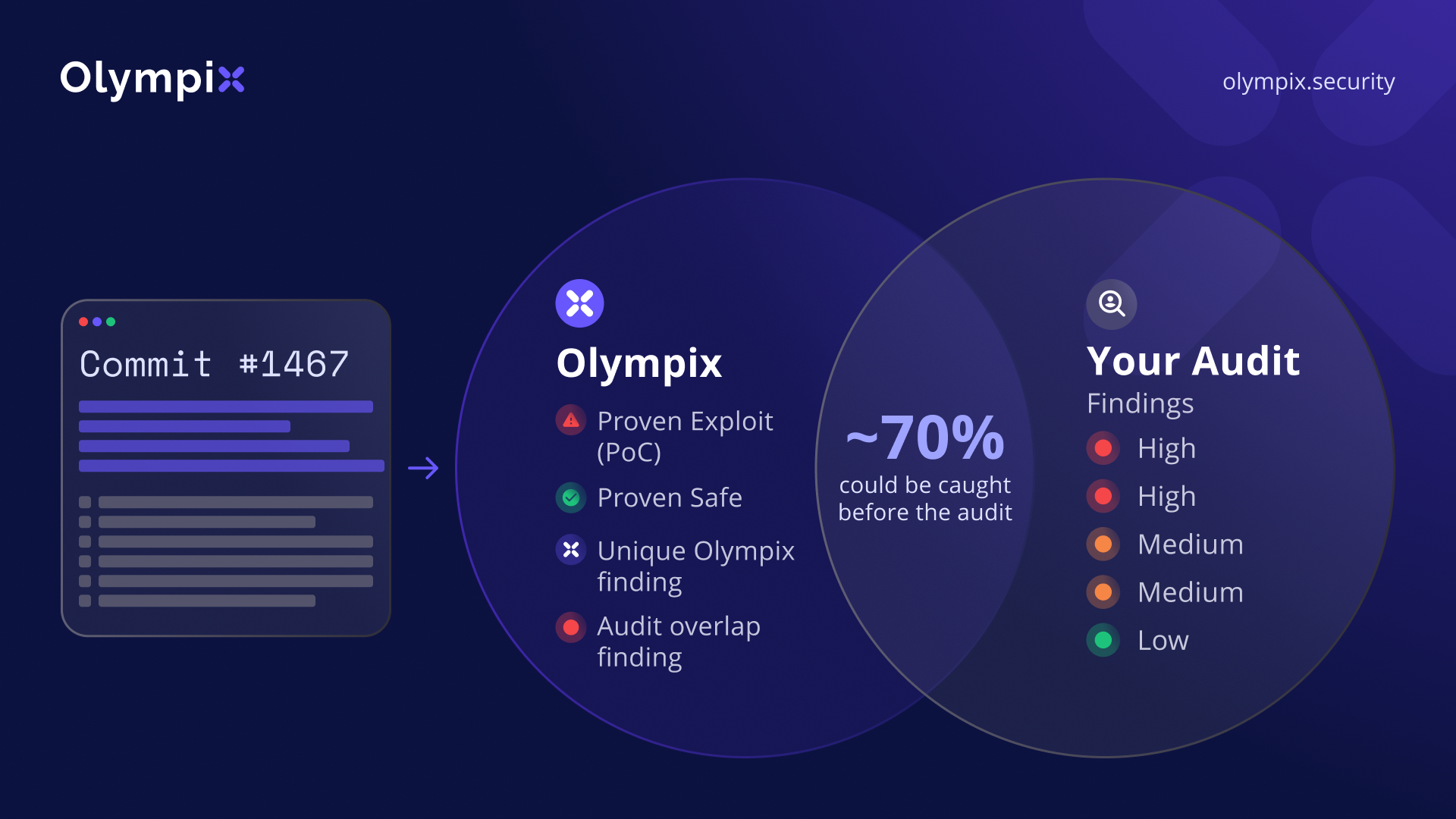
Olympix faces a different education challenge. Rather than traditional sales pitches, they demonstrate value by running their tools on pre-audit code commits and comparing results with actual audit findings. The overlap proves compelling: if their tools can catch what auditors find, they provide insurance and free up auditors to dig deeper.
The Layered Security Model
Both founders emphasized that no single security measure is sufficient. Channi used a Swiss cheese analogy: "You want different cheeses with different holes so nothing seeps through."
The complete security stack includes:
- Proactive security during development (Olympix's domain)
- Third-party audits as expert validation
- Real-time monitoring in production (Guardrail's focus)
- Operational security (OPSEC) for private keys and access control
Teams that over-invest in one area, even getting five audits, while neglecting others still face exploitation. The 90% of exploited contracts that were audited proves audits alone aren't enough.
AI's Role: Optimization, Not Replacement
Both founders have strong opinions on AI in security. Olympix has been "Olympix.ai" since before ChatGPT, but Channi is clear: "I've never believed that models are going to be a foundation you can solely leverage for security."
The analogy they both return to: Would you want an airplane's safety tested by an LLM or by mathematical methods? For life-or-death systems, which includes smart contracts, formal verification and mathematical certainty remain essential. AI optimizes results and makes them digestible, but doesn't replace rigorous security practices.
Guardrail's most exciting AI feature uses blockchain context to explain what happened in suspicious transactions, allowing users to ask natural language questions about complex onchain activity. Olympix is developing "single-touch formal verification" that uses AI to infer security specifications and apply formal methods, making rigorous security more accessible without sacrificing mathematical guarantees.
The 2026 Security Landscape
Looking ahead, both founders identified composability as the critical challenge. As protocols increasingly interact with each other, the attack surface expands exponentially. This requires:
- Mapping every dependency and supply chain risk
- Testing more rigorously across integration points
- Implementing automated response mechanisms for composability failures
- Real-time monitoring with millisecond response times
Sam's advice for teams launching in 2026: "Start small and incremental. Don't wait until you hit X millions in TVL to invest in security. Many teams don't reach that next phase because of an access control issue or hack that leaves them high and dry."
What's Next
Channi is watching for Fortune 500 companies to move from blockchain experimentation to actual implementation. "There is substantial budget allocated, but it's mostly experimentation on testnets. When these tech giants start deploying to public chains, it will be a huge mover for the industry."
Sam sees payments and the creator economy as ripe for disruption. With stable coins, global remittance, and creator monetization all converging, the infrastructure is ready for the next wave of adoption. The key insight: creators living under the threat of being deplatformed by centralized authorities will gravitate toward onchain solutions where they control their audience and monetization.
The Unglamorous Foundation
"Everyone thinks infrastructure isn't sexy," Channi said, "but I think it's the sexiest thing in the world to be able to enable everyone to build what the next generation will thrive on."
Both founders see their role as laying the groundwork, keeping their heads down, staying behind the scenes, and making it easy for innovators to build securely. As Sam put it: "You're paving the road that connects cities. Who knows what will happen in those cities, but you need the road to connect them."
With the right infrastructure in place, security doesn't slow innovation; it accelerates it. Teams with robust monitoring can launch on more chains and ship faster, knowing they have safety nets. That's the promise of continuous, layered security: not preventing all attacks, but making protocols hard enough targets that attackers move on to easier prey.
More from the blog
See every article →



See what Olympix finds on your own code
Send us a repo that's already been audited, and we'll run Olympix at the same commit and show you what comes back.