Top 15 Smart Contract Security Best Practices Solidity Developers Need
The stakes in smart contract development have never been higher. In 2024 alone, DeFi protocols lost over $1.4 billion to exploits and hacks, and here's the sobering reality: 90% of those exploited contracts had been previously audited. Traditional security audits, while valuable, only catch vulnerabilities at a single point in time. The real solution is building security into every line of code you write.
This comprehensive guide covers the essential smart contract security best practices Solidity developers must implement to protect their protocols from exploitation. Whether you're building your first DeFi application or maintaining a production protocol, these practices will help you write more secure, resilient smart contracts.
Why Smart Contract Security Best Practices Matter
Unlike traditional software, smart contracts are immutable once deployed. A single vulnerability can result in irreversible financial losses. The recent Balancer V2 exploit, which resulted in a $121 million loss, demonstrated how even well-established protocols with multiple audits can fall victim to complex reentrancy attacks.
The difference between a secure protocol and a catastrophic exploit often comes down to implementing fundamental security practices during development, not just relying on audits to catch issues after the fact.
1. Implement Comprehensive Reentrancy Guards
Reentrancy attacks remain one of the most devastating vulnerabilities in smart contracts. The infamous DAO hack, the recent Balancer exploit, and countless other incidents stem from reentrancy issues.
Always use the Checks-Effects-Interactions pattern: perform all checks first, update state variables second, and only then interact with external contracts. This simple ordering prevents reentrancy attacks by ensuring state changes happen before external calls.
2. Follow the Checks-Effects-Interactions Pattern
This fundamental pattern is your first line of defense against reentrancy and other state-related vulnerabilities.
The Three Steps:
Checks: Validate all conditions and requirements
Effects: Update all state variables
Interactions: Make external calls last
Anti-Pattern (Vulnerable):
function badWithdraw() external {
    uint256 amount = balances[msg.sender];

    // DANGEROUS: External call before state update
    (bool success, ) = msg.sender.call{value: amount}("");
    require(success);

    balances[msg.sender] = 0; // Too late!
}
This ordering creates a window for reentrancy attacks between the external call and the state update.
3. Use SafeMath or Solidity 0.8+ for Arithmetic Operations
Integer overflow and underflow vulnerabilities have caused numerous exploits. While Solidity 0.8.0+ includes built-in overflow/underflow protection, understanding the underlying risks is crucial.
For Solidity 0.8.0+:
Arithmetic operations automatically revert on overflow/underflow. However, you can use unchecked blocks when you're certain overflow is impossible and want to save gas:
function safeIncrement(uint256 counter) internal pure returns (uint256) {
    // Automatic overflow protection
    return counter + 1;
}

function gasOptimizedLoop(uint256 iterations) internal {
    for (uint256 i = 0; i < iterations;) {
        // Loop logic here

        unchecked {
            ++i; // Safe because loop bounds are controlled
        }
    }
}
Common validation requirements include non-zero addresses, positive amounts within reasonable bounds, array length limits, whitelisted addresses or tokens, and timestamp validations for time-sensitive operations.
5. Implement Access Control Mechanisms
Proper access control prevents unauthorized users from executing privileged functions.
Always assume external calls can fail and implement appropriate error handling.
7. Avoid Using tx.origin for Authorization
Using tx.origin for authorization creates phishing vulnerabilities. Always use msg.sender instead.
Vulnerable Code:
function withdraw() external {
    require(tx.origin == owner, "Not owner"); // VULNERABLE
    // Attacker can trick owner into calling malicious contract
}
Secure Alternative:
function withdraw() external {
    require(msg.sender == owner, "Not owner"); // SECURE
    // Only direct calls from owner succeed
}
8. Implement Emergency Stop Mechanisms
Even with perfect code, unforeseen issues can arise. Emergency stop mechanisms (circuit breakers) allow you to pause critical functions when vulnerabilities are discovered.
Events should include indexed parameters for filtering and all relevant context for understanding the transaction.
10. Test Edge Cases and Boundary Conditions
Smart contract security best practices in Solidity require rigorous testing of edge cases that auditors might miss.
Critical Test Cases:
Test zero values for all numeric parameters, maximum uint256 values, empty arrays and strings, boundary conditions (exactly at limits), sequential operations (deposit-withdraw-deposit), concurrent operations from multiple users, and failure scenarios for external calls.
Example Test Structure:
describe("Vault Security Tests", function() { it("should handle zero deposit attempts", async function() { await expect(vault.deposit(0)) .to.be.revertedWith("Amount must be positive"); });
it("should handle maximum value deposits", async function() { const maxUint = ethers.constants.MaxUint256; await expect(vault.deposit(maxUint)) .to.be.revertedWith("Exceeds maximum deposit"); });
// Only admin can change daily limit function setDailyLimit(uint256 newLimit) external onlyRole(DEFAULT_ADMIN_ROLE) { dailyLimit = newLimit; } }
13. Use Static Analysis and Automated Testing
Manual code review catches some issues, but automated tools find vulnerabilities humans miss.
Essential Tools:
Static analysis tools like Slither, Mythril, and Securify detect common vulnerability patterns. Mutation testing verifies your test suite actually catches bugs by introducing deliberate errors. Fuzzing generates random inputs to discover unexpected behavior. Formal verification mathematically proves contract properties.
Proactive security tools can identify up to 75% of vulnerabilities before deployment, compared to traditional audits that miss issues until after launch. Companies like Olympix provide continuous security monitoring that catches vulnerabilities throughout the development lifecycle.
14. Minimize Complexity and External Dependencies
Complex code introduces more attack surface. Every line of code is a potential vulnerability.
Simplification Strategies:
// Complex and risky
function complexOperation(
    address[] calldata tokens,
    uint256[] calldata amounts,
    bytes[] calldata data
) external {
    for (uint256 i = 0; i < tokens.length; i++) {
        // Multiple external calls
        // Complex state changes
        // Difficult to audit
    }
}

// Simpler and safer
function singleOperation(
    address token,
    uint256 amount
) external {
    // One operation at a time
    // Easy to understand and audit
    // Predictable gas usage
}
Break complex operations into simpler, composable functions. Each function should do one thing well.
15. Implement Comprehensive Documentation
Security includes ensuring everyone understands how the code should behave.
Essential Documentation:
/// @title Secure Vault Contract
/// @author Your Team
/// @notice This contract manages user deposits with reentrancy protection
/// @dev Implements Checks-Effects-Interactions pattern throughout
contract SecureVault {
    /// @notice Deposits tokens into the vault
    /// @param token Address of the ERC20 token to deposit
    /// @param amount Number of tokens to deposit (in token's smallest unit)
    /// @dev Requires prior approval of this contract to spend tokens
    /// @dev Emits Deposit event on success
    /// @dev Reverts if amount is 0 or token is not whitelisted
    function deposit(address token, uint256 amount) external {
        // Implementation
    }
}
Document invariants (conditions that should always be true), assumptions, and security considerations for each function.
Beyond Best Practices: Proactive Security
Following smart contract security best practices in Solidity is essential, but the landscape of DeFi security is evolving. Modern protocols need continuous monitoring for vulnerabilities, automated testing integration in CI/CD pipelines, pre-deployment scanning to catch vulnerabilities before mainnet, and post-deployment monitoring to watch for unusual transactions and potential exploits in real-time.
Traditional audits remain valuable but represent a single snapshot in time. Modern smart contract security requires a proactive, continuous approach that identifies vulnerabilities throughout the development lifecycle, not just at the end.
Conclusion
Smart contract security best practices for Solidity developers are fundamental requirements for responsible blockchain development. The cost of cutting corners is measured in millions of dollars and destroyed user trust.
By implementing these 15 essential practices, you build security into your smart contracts from the ground up. These practices cover reentrancy protection, proper design patterns, arithmetic safety, input validation, access control, safe external interactions, authorization mechanisms, emergency stops, event logging, comprehensive testing, oracle security, least privilege principles, automated security testing, minimal complexity, and thorough documentation.
Remember that 90% of exploited contracts were previously audited. An audit alone will not save your protocol. Security must be embedded in every design decision, every line of code, and every deployment. The difference between a successful protocol and a cautionary tale often comes down to implementing these fundamental practices consistently.
Start building security into your smart contracts today, before an attacker finds the vulnerability you missed.
What’s a Rich Text element?
The rich text element allows you to create and format headings, paragraphs, blockquotes, images, and video all in one place instead of having to add and format them individually. Just double-click and easily create content.
A rich text element can be used with static or dynamic content. For static content, just drop it into any page and begin editing. For dynamic content, add a rich text field to any collection and then connect a rich text element to that field in the settings panel. Voila!
Headings, paragraphs, blockquotes, figures, images, and figure captions can all be styled after a class is added to the rich text element using the "When inside of" nested selector system.
Follow-up: Conduct a follow-up review to ensure that the remediation steps were effective and that the smart contract is now secure.
Follow-up: Conduct a follow-up review to ensure that the remediation steps were effective and that the smart contract is now secure.
In Brief
Remitano suffered a $2.7M loss due to a private key compromise.
GAMBL’s recommendation system was exploited.
DAppSocial lost $530K due to a logic vulnerability.
Rocketswap’s private keys were inadvertently deployed on the server.
Hacks
Hacks Analysis
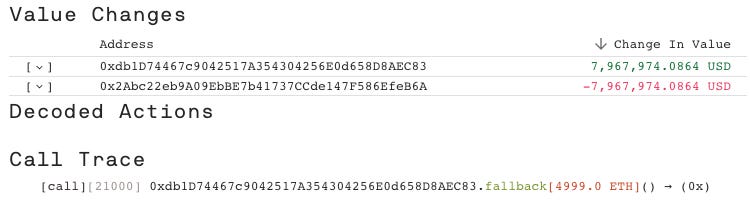
Huobi | Amount Lost: $8M
On September 24th, the Huobi Global exploit on the Ethereum Mainnet resulted in a $8 million loss due to the compromise of private keys. The attacker executed the attack in a single transaction by sending 4,999 ETH to a malicious contract. The attacker then created a second malicious contract and transferred 1,001 ETH to this new contract. Huobi has since confirmed that they have identified the attacker and has extended an offer of a 5% white hat bounty reward if the funds are returned to the exchange.