
Catching issues during development is the standard in every other kind of software. Smart contract development should meet the same bar.
In mainstream software engineering, shift-left is not a trend. It is the default. Teams catch issues during development, on every change, because finding a problem early is cheaper, faster, and safer than finding it late. The cost of a defect climbs the longer it survives, so the entire industry moved its checks earlier in the timeline.
That move became concrete. Static analysis, dependency scanning, secret detection, and automated tests run directly in CI/CD, and many teams add pre-commit hooks so problems are caught before code is even pushed. Every change is examined on the way in. The late-stage security review still exists, but it is the last line, not the only line. The result is fewer defects reaching production and reviews that begin from cleaner code.
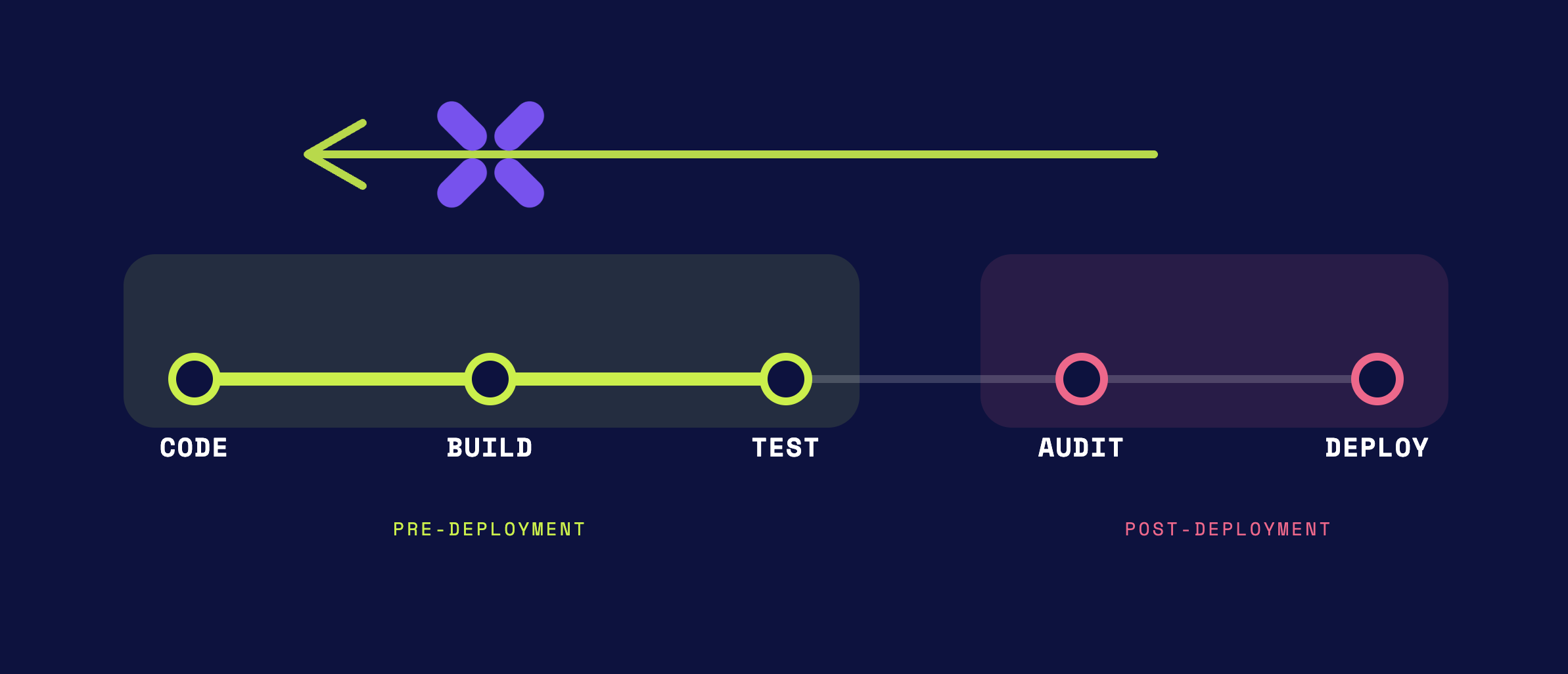
Smart contract security is concentrated on the right side of the timeline, at the audit, close to deployment. The audit is necessary and valuable, but it is a point-in-time human read, and it lands late. About 90% of exploited contracts were already audited, which tells you plainly that a late review, on its own, is not enough. Between the audit and deployment, and between one audit and the next, code changes ship without the same scrutiny.
This is the opposite of shift-left. Most of the security effort arrives after most of the code is written, at the point where changes are most expensive to make. A field that secures more value per line than almost any other kind of software is holding its security to a later, thinner standard than ordinary web apps already meet.
A recent case makes the pattern concrete. On May 28, 2026, the ONTR token was drained of about $98.3K on Ethereum mainnet. Two code-level flaws worked together, and both were present in the source before the token ever reached mainnet.
The first was in the onlyOwner modifier. Instead of locking owner-only functions once ownership was renounced, the guard treated a renounced, zero-address owner as an authorized state. So after the creator renounced ownership, which holders widely read as a safety guarantee, the modifier passed for any caller. An attacker called transferOwnership() and seized a contract that looked permanently locked. The second flaw was a set of deliberately misnamed functions that could inflate an account balance without changing total supply or emitting any transfer events, which breaks the basic ERC-20 invariant that balances and supply move together and that balance changes are logged. The attacker used it to fabricate tokens out of nothing and sell them into the ONTR liquidity pool for real WETH.
Security here rested on a surface signal, renounced ownership, that said locked while the code did the opposite. Nothing tested whether the contract actually held its guarantees before it shipped. The flaws were not exotic. They sat in plain Solidity, reachable by anyone, present at deployment. That is the cost of right-heavy security: the checks that would have caught this needed to run while the code was being written, not as a signal bolted on at launch. The full breakdown is in the ONTR post-mortem.
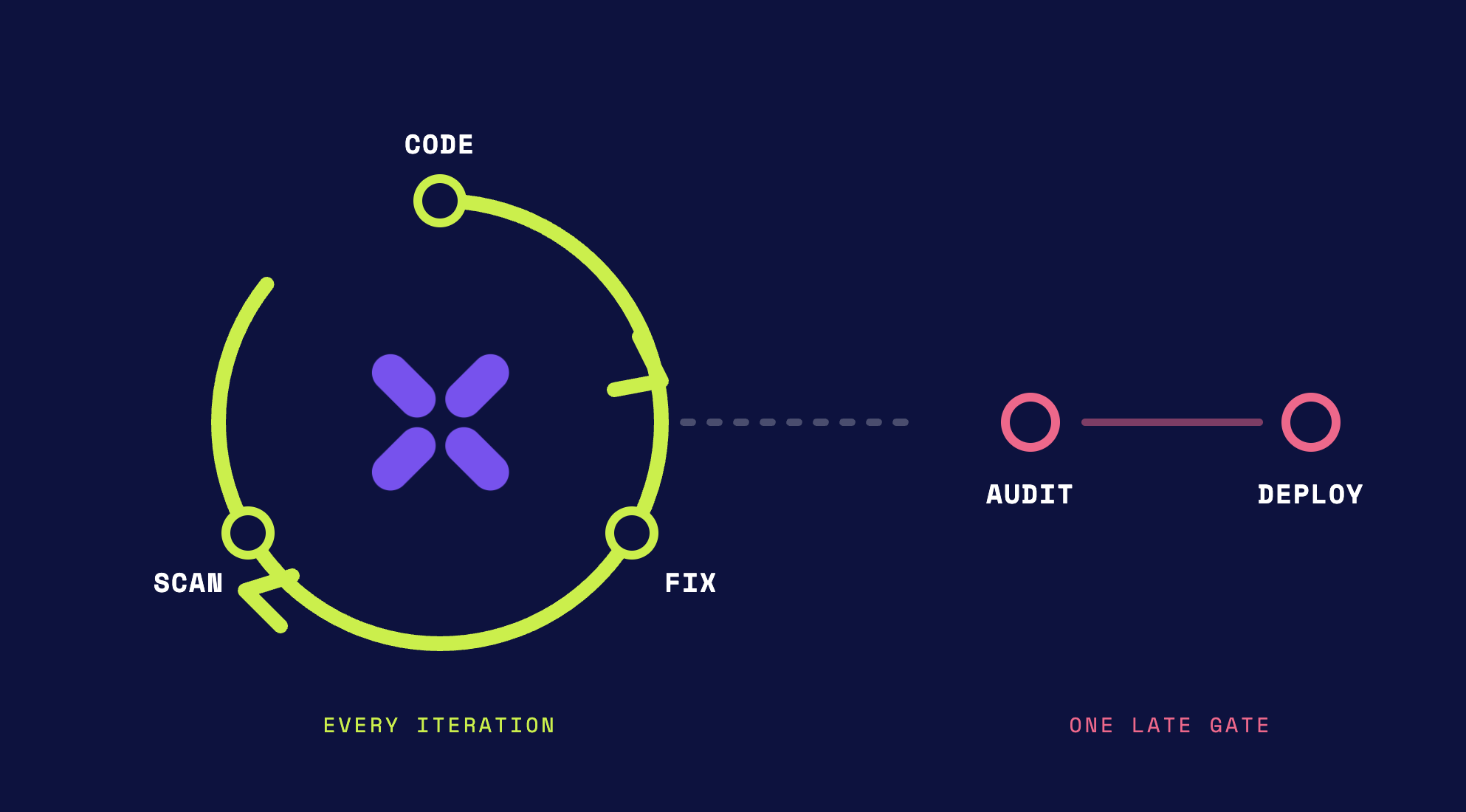
Bringing shift-left to smart contracts means security that runs continuously during development, before deployment, on every change, and that tests the contract's own guarantees rather than reading its surface. That is what Olympix is built for. Olympix is tooling, and it meets developers at the three points where shift-left actually happens.
While you write, the VSCode extension and the CLI's interactive mode run Olympix's checks against the code in front of you, so a flaw surfaces in the editor rather than months later in a report.
On every commit and pull request, the same checks run in CI. Olympix ships GitHub Actions for static analysis, BugPOCer, and test generation, and the CLI emits results in SARIF, so findings appear in your code-scanning view alongside every other security gate and can gate a merge the way a failing test does. Nothing reaches deployment unchecked.
Inside Claude Code, the Olympix plugin adds the same tools as skills. One command chains static analysis, unit and mutation test generation, BugPOCer, and a written report, without the developer leaving the environment they already build in.
The ONTR flaws fall directly in that path. Analysis that tests properties instead of prose flags an access-control guard an unauthorized caller can satisfy, and generates a proof of concept showing an arbitrary address seizing ownership. It flags the balance manipulation by checking the invariant that balance changes are matched by supply changes and logged as events, and produces a proof of concept of the off-the-books inflation. Obfuscated names and an inverted comparison do not hide behavior from a check that runs against the code itself. A working, reproducible exploit is what forces the fix before deployment, rather than after the pool is drained.
None of this replaces the audit. It makes the audit more efficient. When routine and code-level issues are already caught and fixed, the code arrives cleaner, the audit moves faster, and auditors spend their time on the design-level questions that genuinely need human judgment. Teams running Olympix ahead of the audit report about 65% fewer audit findings and up to 50% less audit spend on the same code, because the audit starts from a stronger baseline.
Customers describe the same effect. Philipp Zentner, Co-Founder and CEO of Li.Fi, says his team has used Olympix to "uncover audit-level findings early in the development lifecycle which has streamlined our internal audits and given us confidence that we're maximizing external auditors' time." Shift-left and the audit are not in tension. Shift-left is what makes the audit land on better code.
In the rest of software, no serious team treats automated pre-deployment security as optional. It is part of what it means to ship responsibly, sitting alongside version control, testing, and CI as basic engineering hygiene. Smart contracts have a stronger case for that standard, not a weaker one. They move real value, they are exposed to adversaries the moment they go live, and they cannot be patched as freely once deployed.
Channi Greenwall, Olympix's CEO, frames it as a question of tolerance. In most software, a small correctness error is a bug you patch next release. On-chain, where the code holds capital and executes exactly as written, the tolerance for correctness errors drops to zero. Her view is that the field leaned on the audit as its security model out of habit, a habit formed when contracts held less and shipped slower, and that it has outlived the conditions that produced it. When code becomes capital, correctness has to be provable before deployment, not investigated after failure.
Sarah Hicks, Olympix's Co-Founder and CSO, sees the same shift arriving from the demand side. As institutions move on-chain, they bring the security expectations they already hold everywhere else, and a point-in-time review does not meet them. Immutability makes it sharper. An institution cannot patch its way out of a deployed flaw the way it can in a web app, so the assurance has to be continuous and it has to come before deployment. In her framing, pre-deployment security stops being a differentiator and becomes infrastructure, the baseline any serious on-chain operation is expected to have.
Treating continuous pre-deployment security as a baseline requirement, the way CI and automated testing are already treated, is the direction the field is heading. For the teams building on-chain, and for the leaders who set the standards those teams work to, the question is not whether pre-deployment security becomes the default. It is how soon.
Shift-left won everywhere else because catching issues early is simply better engineering. Smart contract development should meet that same bar, and the tooling to do it already exists. Teams securing real value already treat it that way. Michael McCurrey, who leads product and blockchain security at Circle, describes Olympix as bringing security into the development environment, "first bringing parity with traditional Web2 tools, then exceeding them."
To see how Olympix brings continuous pre-deployment security into your workflow, book a technical conversation or a POC here.