
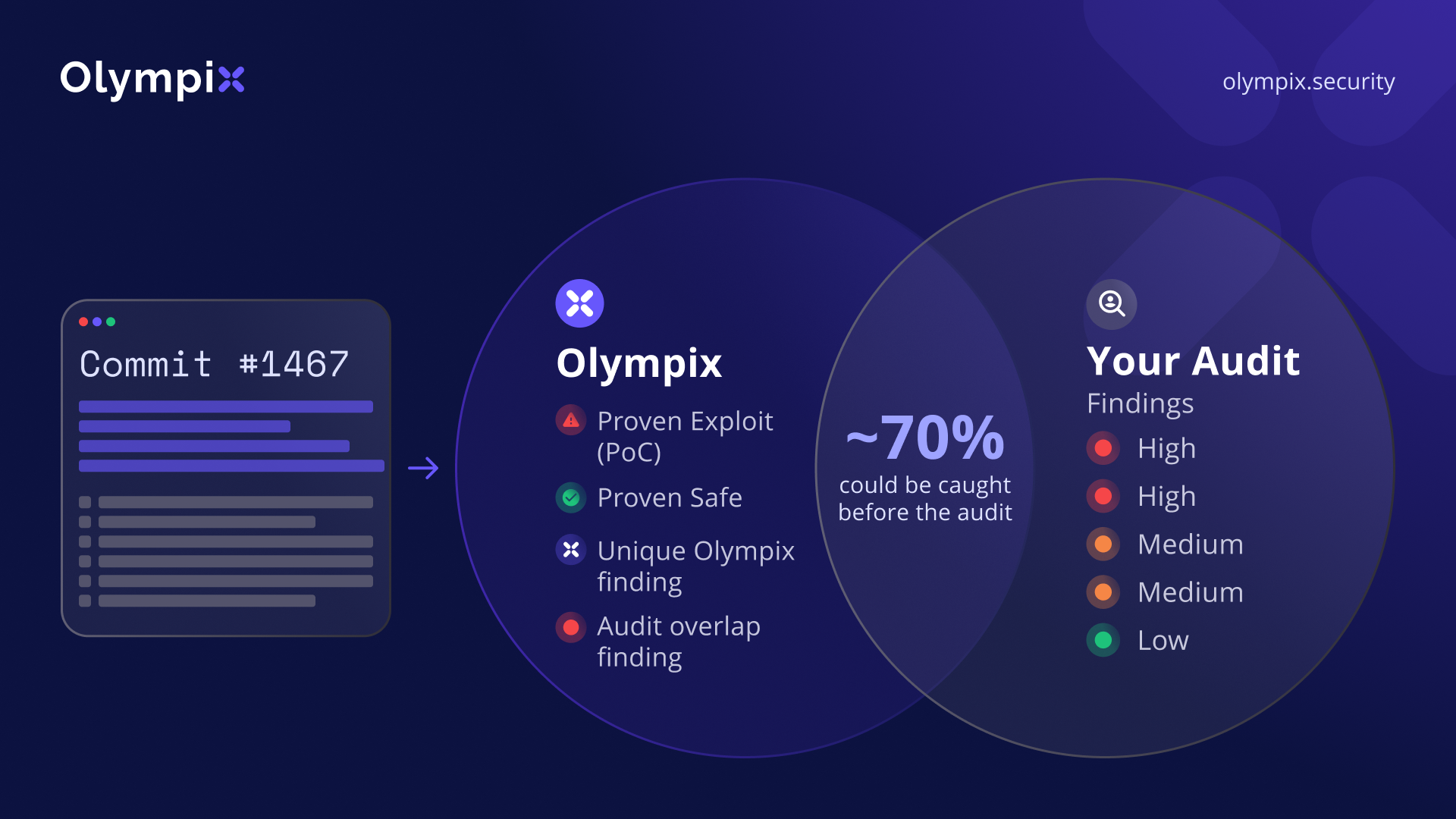
Continuous pre-deployment security, built on a formal methods and AI engine. Here is why smart contract security has to run before deployment, on every change, and prove what it finds.
About 90% of exploited contracts were already audited. That number is not an argument against audits. It is a description of where the losses actually happen.
An audit is a point-in-time human read. It is scoped to the code as it existed on a particular commit, and it is thorough within that snapshot. But smart contract code does not stay still. It changes on every commit, through new features, refactors, dependency bumps, and last-minute fixes. Each change can reopen a path an audit already closed, and re-auditing every change is neither fast nor affordable. The exposure lives in the space between the audit and deployment, and between one audit and the next.
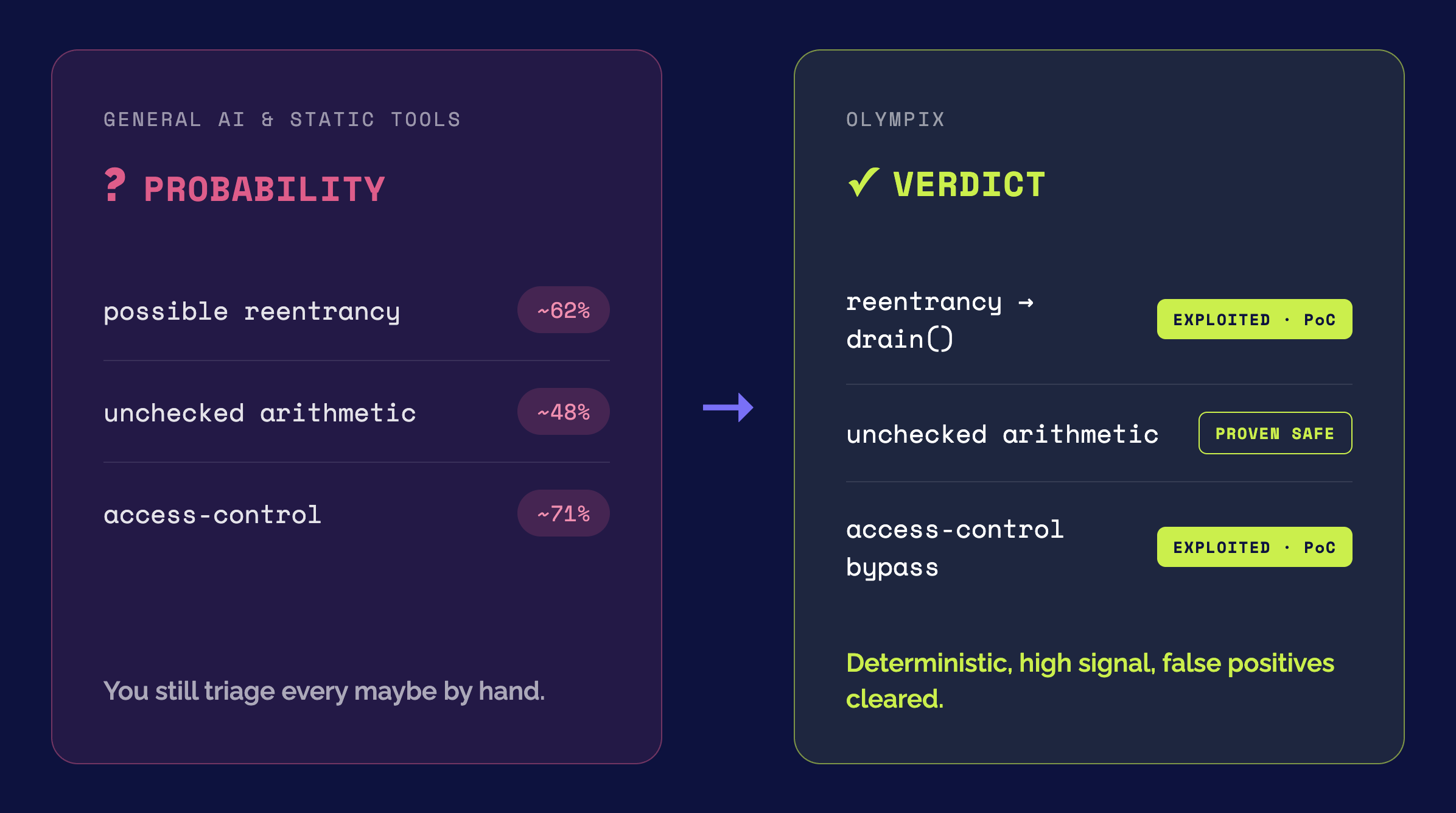
General AI tools have moved into that space, and they help. But they return probabilistic findings: a list of possibilities, each with a confidence score, and no proof that any of them is real. Someone still has to open the file, trace the path, and decide. Across a backlog, that triage turns into noise, and the finding that mattered hides in the pile with the ones that did not. Code passes review with green tests and gets exploited anyway.
Closing that gap takes two things that neither a point-in-time audit nor a probabilistic tool provides on its own: security that runs continuously before deployment, and findings you can trust because they are proven.
Olympix is tooling built on a formal methods and AI engine. The AI orchestrates, and the deterministic core proves.
That distinction is the whole point. A probabilistic tool tells you something might be wrong. Formal methods reason about the code itself and return a verdict: a deterministic result on the properties being checked. Where a general AI tool gives you a confidence score, Olympix gives you an answer, and where a real vulnerability exists, it backs that answer with a working proof of concept for the vulnerability it surfaced. You act on demonstrated exploits, not a backlog of maybes. Because the result is proven rather than guessed, the signal is high and the false positives are cleared.
This is what "find what AI can't, and prove it" means in practice. Formal methods reach past what AI and static analysis alone can find, and everything they surface arrives with the evidence attached.
Detection is the first of two automated dimensions, and it works in two layers.
The first is static analysis across more than 80 detectors, tuned for the known bug classes: reentrancy, access-control flaws, arithmetic errors, and the other patterns with established signatures. This is the baseline every serious codebase should clear, and Olympix clears it automatically on every change.
The second layer is BugPOCer, and it is where detection moves past pattern matching. BugPOCer reasons about your code with symbolic execution and by breaking invariants, which lets it find vulnerabilities that do not match a known signature. When it finds one, it does not just flag it. It generates a working proof of concept that reproduces the exploit. That is the difference between "this looks risky" and "here is the transaction that drains the contract."
Detection tells you what is wrong. Coverage tells you whether you would even have caught it.
Green tests are not proof. A test suite can pass every case and still never touch the path an attacker would take, which means a coverage number can look healthy while the exploit route sits untested. Line and branch counts do not capture that.
Olympix measures coverage against real attack paths instead. Mutation testing injects deliberate faults into your code and checks whether your tests catch them, which shows exactly where the suite is blind. Bounded Adversarial Verification walks feasible adversarial paths deterministically and emits runnable Forge tests for the gaps it finds. The result is coverage measured by whether your tests exercise the paths that matter, not by how many lines they happen to run.
Two figures capture what this does in practice.
Teams that run Olympix ahead of the audit go in with about 65% fewer findings. The routine issues are already caught and fixed, so the audit starts cleaner, moves faster, and spends its time on the design-level questions that need human judgment rather than on bugs a machine should have caught.
And backtested against real 2025 incidents, $240M in losses were preventable by running Olympix before deployment. That figure is what the tooling would have caught ahead of time, measured against exploits that actually happened. It is not a claim about total market losses, and it is not a claim to stop every exploit. It is a measured, backtested account of what continuous pre-deployment security would have prevented.
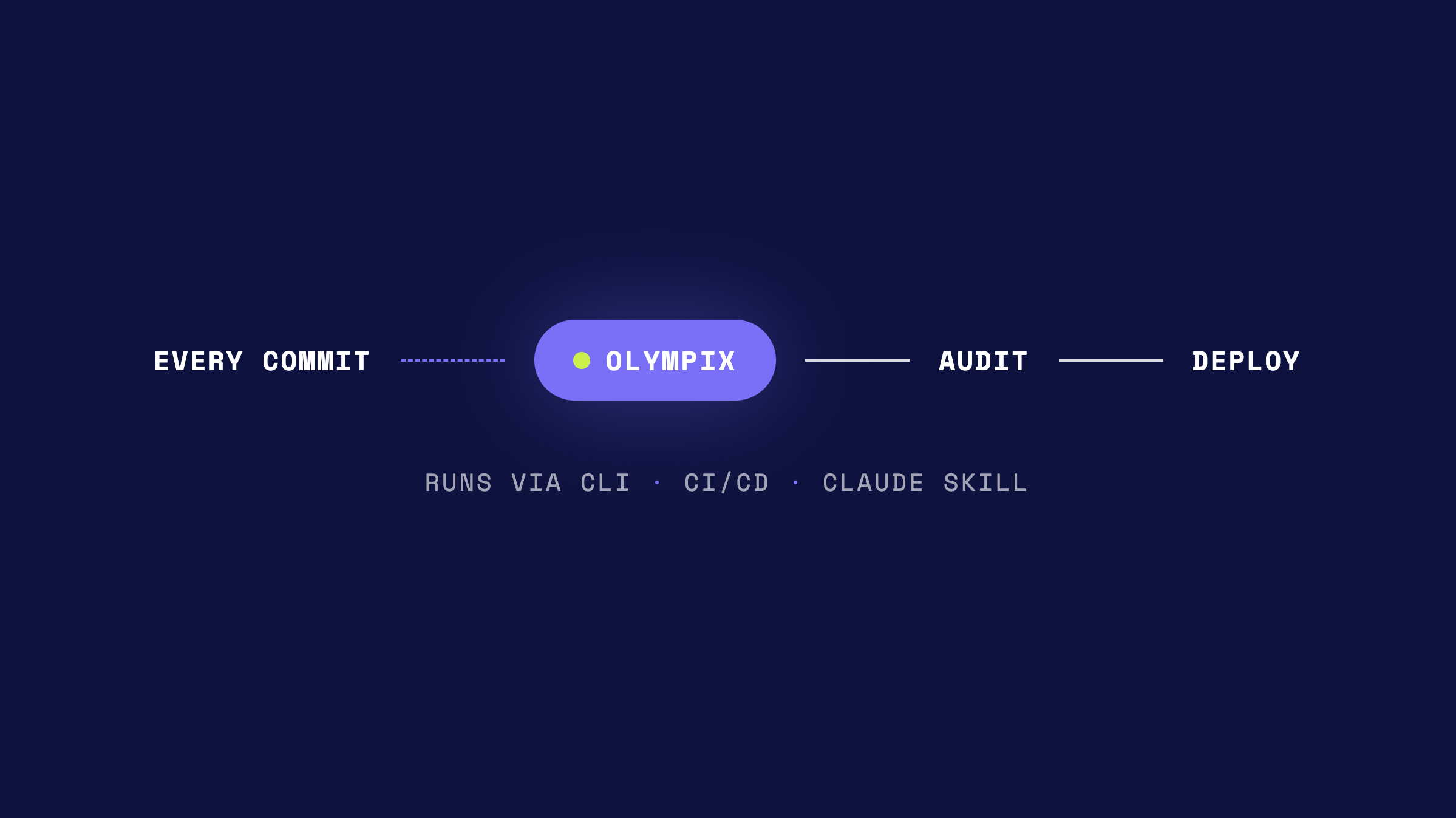
Olympix runs before the audit, on every change. It is not a replacement for the audit, and it is not positioned against it. It catches vulnerabilities and bugs early, which makes the audit more efficient and frees auditors for the work that genuinely needs human judgment. The audit stays necessary. Olympix makes it land on cleaner code.
It fits where you already build. Run it locally through the CLI, wire it into CI/CD so every commit is checked, or use the Claude skill to surface findings directly in Claude Code. Continuous security should not add a step to your workflow. It should live inside the workflow you already have.
Audited code still gets exploited, and probabilistic tools add noise to an already noisy problem. The way forward is security that runs continuously before deployment and proves what it finds, so the code that ships is the code that was checked.
That is what Olympix is built to do. To see it on your own code, book a technical conversation or a POC.