The Next Billion in Web3 Will Get Hacked Unless We Rethink Security
The crypto ecosystem is racing toward mass adoption. Billions of dollars are flowing into DeFi protocols, Layer 2 bridges, and tokenized real-world assets. Institutional capital is arriving. And the security infrastructure underpinning all of it is, in most cases, a PDF report and a bug bounty page.
This is not a minor gap. It's a structural failure, and one that will produce spectacular losses as the user base expands from early adopters who expect to get rugged into a broader population that absolutely does not.
The industry needs to stop treating security as a milestone and start treating it as infrastructure. Here is the case for why, and what the teams building correctly are doing about it.
The Attack Landscape Has Outgrown the Defense Playbook
Cross-chain bridges, governance modules, MEV extraction, and validator-level manipulation are not edge cases. They are the primary attack surface of modern Web3, and they share a common characteristic: they exploit the systemic properties of the protocol, not just individual lines of code.
A traditional audit reviews code at a point in time. It cannot model what happens when a governance token accumulates in a few wallets. It cannot simulate the economic incentives facing validators as staking concentrates. It cannot anticipate how a new liquidity pool will interact with a bridge two protocol upgrades from now.
$2B+ lost to cross-chain bridge exploits alone. These are not edge cases. They are the predictable outcome of securing protocols as if they exist in isolation.
Cross-Chain Bridge Exploits
Bridges are the most valuable targets in crypto precisely because they hold the most assets in custody. They are also the hardest to audit: their security depends on the interplay between two different chains, two different execution environments, and the economic assumptions that hold them together. Auditing either side in isolation leaves the seam between them untested.
Governance Weaponization
Attackers do not need to find a reentrancy bug when they can simply buy enough governance tokens to pass a malicious proposal. Flash loan-enabled governance attacks have turned voting mechanisms into attack vectors. Protocols with low participation thresholds and no time-lock protections are perpetually exposed, and most of them have no real-time visibility into the voting power concentrations forming against them.
Sophisticated MEV Extraction
Maximum Extractable Value has evolved from arbitrage into a systematic extraction mechanism that bleeds users on every transaction. Sandwich attacks, backrunning, and just-in-time liquidity manipulation are not bugs. They are features of permissionless block production that require economic engineering, not just code review, to address.
Validator-Level Manipulation
As staking concentrates among large operators, the assumptions underlying proof-of-stake security begin to degrade. Validator collusion, censorship, and equivocation attacks become economically rational at sufficient scale. This is infrastructure-level risk that no smart contract audit touches.
These vectors are not independent. A governance attack can be used to disable circuit breakers before a bridge exploit. MEV extraction can fund the capital required to execute a governance takeover. Modern attacks are composable, just like the protocols they target.
90% of Exploited Protocols Had Passed an Audit
This statistic does not indict auditors. It indicts the framework that treats an audit as a security guarantee rather than a security input.
Audits are point-in-time assessments. They review the code that exists at the moment of engagement. They cannot review code that will be written after the audit closes. They cannot model the economic conditions that will exist when a protocol reaches significant TVL. They cannot simulate the adversarial creativity of a team with a financial incentive to find what the auditors missed.
An audit is a necessary input to a security program. It is not, by itself, a security program. The teams conflating the two are the ones generating the case studies the rest of us learn from.
Bug bounties suffer from the same structural problem in a different form. They are reactive by design. They pay out after a vulnerability has been discovered, ideally by a researcher acting in good faith, but there is no mechanism guaranteeing that. A team relying on bug bounties as its primary security layer is essentially offering a prize to whoever finds the exploit first and hoping the winner has ethical constraints.
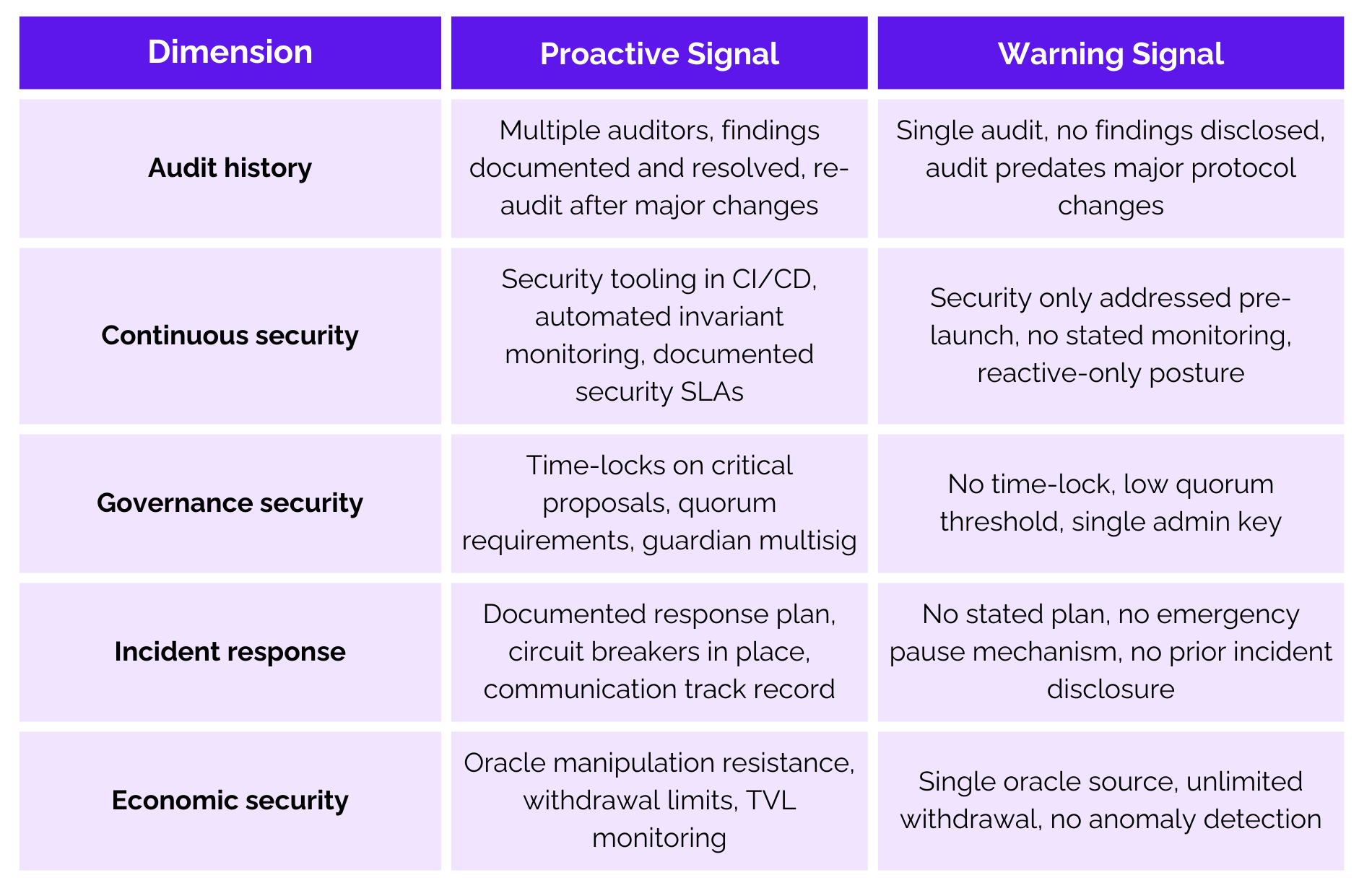
What Proactive, Continuous Security Actually Looks Like
The teams doing this correctly are not spending more money on audits. They are rearchitecting security as a continuous process embedded into how the protocol operates and evolves.
Formal Verification and Deterministic Analysis
Formal verification uses mathematical proofs to establish that a program satisfies a specified set of properties under all possible inputs. For a lending protocol, this means proving that the invariant "total collateral always exceeds total debt" holds not in the test cases the developer thought to write, but in every possible execution path the program can take.
This is not a replacement for human judgment. It is a way to give human judgment a deterministic foundation. When a formal verification run completes without finding a violation, you have a proof, not a probability.
Security-as-Code in CI/CD Pipelines
Security checks that only run before deployment are not continuous security. They are deferred security. The protocols operating at the frontier are running static analysis, fuzzing, and mutation testing on every pull request, catching vulnerabilities at the point where they are cheapest to fix, before they ever touch production.
This approach, sometimes called "shift left" security, transforms security from a launch checklist into a development practice. It also creates an institutional record: every change to the protocol has a corresponding security evaluation, which means the team always knows the current security posture of the codebase, not just the security posture that existed at the last audit date.
On-Chain Circuit Breakers and Economic Security Modules
The most underutilized security primitive in DeFi is the circuit breaker: an on-chain mechanism that detects anomalous conditions and pauses protocol operations before an exploit can fully drain funds. Price oracle deviation triggers, withdrawal rate limits, and TVL change monitors are all examples of economic security that operates at the protocol level, independent of whether a human is watching.
These mechanisms do not prevent attacks. They contain them. The difference between a $50M exploit and a $500M exploit is often whether a circuit breaker was in place.
Adversarial Testing Environments
Mainnet forking has made it possible to test attack scenarios against exact protocol state with real liquidity depths and real token distributions. Teams that run adversarial simulations against their own protocols before deploying changes are, in effect, hiring themselves as their own red team. The attack vectors being tested can be drawn from the historical record of DeFi exploits, which at this point is an extensive and well-documented library of failure modes.
The five pillars of a proactive security program:
Real-time monitoring with anomaly detection. On-chain activity streams fed into detection logic that flags deviation from normal protocol behavior, not just known attack signatures.
Formal verification of core invariants. Mathematical proofs of the properties that must hold for the protocol to remain solvent: collateralization ratios, supply caps, access controls.
Automated security gates in CI/CD. Static analysis, fuzzing, and mutation testing on every code change, not just on release candidates.
On-chain circuit breakers. Protocol-native mechanisms that pause or limit operations when conditions deviate from expected ranges.
Adversarial simulation against mainnet forks. Red-team exercises using real protocol state to validate that security mechanisms work under actual attack conditions.
Red Flags: Walk Away From These
A team that describes their audit as proof of security, rather than one input into a security program
Governance parameters set at launch and never revisited as TVL and token distribution changed
No documented circuit breakers or emergency pause capability on a protocol holding significant user funds
A security budget that does not scale with TVL; a $1B protocol spending $50K/year on security is not a security-first team
A track record of shipping protocol changes without corresponding security reviews
Incident response that consists of posting a thread after the exploit rather than pausing the protocol before funds are drained
The Institutional Inflection Point
This is not an abstract argument about best practices. It is a description of where market pressure is heading.
As TradFi institutions move onchain, they are bringing risk management frameworks built around regulatory requirements and fiduciary duty. A bank cannot put customer funds into a protocol that does not have documented security controls, incident response procedures, and ongoing monitoring. A fund cannot invest in infrastructure with no mechanism for verifying current security posture.
The protocols that survive the next cycle will not necessarily be those with the most innovative mechanisms or the deepest liquidity. They will be the ones that institutional capital trusts enough to anchor. That trust is built on mathematically verifiable security guarantees, not assurances.
The teams getting this right are not waiting for the regulatory moment or the institutional inflection point to take security seriously. They are building security into their development culture now, while there is still time to do it as a competitive advantage rather than a compliance requirement.
The Transition Already Happening
The shift from reactive to proactive security is not theoretical. It's observable in the practices of the protocols that have not become case studies.
They treat security tooling as infrastructure cost, not project cost. They run formal verification on their core invariants before deploying significant TVL. They instrument their protocols to detect and respond to anomalies at the speed of blockchain state changes, not at the speed of human monitoring. They build upgrade paths that include security reviews as a gate, not an afterthought.
This is what "security woven into the DNA" actually means in practice. It is not a philosophy. It's a set of specific, measurable practices that either exist in a protocol's development process or do not.
The next billion Web3 users will not tolerate the exploit-as-learning-experience culture that characterized the early DeFi years. The protocols prepared to serve them are the ones that have already made the transition from point-in-time security theater to continuous, provably verifiable security infrastructure.
The teams building the future of finance do not have the luxury of treating security as a feature to ship in a later sprint. Security is the foundation, and the time to pour it correctly is before the building goes up, not after the walls start cracking.
What’s a Rich Text element?
The rich text element allows you to create and format headings, paragraphs, blockquotes, images, and video all in one place instead of having to add and format them individually. Just double-click and easily create content.
A rich text element can be used with static or dynamic content. For static content, just drop it into any page and begin editing. For dynamic content, add a rich text field to any collection and then connect a rich text element to that field in the settings panel. Voila!
Headings, paragraphs, blockquotes, figures, images, and figure captions can all be styled after a class is added to the rich text element using the "When inside of" nested selector system.
Follow-up: Conduct a follow-up review to ensure that the remediation steps were effective and that the smart contract is now secure.
Follow-up: Conduct a follow-up review to ensure that the remediation steps were effective and that the smart contract is now secure.
In Brief
Remitano suffered a $2.7M loss due to a private key compromise.
GAMBL’s recommendation system was exploited.
DAppSocial lost $530K due to a logic vulnerability.
Rocketswap’s private keys were inadvertently deployed on the server.
Hacks
Hacks Analysis
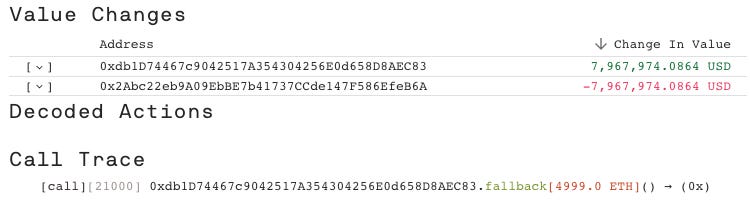
Huobi | Amount Lost: $8M
On September 24th, the Huobi Global exploit on the Ethereum Mainnet resulted in a $8 million loss due to the compromise of private keys. The attacker executed the attack in a single transaction by sending 4,999 ETH to a malicious contract. The attacker then created a second malicious contract and transferred 1,001 ETH to this new contract. Huobi has since confirmed that they have identified the attacker and has extended an offer of a 5% white hat bounty reward if the funds are returned to the exchange.