

Lucid Labs builds bridge-agnostic stablecoin infrastructure for chain foundations, L2s, L3s, and app chains, routing real capital across 25+ chains through eight leading messaging bridges. At that scale, in that category, point-in-time security is not enough. The bar ecosystems and integration partners expect from a protocol routing their capital looks more like the one institutional finance has spent decades enforcing in its own systems: continuous, measurable, and provable security of the code itself, applied before deployment and re-verified as the codebase evolves.
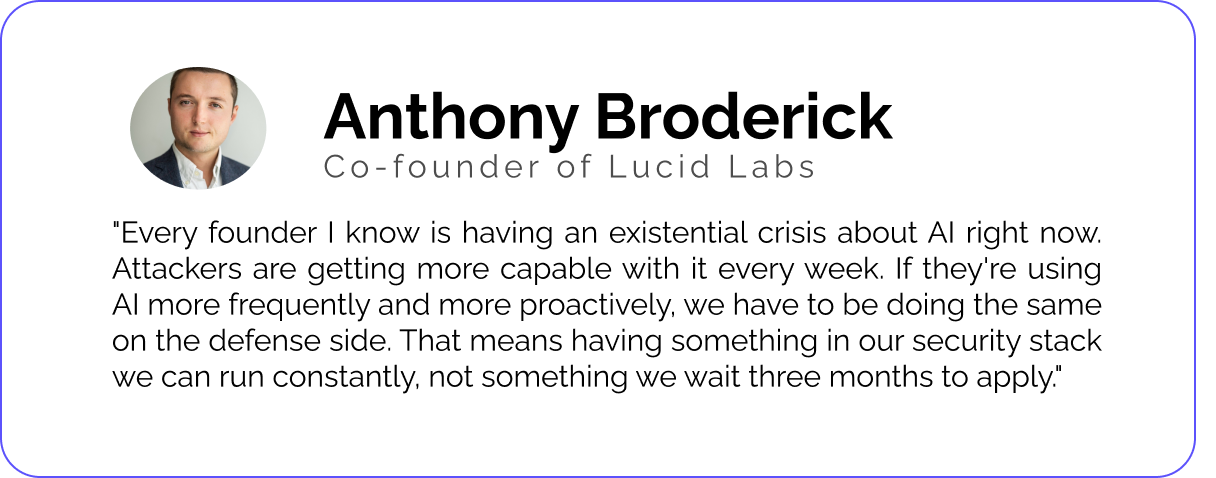
That bar drives how Lucid thinks about its security stack. Top-tier external audits remain critical, and on-chain monitoring through Hypernative adds a second layer. Lucid added Olympix as a third: continuous, deterministic security infrastructure that runs alongside the audits and gives the team enforceable security metrics throughout the development lifecycle.
Stablecoin infrastructure protocols occupy a unique position, because they don't only carry their own security posture. They inherit the risk expectations of every partner who integrates them. For Lucid, that means every ecosystem running Nebula, every foundation using L-USDC or L-USDT to convert idle TVL into chain-owned liquidity, and every app chain routing assets through the Multi-Bridge. An exploit on Lucid is never just an exploit on Lucid. It propagates to every partner whose users transact through the protocol.
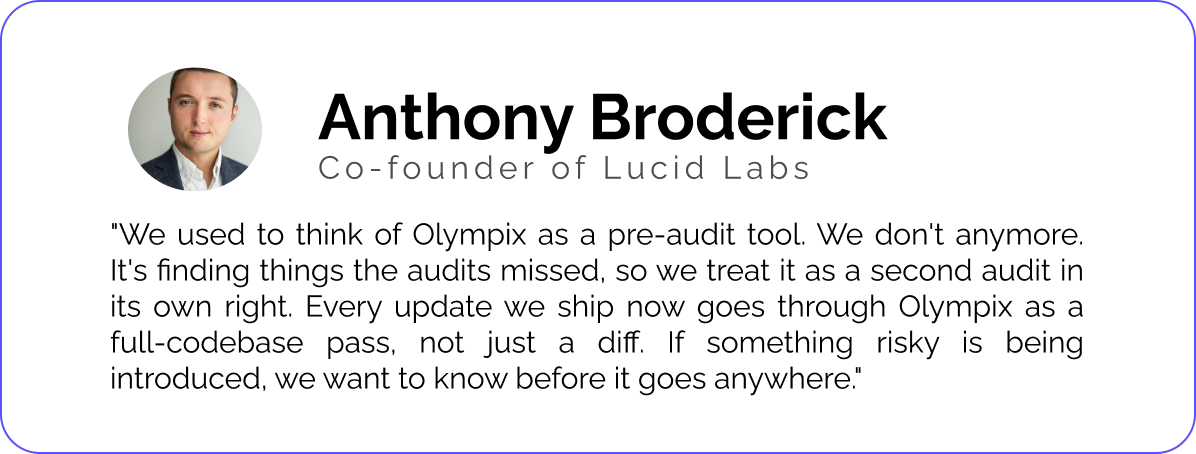
That position changes what counts as adequate security. A single audit, or even several, cannot underwrite the trust expectations of a partner whose own treasury and end-user assets depend on the soundness of the integrating protocol's code, and stacking more audits runs into a hard constraint. Three or four of them on the same codebase would have multiplied cost without proportionally multiplying coverage, and would not have solved the underlying problem: code keeps changing after the audit ends.
Lucid came to Olympix in the run-up to its first product launch with exactly that calculus in mind. The team wanted multiple layers of pre-deployment review, both to raise their own confidence in the code and to demonstrate that confidence to the integration partners they would need to grow.

The problem is not that audits fail. The problem is that audits are point-in-time, and 90 percent of exploited smart contracts had been audited at least once before the exploit.
The CrossCurve exploit in February 2026 is a useful illustration for the cross-chain category specifically. An attacker drained approximately $1.4 million from CrossCurve's PortalV2 contract by exploiting a missing access control check on the expressExecute() function in the protocol's ReceiverAxelar contract. The function was publicly callable and lacked any meaningful source validation, accepting arbitrary sourceChain, sourceAddress, and payload inputs. By generating a fresh commandId and supplying fake source data, the attacker triggered unauthorized token releases as if a legitimate cross-chain message had arrived from Axelar, then repeated the attack across multiple chains.
CrossCurve was not an anonymous protocol. It had received early support from Curve Finance founder Michael Egorov and positioned its multi-validation architecture, involving Axelar, LayerZero, and its own EYWA Oracle Network, as a security strength. None of that prevented a publicly callable function from missing the gateway validation check that should have been the primary security boundary of the entire integration.
The Balancer exploit in November 2025 illustrates the same thesis from a different angle. An attacker drained $121 million across multiple chains by exploiting a precision rounding flaw in invariant calculations inside Balancer V2's ComposableStablePool contracts, chaining dozens of calibrated micro-swaps inside a single batchSwap to compound wei-level rounding losses into catastrophic invariant manipulation. Balancer V2 had been reviewed by OpenZeppelin, Trail of Bits, Certora, and ABKD, among others, with on-chain monitoring in place, and none of it caught the exploit before funds left the contracts. The flaw was not a missing check that pattern matching would have flagged. It was an arithmetic interaction across the codebase that only became visible when execution paths were exhaustively explored.
Both exploits illustrate the same gap. CrossCurve was a missing access control check on an externally callable function, Balancer was an arithmetic interaction that only surfaced under adversarial path exploration, and both follow patterns the industry has seen before, including the 2022 Nomad bridge hack and dozens of other incidents. Both are exactly the kind of vulnerability an engine that traverses code paths, infers invariants, and tries to break them is built to surface before deployment, with a proof-of-concept exploit as evidence.
Olympix has published full breakdowns of both exploits and the tooling that would have caught them (CrossCurve, Balancer). The relevance to Lucid is direct: the Multi-Bridge architecture also routes through Axelar, LayerZero, and several other messaging protocols, and Lucid's own stablecoin and routing logic creates the kind of cross-contract arithmetic surface area where Balancer-class flaws emerge. These are the classes of vulnerability Lucid's security stack has to rule out before any release ships.
That conversation reframed Lucid's entire approach. The team needed something earlier in the cycle, something that could catch vulnerabilities before code ever reached an external auditor and keep catching new ones as the codebase evolved across new chain integrations and new bridge routes. A third pressure compounded the first two: as AI capabilities accelerate on both sides of the security equation, point-in-time review cycles look increasingly insufficient against attackers who can iterate faster than ever.
BugPoCer is the Olympix tool Lucid leverages most.
BugPoCer: Provable Exploitability Before External Audit. BugPoCer is the final internal validation layer before code reaches an external auditor, leveraging the Olympix engine to generate audit-style findings and catch issues that audits continually miss. Each finding comes with an automatically generated proof-of-concept exploit, which turns audit prep into a set of confirmed, reproducible attack scenarios the team can resolve before an external auditor ever opens the codebase.
This matters for two reasons specific to Lucid's situation. First, every BugPoCer finding resolved in development is one that does not appear in the external audit report, which directly addresses the "clean report" problem. Second, the proof-of-concept exploit serves as evidence: the team is not debating whether something is theoretically reachable, they are looking at the code path that reaches it. That removes a category of internal friction and accelerates remediation.
The Engine Behind BugPoCer. BugPoCer is built on the Olympix engine: an intermediate representation of the codebase, a layer of static detectors, a symbolic execution machine, and AI orchestration on top. The engine mathematically traverses code paths, infers the invariants the code is supposed to hold, and tries to break them, automatically generating a proof-of-concept exploit wherever it succeeds and showing the exact steps a hacker would take. This is how BugPoCer surfaces vulnerabilities that pattern-matching tools and manual audits miss.
A Stronger Commercial Position With Integration Partners. Lucid can now tell prospective partners that all production code has been through two layers of audit-grade review before deployment. For a protocol whose growth depends on integrations with chain foundations and ecosystem operators, that posture is a closing tool, not just a security one.

Full-Codebase Retest at Every Update and Every Release. Lucid runs the entire codebase through Olympix at every update and every release, not just the diff. New contracts and updates are evaluated in the context of the rest of the codebase, where vulnerabilities most often emerge, and code stays inside the development workflow until it clears that check.
A Compounding Advantage as Olympix Evolves. Detection capability is not static. As the Olympix engine improves, every subsequent scan brings the latest best practices to every line of code Lucid runs through it, including code already in development, code queued for release, and code about to be re-released as part of an update. The team doesn't have to retroactively bring old code up to a new standard, because the next scan does that automatically.
Together, these behaviors produce something that did not previously exist for smart contract development at Lucid's scale: a continuous, enforceable, and provable security posture before the first external audit, and a re-verification at every update and every release that does not depend on the next audit cycle to surface new risks.
Lucid is backed by Wintermute, ex-BlackRock leadership, and Syndicate co-founder Will Papper. The Syndicate connection is more than incidental, because Syndicate, the on-chain infrastructure platform Will co-founded, is also an Olympix customer.
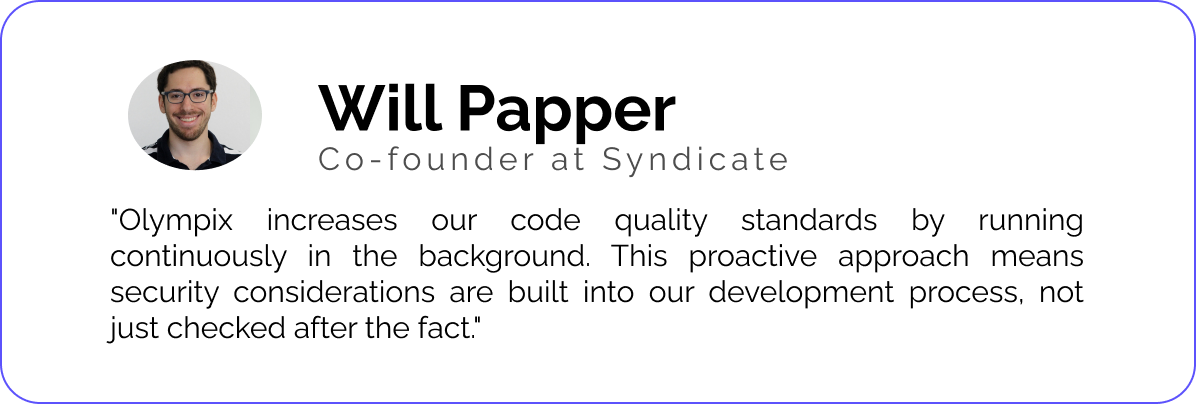
The teams choosing Olympix are the same teams choosing each other. Lucid is one of a growing set of them that have made continuous, deterministic, pre-deployment security a permanent part of their development pipeline. For cross-chain infrastructure at this scale, it is no longer optional.
Your security posture should meet the standards your partners already expect. Book a demo to see how Olympix fits into your development workflow.