
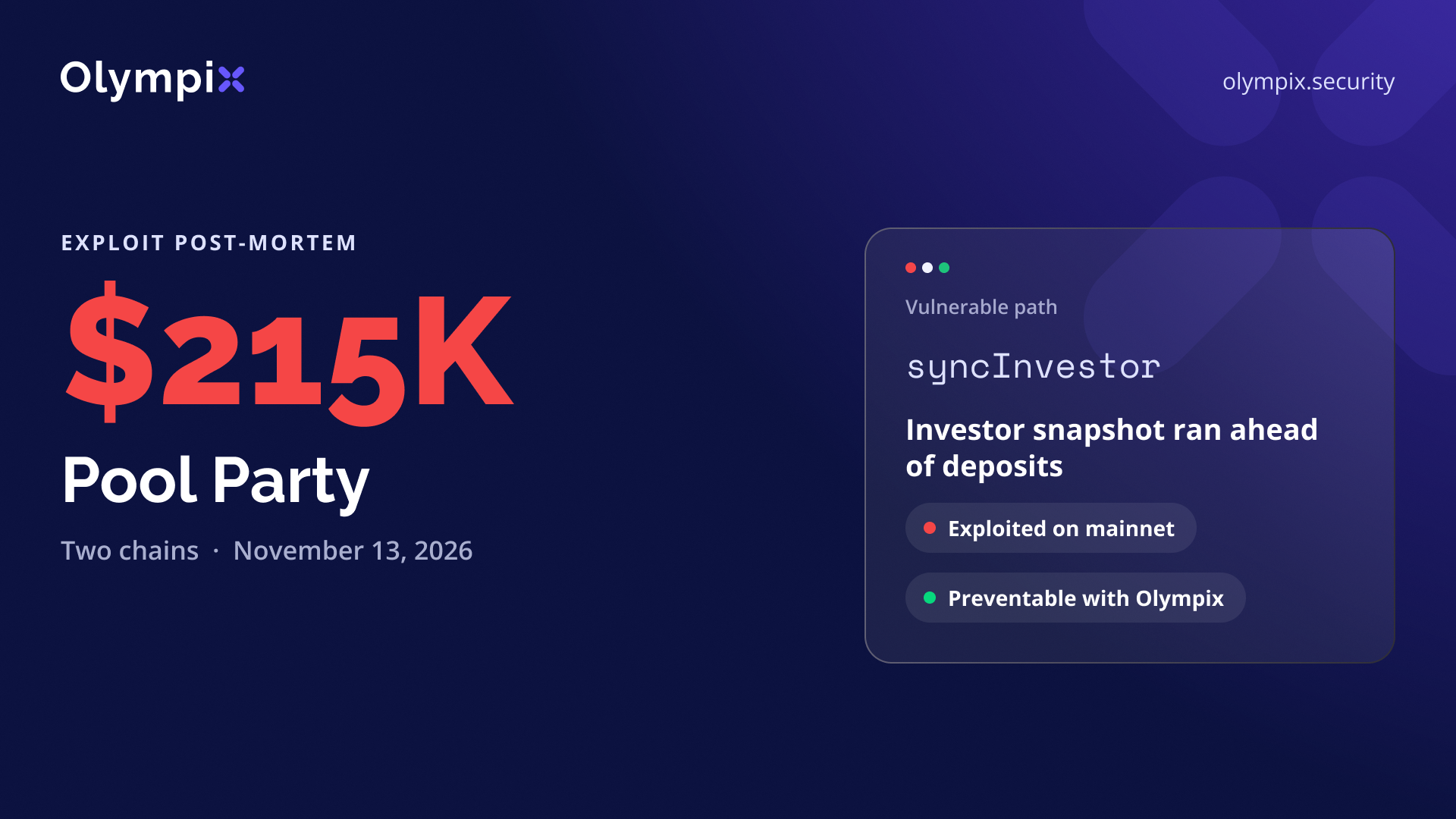
Pool Party's $215K Loss and How Olympix Would Have Prevented It
At 01:56:35 UTC on November 13, 2026, a fresh wallet on Base received 10.000002 USDC. Three minutes later it spent exactly 10 USDC joining a Pool Party pool. Over the next hour and a half that same wallet kept buying its way into pools for 10 USDC at a time and leaving with thousands. By 03:38 UTC it had drained 15 pools across Arbitrum and Base, and according to Pool Party's incident thread, the total loss came to approximately $215,000.
No flash loan or price feed was involved. A ledger that recorded what each investor owned could be made to say the attacker owned far more than the 10 USDC they'd paid in, and the withdrawal function believed the ledger.
A Managed Pool With a Separate Ledger
Pool Party is a self-custodial protocol for managed liquidity. An investor deposits a stablecoin into a pool, and a pool operator runs a Uniswap-style liquidity position on everyone's behalf. Investors can follow specialists, influencers or friends into strategies while keeping custody of their own wallets.
The interesting part is how Pool Party keeps score. Each pool has its own snapshot contract, and that contract tracks two things: a pool-wide snapshot of the strategy's liquidity and fee indexes, and a per-investor snapshot holding that investor's recorded liquidity, accumulated fees and share percentages. A function called syncInvestor brings an individual investor's record forward against the latest pool-wide snapshot, so a withdrawal can settle cheaply without replaying every deposit and fee accrual since the investor joined.
It's a sensible design and plenty of vaults use a version of it. It also creates a quiet dependency. Once withdrawals pay out from the per-investor record, that record is effectively money. Whatever can change it is as sensitive as the withdraw function itself.
Pool Party ran on Arbitrum, Base, Polygon and Robinhood Chain at the time. Only the Arbitrum and Base pools were drained.
The Record Got Ahead of the Deposit
Pool Party's own explanation is short. The attacker found a vulnerability in the per-pool snapshot contract, changed their recorded position, deposited 10 USDC and withdrew the pool's funds. SlowMist's public incident record carries the same root-cause summary and the same $215k figure.
The team hasn't said which line accepted the manipulated write, and as of November 24, 2026, it hadn't published the full post-mortem it promised. What the public record does pin down is the shape of the failure. The per-investor snapshot could be pushed to a value that the investor's actual contribution didn't back, and the withdrawal path paid out against that value without checking it against anything the investor had put in.
The 10 USDC did one job. It made the account look like a real investor with a live position, which is all a small deposit floor can ever prove. The size of the claim attached to that position came from the snapshot, and the snapshot had already been changed.
Think of a coat check that hands back whatever coat matches the number on your ticket, where the number can be rewritten after you've handed in your scarf. The attendant follows the rules perfectly and still gives away someone else's coat.
Fifteen Pools in Two Hours
The attacker worked from a single externally owned account, 0x2075...7f8f, which Pool Party named in its thread. On Base, according to PandaSecurity's on-chain analysis, that account called the protocol's official Position Manager, the contract Pool Party lists on its security page, and called syncInvestor on the snapshot contracts attached to individual pools. Each pool got the same treatment: a 10 USDC addLiquidity call, snapshot syncs, then a withdraw that returned far more than the deposit.
The receipts on Base show the pattern clearly. One of the first deposits landed at 01:59:52 UTC, moving exactly 10 USDC from the attacker into the Position Manager. The withdrawals were on a different scale. A withdraw at 03:14:01 UTC paid the attacker about 4,265 USDC, and another about 90 seconds later returned about 4,140 USDC, according to PandaSecurity. Across the seven Base deposits PandaSecurity decoded, the attacker spent 70 USDC and received about 12,066 USDC.
Base was the small end of the operation. Pool Party said 12 of the 15 drained pools were on Arbitrum and only three on Base, and the three Base snapshot contracts the attacker synced line up with that count. The roughly $12,000 taken on Base is a minority of the $215,000 total, which fits most of the damage landing on Arbitrum.
Monero, a Bounty Offer and a Same-Day Fix
The money moved fast. According to Pool Party's thread, the attacker had already converted the funds to XMR by the time the team went public at 18:23 UTC. The team also said 115,056.36 DAI, paid with funds from the incident, arrived at a wallet from CCE Cash at 04:58 UTC, and later asked that wallet's owner to get in touch if the payment had come in through an ordinary trade.
At 18:13 UTC Pool Party sent an on-chain message on Arbitrum offering the attacker a 10% white-hat bounty and no legal action if the remaining approximately $193,500 came back. PandaSecurity reported no public confirmation of a return. The team said it had reported the incident to law enforcement and to the exchanges involved, asked investigators to get in touch, and thanked pcaversaccio and SEAL 911 for help during the response.
The patch went out the same day on all four chains, including Polygon and Robinhood Chain, which hadn't been touched. That's the right call when one snapshot design is shared across every deployment.
How Olympix Would Have Caught a Ledger That Pays More Than It Holds
Olympix reads a contract the way an attacker does, as states, transitions and entry points, and takes in the context around the code to infer the invariants the system depends on. In Pool Party's design the state that matters is the per-investor snapshot, because the withdraw path converts it straight into tokens. Every function that can write to that record, syncInvestor included, is an entry point the engine would have mapped next to the withdraw function that reads it.
The invariant the engine would have inferred fits in a sentence: no investor's recorded claim on a pool can exceed what that investor contributed, net of fees earned. From there Olympix narrows the search from every path through the contract to the feasible ones, and then to the ones that touch that rule. A sequence that writes a larger claim into the snapshot without a matching deposit, adds the minimum liquidity and then withdraws would have broken it.
Had the team run Olympix on the snapshot contract, that broken sequence would have come back as a counterexample: the order of calls, the minimal state needed to make the claim outrun the deposit, and a generated Forge test that replays it. That test would have been the November 13 drain, produced in development against a local fork instead of against 15 funded pools. Because the engine runs at every merge and before release, it would have surfaced the first time the snapshot logic and the withdraw path met in the same build.
The exact code path isn't public yet, so the specifics of the counterexample can't be shown here. The invariant doesn't depend on them. Whatever line let the record move, a payout that exceeds the payer's contribution is the break, and that's what the search targets.
It's a familiar shape. A per-account checkpoint that could be left in the wrong state is what cost NovaBox $107K in June, when a new account claimed years of dividends it had never earned.
Treat the Sync Function Like the Withdraw Function
Snapshot and share accounting exist to make withdrawals cheap and fee attribution fair, and nothing about Pool Party's architecture was exotic. The lesson sits in where the trust lives. A function that rewrites an investor's recorded liquidity never moves a token by itself, so it's easy to file under bookkeeping. In a design where withdrawals pay from that record, it's part of the value path, and it deserves the same scrutiny and the same invariant tests as the function that sends the money.
For builders running managed pools, vaults or any design that snapshots investor positions, the test worth writing is simple to state: no sequence of syncs, deposits and withdrawals should ever let an investor take out more than they put in plus what they earned. To see how Olympix would map those paths in your own contracts and hand back a runnable counterexample for every break, book a technical walkthrough.
On-Chain References
Attacker EOA: 0x2075...7f8f
Pool Party Position Manager (Base): 0xd6f2...b54f
Snapshot contract, Base pool 1: 0x01ac...8797
Snapshot contract, Base pool 2: 0x8bdc...9506
Snapshot contract, Base pool 3: 0xd574...26a0
Exploit tx, 10 USDC deposit (Base, 01:59:52 UTC): 0xdd45...ea71
Exploit tx, withdraw of about 4,265 USDC (Base, 03:14:01 UTC): 0xead5...c14a
Exploit tx, withdraw of about 4,140 USDC (Base, 03:15:35 UTC): 0x2378...fee7
More post-mortems
See every post-mortem →

See what Olympix finds on your own code
Send us a repo that's already been audited, and we'll run Olympix at the same commit and show you what comes back.