
K3 Capital's $3.43M Loss and How Olympix Would Have Prevented It
At 12:25:23 UTC on November 18, 2026, the first attack transaction landed against K3 Capital's sBOLD vault on Ethereum. Seven and a half minutes later the vault had lost 99.9% of its assets. By the time the owner paused it at 13:05:11 UTC, roughly 3.43 million BOLD was gone, and more than half of that value had already been handed to block builders by attackers bidding against each other for the right to drain it first.
The attackers didn't break Liquity V2 or the 1inch router. They found a vault function that granted a token approval, let the caller decide what happened next, and only checked that enough BOLD came back. Twice per round, that was enough to make depositors pay for a donation the attacker took back.
A Yield Vault Built on Liquity's Stability Pools
sBOLD is an ERC-4626 vault that K3 Capital built on top of Liquity V2. Depositors supply BOLD, Liquity V2's dollar stablecoin, and receive sBOLD shares redeemable for a proportional cut of the vault's assets. According to K3 Capital's post-mortem, the vault spread its deposits across Liquity's three stability pools, 30% in the WETH pool, 60% in wstETH and 10% in rETH.
Stability pools are Liquity's backstop. BOLD in a pool repays the debt of liquidated loans, and the pool's depositors receive the liquidated collateral, worth up to 5% more than the debt they covered. They also earn part of the interest that borrowers pay. sBOLD wrapped all of that into one compounding token.
Before the attack the vault held 3.429 million BOLD against 3.128 million shares, so each sBOLD was worth 1.0961 BOLD. Two parts of the design decided what happened next.
The first was the share price. K3 computed it as the vault's total assets divided by the number of shares, and total assets counted the BOLD in the three pools, the BOLD sitting in the vault, the value of unclaimed collateral in the pools, and the value of any collateral held directly by the vault. Anything of value sent to the vault, from anyone, raised the price of every share.
The second was the collateral swap. Liquidations leave the vault holding WETH, wstETH and rETH, which earn nothing, so the vault exposed a public swap() function that anyone could call with a 1inch order to turn that collateral back into BOLD. The vault approved the 1inch router for the collateral, submitted the caller's order, and checked that it received at least the oracle value of the collateral minus 0.5%. While the vault held more than 7,500 BOLD worth of collateral, it refused deposits and withdrawals.
Each rule made sense alone. Together they let a single caller decide what the vault approved, what the router did with that approval, and how much the share price moved in between.
The Approval That Outlived the Swap
The swap ends in a private helper called _execute in the vault's SwapLogic library. This is the function as verified on Sourcify for the sBOLD contract:
Read it as a sequence of promises. The vault approves the adapter for _inAmount of the collateral token, hands the adapter the caller's _swapData untouched, and then measures only one thing: how much BOLD arrived. It never checks that its own collateral balance went down by _inAmount, and it never sets the approval back to zero.
K3's post-mortem, based on analysis ChainSecurity carried out for the team, names exactly those two missing checks as the root cause. If BOLD arrives but no collateral leaves, the BOLD acts as a donation that raises the share price, and the unused approval stays sitting on the router for the next call to spend.
The adapter made that worse. It was the 1inch Aggregation Router v6, and the attackers used its generic swap(executor, desc, data) entry point, where the caller picks the executor, the token sold and the amounts. Nothing tied the token in the order to the token the vault had just approved, so the attackers plugged in their own contract as the executor and ran their own logic in the middle of the vault's swap().
Think of a cashier who tells the delivery driver to take a case of wine from the stockroom, checks that the right payment landed in the till, and closes the ticket. Nobody counts the stockroom. If the driver pays without taking the wine, the store looks richer, and the driver still holds a pass that lets them walk out with that case later.
Five Steps, Eight Times a Transaction
Each attack transaction started by borrowing. In the transaction at 12:25:47 UTC, sent by the operator who had first deployed the exploit code, the attack contract flash-borrowed 10,000 wstETH from Morpho and 5 WETH from Balancer, neither of which charges a fee. It locked the wstETH in a fresh Liquity V2 trove and borrowed 9,010,000 BOLD against it, paying an upfront fee of 4,262.50 BOLD, according to K3. That gave it several times the vault's entire balance to play with.
Then came the round, repeated inside the same transaction.
First, the contract deposited 9,000,000 BOLD into sBOLD and received 8,730,950.13 shares, which K3 says was 72.4% of all shares. Whoever holds most of the shares captures most of any increase in total assets.
Second, it sent 4 WETH to the vault as a plain transfer. Now the vault held collateral that could be fed to swap(), with no liquidation needed.
Third, it called swap() for those 4 WETH with a crafted 1inch order. The vault approved the router for the WETH and passed the order along. The order sold a dummy token belonging to the attacker instead of the WETH, and the attacker's executor delivered the BOLD the vault expected. In the transaction's transfer log, 7,159.16 BOLD moves from the attack contract to the router and on to the vault. The vault's check passed, the WETH stayed in the vault, and the WETH approval stayed live on the router. The vault now held two donations, the 4 WETH and the 7,159.16 BOLD.
Fourth, the contract redeemed all its shares. Both donations had raised the share price, so it got back 9,010,367.62 BOLD for its 9,000,000, according to K3.
Fifth, it took the WETH back. It sent a dust amount of wstETH to the vault and called swap() again. The vault approved the router for that dust, but this second order told the router to sell 4 WETH, using the approval left over from step three, and send it to the attacker. The attacker's executor returned slightly more than the vault's tiny minimum for a dust swap, so the vault accepted that too.
K3 puts the first round's profit at 3,208.46 BOLD. The transaction ran eight rounds, earned 25,742.80 BOLD, and cleared 21,480.30 BOLD after the trove fee. At the end, the contract repaid its BOLD debt, closed the trove, recovered the wstETH, repaid both flash loans and swapped its profit into ETH-based assets through a Liquity redemption.
K3's own arithmetic shows why the round worked. A donation normally costs the donor, because other shareholders take a slice of it. Here the attacker recovered its share of both donations on redemption, then took the donated WETH back in full. With the two donations roughly equal, the profit per round is about twice the attacker's share of the vault minus one, times the value of the WETH. Above 50% ownership, every round pays.
Why It Took Ninety-Nine Transactions
The vault couldn't be drained in one shot. While it held collateral it refused redemptions above 7,500 BOLD worth, which capped each round at about 7,460 BOLD. The attackers started at about 3,200 BOLD a round and pushed past 7,000 once they owned most of the shares. Each round also cost about 1.3 million gas, so eight rounds used about 10.5 million gas against a per-transaction limit of about 16.8 million.
That cap turned the drain into a race. K3 says ten attacker operators, including a generalized MEV bot that started replicating the attack at 12:26:47 UTC, drained the vault in 99 transactions. Once the first transaction was public, anyone could copy it, and they all paid to get included first.
Where 3.43 Million BOLD Went
The bidding war is the strangest part of the money trail. According to K3, the attackers paid about 986 ETH, roughly 1.77 million BOLD and more than half of the loss, to block builders, who passed 986.55 ETH on to 21 validator fee recipients through Ethereum's standard block auction. The largest single recipient was Lido's execution-layer rewards vault, with 256.31 ETH across nine blocks. K3 lists the builders and validators because they received exploit-derived funds, not because they took part.
The damage reached past sBOLD holders. Pendle's SY-sBOLD wrapper held 399,993 sBOLD before the attack, 12.79% of all shares, and its users lost value as the share price collapsed. K3 said its analysis to date doesn't quantify those losses.
K3 was equally clear about what didn't happen. None of Liquity's three branches emitted a liquidation event during the drain, contradicting early reports that described it as a liquidation attack. The troves were opened and closed inside single transactions purely as a source of BOLD. Liquity V2 and 1inch both behaved exactly as designed.
Paused, Then a Recovery Race of Its Own
Hypernative was first to flag the suspicious transactions, K3 said. The team posted at 13:08 UTC that it was investigating malicious activity and that contracts had been paused, and by 13:24 UTC it had set up a war room with SEAL 911 focused on the funds sitting with builders and validators. c0ffeebabe and pcaversaccio helped identify the fee recipients.
The full post-mortem followed on November 19. K3 said it had identified nine counterparties holding 894.50 ETH and 131,316 yBOLD from the exploit, about 1.7 million BOLD at the time of the attack, and that some, including Bitcoin Suisse and Yearn, had committed to the recovery. It offered a 15% bounty on returned funds, designated a single recovery address, and set out a plan to collect ETH for four weeks, convert it to BOLD and redeem affected clients case by case. As of November 24, 2026, K3 hadn't announced the outcome of that collection period.
How Olympix Would Have Caught the Approval That Never Got Spent
Olympix reads a contract as states, transitions and entry points, then takes in the surrounding context to infer the invariants the system relies on. In sBOLD the states that matter are the vault's collateral balances, the allowances it grants to the swap adapter, its BOLD balance and the share price built from all three. swap() is a public entry point that writes to every one of them, and deposit and redeem read the result.
The signal in _execute is the kind static analysis is built to spot. An approval goes to an external contract, that contract is called with caller-supplied bytes, and the only check afterward measures a different token. The approved token's balance is never compared to _inAmount, and the allowance is never cleared. Had the team run Olympix on the vault, static analysis would have surfaced that signal on the first pass.
A signal alone doesn't prove loss, and that's where BugPoCer comes in. It starts from an invariant and works outward through the system looking for a sequence that breaks it. For a share vault, the invariant writes itself: no depositor should be able to redeem more value than they deposited plus their fair share of real yield, and every collateral approval the vault grants should be consumed or cleared within the same swap. From all the paths through sBOLD, the engine narrows to the feasible ones and then to the ones that touch those rules.
The sequence that broke them isn't exotic. Deposit, transfer collateral in, call swap() with an order that pays BOLD without taking the collateral, redeem, then call swap() again so the router spends the leftover approval. BugPoCer would have returned that sequence as a counterexample, with the minimal conditions it needs: a caller holding more than half the shares, an adapter that accepts arbitrary order data, and a collateral balance small enough to stay under the 7,500 BOLD redemption gate.
It would also have come with a generated Forge test that replays the round against a fork. That test would have been the November 18 drain, produced in development instead of on mainnet with block builders bidding for the proceeds. Because the engine runs at every merge and before release, the counterexample would have appeared the moment swap() and the share-price formula shipped side by side.
Why It Got Through
sBOLD had a ChainSecurity code assessment in 2025, covering several versions of the codebase, and ChainSecurity also did the technical analysis behind the post-mortem. This incident sat where two separately reasonable decisions met. Counting donated collateral in total assets is a choice about accounting. Letting the caller supply the router's order is a choice about integrations. The exploit only exists when you hold both in your head at once and add a caller who owns most of the shares.
That's a scope problem every review faces. Time-boxed reviews look closely at the code in front of them, and the interaction between an external router's generic entry point and a vault's own price formula is easy to put on the far side of the line. Continuous checks against stated invariants are how those seams get covered between and after reviews.
Measure What Leaves, Not Just What Arrives
For anyone building a vault that swaps through an aggregator, K3's root cause reads like a checklist. Record the input token's balance before the call and assert it fell by the amount you approved. Reset the allowance to zero after every swap, or use an exact-amount pull pattern so nothing survives the call. Don't let the caller choose the router's executor or token path when the vault is the one granting approval. And treat any public function that can move the share price as part of the deposit and redeem paths, because that's how an attacker will use it.
To see how Olympix would map those paths in your own contracts and return a runnable counterexample for every break, book a technical walkthrough.
On-Chain References
Exploit tx (12:25:47 UTC, block 26441931): 0x915c...02cb
Attacker EOA (first exploit deployment): 0xDC0e...4dAA
Attack contract: 0x19Ad...9634
Attacker EOA (first drain, 12:25:23 UTC): 0x2324...ad2d
Victim contract (sBOLD vault): 0x50Bd...DD11
Swap adapter (1inch Aggregation Router v6): 0x1111...2A65
Flash loan source (Morpho): 0xBBBB...FFCb
Liquity V2 wstETH ActivePool: 0x531a...19a0
K3 recovery address: 0x2f02...C795
More post-mortems
See every post-mortem →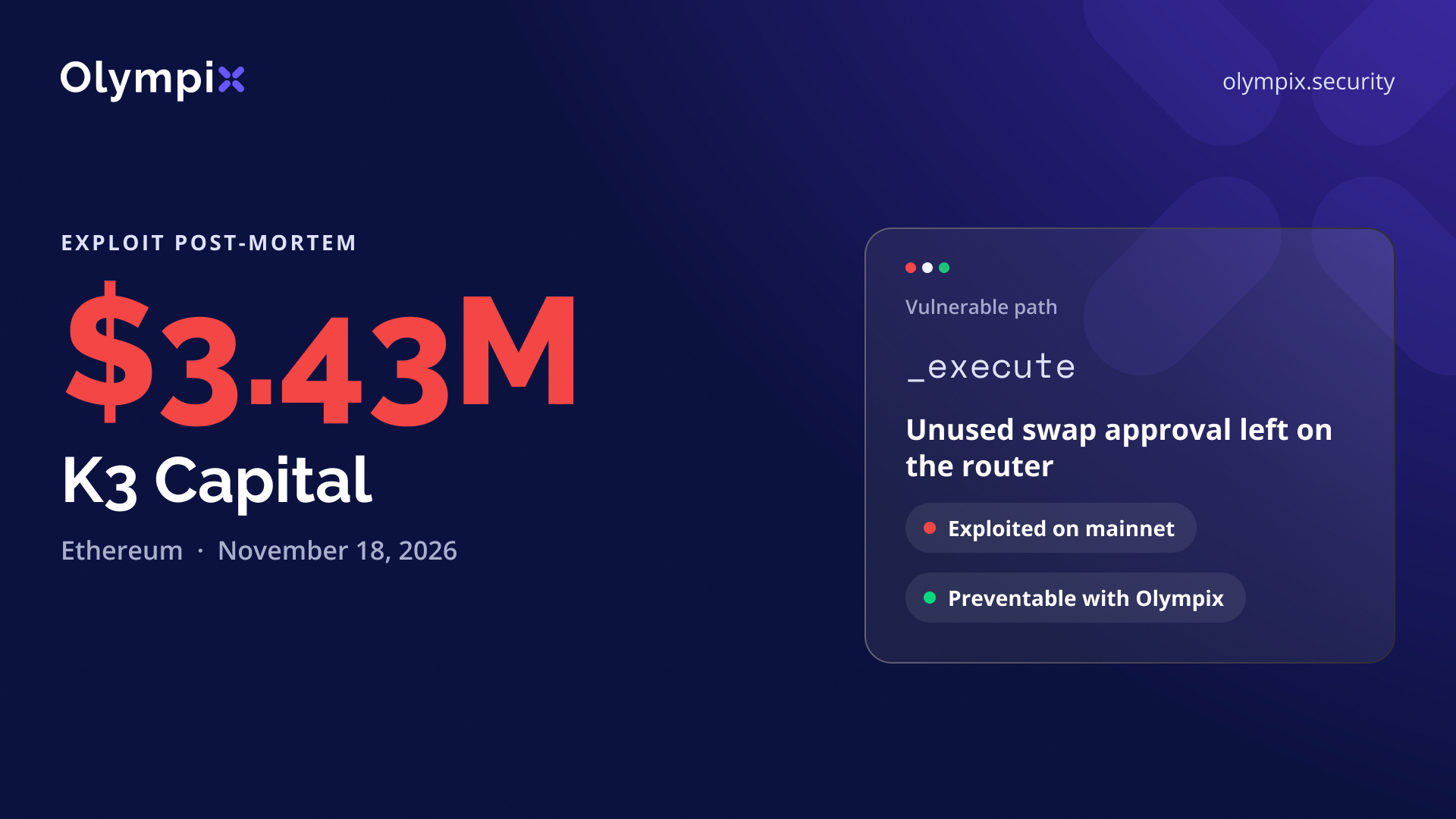

See what Olympix finds on your own code
Send us a repo that's already been audited, and we'll run Olympix at the same commit and show you what comes back.