DeFi's Next Exploit Won't Just Drain Protocols. It Will Drain Confidence in the Entire Category.
The DeFi industry has a tolerance problem. Not a technical one. A psychological one.
Every time a protocol gets drained, the community runs the same playbook: freeze what's left, publish a post-mortem, promise better audits next time, and move on. This has worked, more or less, because the people losing money were mostly crypto-native. They understood the risks. They stayed anyway.
That era is ending. Institutional capital is at the door. Regulatory frameworks are taking shape. The next wave of users arriving in DeFi will not have the same risk tolerance as the cohort that survived the 2022 bear market. And the next wave of exploits, which is coming regardless of how many audits get commissioned, will land in a completely different context.
The industry is not prepared for what that means.
The Post-Mortem Economy Is Not a Security Strategy
DeFi has built an entire culture around the post-mortem. A protocol gets exploited. Within 48 hours, a detailed breakdown appears explaining exactly what went wrong, which lines of code were vulnerable, what the attacker did step by step, and what the team will do differently going forward.
These documents are genuinely useful. They advance collective knowledge. Security researchers learn from them. Developers copy the lessons into future designs. The ecosystem inches forward.
But the post-mortem is, by definition, a document about failure. It is proof that the security process did not work. Publishing a thorough post-mortem after losing $50 million in user funds is the equivalent of a bank releasing a detailed report on exactly how its vault was opened. The transparency is admirable. The underlying fact remains: the money is gone.
The DeFi industry has confused transparency about failure with prevention of failure. These are not the same thing.
The Audit Illusion
The standard security model in DeFi goes roughly like this: build the protocol, write the contracts, engage one or two audit firms, receive a report, address the critical findings, ship to mainnet. Done. Secure.
Except it is not secure. The evidence is overwhelming and consistent. The Ronin Network had been audited. Wormhole had been audited. Nomad had been audited. Euler Finance, which lost $197 million in March 2023, had been audited multiple times by multiple firms.
Audits catch a meaningful percentage of vulnerabilities present at the time the audit is conducted. They do not catch vulnerabilities introduced after the audit. They do not catch the interaction effects between a protocol and new market conditions. They do not run continuously. They are a point-in-time assessment, and DeFi protocols are not point-in-time systems. They are living codebases operating in a constantly shifting environment.
The industry has known this for years. It has responded by commissioning more audits, paying more for audits, treating audit firm reputation as a proxy for security confidence. None of this has produced a meaningful reduction in the volume or severity of exploits.
The problem is not the quality of audits. The problem is that audits are the wrong tool for the job.
What Institutional Adoption Actually Requires
When people talk about institutional DeFi adoption, they tend to focus on regulatory clarity and custody solutions. These matter. But there is a third requirement that gets far less attention: proof of continuous security.
A pension fund allocating to a DeFi protocol does not want to read a post-mortem. It wants evidence, produced by automated systems running in real time, that the code does what it claims to do and that the security properties have been verified continuously. It wants something closer to what financial infrastructure expects from any system handling significant assets: not a certificate from a third party saying the code looked fine in October, but ongoing verification that the system is behaving as specified.
This is not an exotic requirement. It is exactly what traditional financial infrastructure demands. The fact that DeFi cannot currently provide it is a market structure problem, not a technology problem. The underlying tools exist. Static analysis, mutation testing, fuzzing, and automated unit testing can together produce the kind of continuous verification that institutional capital expects. The industry has simply not treated building this infrastructure as a priority.
Instead, it has treated security as a cost to be minimized and a check box to be completed before launch. The audit gets done. The box gets checked. The protocol ships. And the next exploit is already being written.
The Confidence Threshold Is Closer Than It Looks
The DeFi ecosystem has survived over $6 billion in documented losses since 2020. It has survived because the participants were risk-tolerant, because crypto-native capital has a higher threshold for loss, and because the narrative around DeFi's potential has remained compelling enough to attract replacement capital after every major incident.
None of those conditions will hold indefinitely.
The Euler Finance exploit in 2023 was notable not just for its size but for its target. Euler was a sophisticated lending protocol with a strong technical reputation. Its user base included people who knew what they were doing. If Euler could be drained for $197 million despite multiple audits and a technically credible team, the implicit message to sophisticated allocators is that no protocol can be treated as safe based on reputation and audit history alone.
That message is registering. Slowly, but it is registering.
The confidence threshold for institutional DeFi participation is not as far away as the industry's growth numbers might suggest. A sufficiently large, sufficiently high-profile exploit targeting a protocol that had done everything right by current standards, completed audits, maintained a bug bounty program, operated transparently, could trigger a confidence crisis that takes years to reverse.
This is not speculation. It is the normal pattern for emerging financial infrastructure. One failure at the wrong moment, with the wrong audience watching, sets the category back a decade. The history of payment networks, online banking, and early e-commerce all contain versions of this story.
The Shift That Needs to Happen
The DeFi security model needs to move from reactive to continuous. This is not a marginal improvement. It is a structural change in how the industry thinks about what security means.
Reactive security is what the industry has now: audits before launch, bug bounties after launch, post-mortems after exploits. Each of these activities happens in response to something, either anticipated risk or realized loss. None of them produce the thing that actually prevents exploits at scale, which is ongoing, automated verification that code behaves as specified under all conditions the system might encounter.
Continuous security means integrating static analysis, mutation testing, and fuzzing directly into the development process so that vulnerabilities are caught during development, not after deployment. It means running automated unit tests that verify protocol behavior not just against expected inputs but against adversarial ones. It means treating security verification as a continuous process rather than a periodic event.
This approach shifts the detection point from post-deployment to pre-deployment. Vulnerabilities that get caught during development do not become exploits. Post-mortems that never get written do not damage confidence. The math is straightforward: catching a vulnerability during development costs a fraction of what it costs to recover from an exploit, and that calculation does not include the reputational damage, which is not recoverable at all.
The tools to do this at scale exist today. The gap is adoption, not capability.
Proof, Not Promises
The DeFi industry will not win institutional trust by promising better security practices. It will win institutional trust by producing proof that security properties are continuously verified.
This is a distinction that matters enormously. A promise is a statement about intent. Proof is a statement about fact. Institutional capital allocators have seen enough promises from enough industries to be deeply skeptical of the former and highly responsive to the latter. What moves capital at scale is evidence, automated, continuous, auditable evidence, that the system works as claimed.
The infrastructure to produce that evidence needs to be built now, before the next wave of exploits lands in front of an audience that has less tolerance for post-mortems than the crypto-native community that has absorbed the last five years of losses.
The window to build proactive security infrastructure before a confidence crisis is not unlimited. The participants who treat that window as an opportunity rather than an afterthought will be the ones still operating when institutional DeFi moves from aspiration to reality.
The rest will be writing post-mortems.
What’s a Rich Text element?
The rich text element allows you to create and format headings, paragraphs, blockquotes, images, and video all in one place instead of having to add and format them individually. Just double-click and easily create content.
A rich text element can be used with static or dynamic content. For static content, just drop it into any page and begin editing. For dynamic content, add a rich text field to any collection and then connect a rich text element to that field in the settings panel. Voila!
Headings, paragraphs, blockquotes, figures, images, and figure captions can all be styled after a class is added to the rich text element using the "When inside of" nested selector system.
Follow-up: Conduct a follow-up review to ensure that the remediation steps were effective and that the smart contract is now secure.
Follow-up: Conduct a follow-up review to ensure that the remediation steps were effective and that the smart contract is now secure.
In Brief
Remitano suffered a $2.7M loss due to a private key compromise.
GAMBL’s recommendation system was exploited.
DAppSocial lost $530K due to a logic vulnerability.
Rocketswap’s private keys were inadvertently deployed on the server.
Hacks
Hacks Analysis
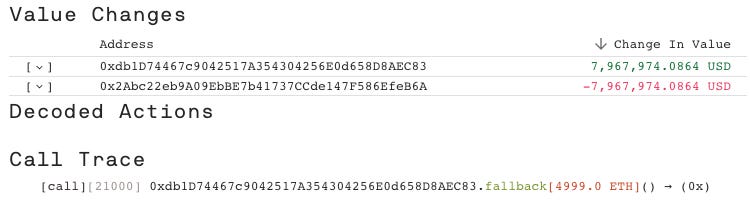
Huobi | Amount Lost: $8M
On September 24th, the Huobi Global exploit on the Ethereum Mainnet resulted in a $8 million loss due to the compromise of private keys. The attacker executed the attack in a single transaction by sending 4,999 ETH to a malicious contract. The attacker then created a second malicious contract and transferred 1,001 ETH to this new contract. Huobi has since confirmed that they have identified the attacker and has extended an offer of a 5% white hat bounty reward if the funds are returned to the exchange.