Adding a New Layer of Security: How Securitize Complements Its Audits with Olympix
Securitize is the world's leading platform for tokenizing real-world assets, issuing and servicing tokenized funds for institutions including Apollo, BlackRock, BNY, Hamilton Lane, KKR, and VanEck. When you hold about $5billion in tokenized assets under management on behalf of institutions whose security standards have been refined over decades, the bar for smart contract security looks different than it does for the rest of the industry. “Point-in-time audits are a critical component, but security expectations extend throughout the development lifecycle as the codebase evolves.”
That bar drives how Securitize thinks aout its security stack. Audits from top-tier firms remain a critical layer. So does on-chain monitoring. In February 2026, Securitize added Olympix as a third layer, a continuous and deterministic security infrastructure that runs alongside the audits and gives the team enforceable security metrics throughout the development lifecycle. This is how the stack fits together, and why the additional layer matters for a platform operating at the institutional end of the tokenization market.
The Institutional Security Expectation Extends to Partners
Tokenization platforms occupy a unique position. Securitize is not only responsible for its own security posture. It inherits the risk expectations of every institution that issues, holds, or settles assets through it. A BlackRock fund tokenized on Securitize is, from BlackRock's perspective, exposed to whatever security controls Securitize has in place. The same logic applies to Apollo, KKR, Hamilton Lane, BNY, and every other counterparty on the platform.
Traditional finance has spent decades developing deterministic, mathematically grounded methods for verifying the correctness of financial systems. Formal methods, exhaustive testing, and provable invariants are standard practice in high-risk environments. Blockchain has historically not had access to those methods at production scale, in part because formal verification required specialist consultants and could not run continuously inside a development workflow.
Securitize added Olympix to its stack because it brings those methods to smart contract development in a form that is automated, continuous, and enforceable inside CI/CD. “Those same rigorous, measurable security standards can now be applied to the smart contracts supporting tokenized assets.”
A New Layer to Complement the Audit
Securitize works with top-tier audit firms, and audits remain an essential layer of any serious security program. They surface issues that automated tooling cannot, and a manual review by experienced auditors continues to be a permanent fixture in a robust stack. The problem is not that audits fail. The problem is that audits are point-in-time, and 90 percent of exploited smart contracts had been audited at least once before the exploit.
The Balancer exploit in November 2025 is a useful illustration. An attacker drained over 116 million dollars across multiple chains by exploiting a precision rounding flaw in invariant calculations inside Balancer V2's ComposableStablePool contracts. The attack chained dozens of calibrated micro-swaps inside a single batchSwap to compound wei-level rounding losses into catastrophic invariant manipulation. Balancer V2 had been reviewed by OpenZeppelin, Trail of Bits, Certora, and ABKD, among others. The protocol also had on-chain monitoring in place, which is above and beyond standard best practice. None of it caught the exploit before funds left the contracts.
The exploit was not a missing check that pattern matching would have flagged. It was an arithmetic interaction across the full codebase that only became visible when execution paths were exhaustively explored. Olympix runs across the entire codebase, not diffs, and uses deterministic methods including symbolic execution, mutation testing, and formal verification techniques to validate invariants under adversarial conditions. The Balancer-class precision flaw is exactly the kind of issue these methods are designed to surface. The Olympix team has published a full breakdown of the Balancer attack.
Why AI-Only Tools Are Not Enough
A second class of vendor has emerged offering AI auditors, and Securitize evaluated the category as part of building out its security stack. These tools rely on large language models trained on public vulnerability data to pattern-match against new code. They are useful for catching common issues quickly, but for a platform custodying tokenized exposure for the largest asset managers in the world, they have two structural limitations that disqualify them as a standalone layer.
First, AI tools cannot reliably find novel vulnerabilities. Pattern matching by definition looks for what is already known. The most expensive exploits in smart contract history have not been textbook bugs. They have been logic flaws specific to the protocol, attack vectors that combined several individually benign behaviors, or mathematical edge cases that only emerged under adversarial conditions.
The Cork Protocol exploit in May 2025 is one example. An attacker drained approximately 12 million dollars in wstETH from Cork's wstETH-weETH liquidity vault by exploiting missing access controls and input validation in a Uniswap V4 hook implementation, combined with a complex sequence of operations across a custom market the attacker created. The vulnerability was specific to how Cork's hook interacted with permissionless market creation. There was no public training data on that pattern because the pattern was new. AI tooling looking for known vulnerability signatures would not have flagged it. Cork became an Olympix client after the incident, and the Olympix team has published a case study on the engagement.
Second, AI tools typically run on code diffs rather than the full codebase, and they struggle with the complexity and interconnection that defines sophisticated DeFi protocols. AI tools are also probabilistic by design. A model that mostly catches vulnerabilities is the wrong shape of answer for capital that mostly stays where it is supposed to be. Olympix runs across the entire codebase and uses deterministic methods that produce reproducible, measurable results. That is the standard Securitize and its institutional partners are accustomed to in the rest of their stack, and it is the standard on-chain finance now requires.
How Securitize Uses Olympix
Securitize uses Olympix as a continuous security layer that runs alongside its traditional audit relationships. Four components of the Olympix stack are active in the Securitize development workflow, each enforcing a specific security metric that the team can measure and act on.
Static Analysis
Olympix's static analysis runs as code is written, identifying known vulnerability patterns mapped to real-world exploit classes. The findings are deterministic and reproducible, with near-zero noise. Securitize blocks merges on static analysis findings, which means vulnerabilities introduced during development are surfaced and resolved before they enter the codebase.
Unit Test Generation
Olympix automatically generates unit tests aligned to internal standards, producing measurable line and branch coverage. Securitize enforces a minimum branch coverage threshold across the codebase. Coverage is no longer a vague aspiration. It is a number the team can require and verify on every change.
Mutation Testing
Coverage alone does not guarantee that tests are catching faulty logic. Mutation testing introduces controlled faults into the code and checks whether the existing test suite detects them. Securitize enforces a minimum mutation score, which gives the team evidence that their tests are actually effective rather than just present.
BugPOCer
BugPOCer is the final internal validation layer before external audit. It automatically generates proof-of-concept exploits for vulnerabilities it identifies, which means findings come with provable exploitability rather than theoretical risk. For Securitize, BugPOCer has surfaced audit-level findings and findings that audits had missed, with the proof-of-concept exploit serving as evidence in each case.
Together these layers produce something that did not previously exist for smart contract development: a continuous, enforceable, and provable security posture before the first audit. Vulnerabilities are introduced, detected, fixed, and re-verified inside CI/CD, with an evidence trail at every step.
When Code Becomes Capital, Correctness Becomes Non-Negotiable
“Securitize has grown into one of the largest institutional tokenization platforms in the market, supporting tokenized assets from Apollo, BlackRock, BNY, Hamilton Lane, KKR, VanEck, and others. BlackRock's BUIDL fund, issued through Securitize, has grown into one of the largest tokenized money market funds in the world.
Securitize's institutional footprint has continued to expand across tokenized funds, public equities, regulated market infrastructure, and integrations throughout the onchain financial ecosystem. In July 2026, Securitize became a publicly traded company on the New York Stock Exchange under the ticker SECZ.”
The institutional footprint is expanding rapidly. In Q1 2026, Securitize signed a memorandum of understanding with the New York Stock Exchange to become the first digital transfer agent for NYSE's upcoming Digital Trading Platform for tokenized securities. The company also announced a partnership with Computershare, the world's largest transfer agent, for issuer-sponsored tokenized securities, and received FINRA approvals for custody, atomic settlement, and underwriting tokenized IPOs. A SPAC merger with Cantor Equity Partners II, valued at $1.25 billion pre-money, is expected to take Securitize public on Nasdaq under the ticker SECZ in the first half of 2026.
This is the scale and the scrutiny that defines institutional tokenization in 2026. The amount of regulated capital moving on-chain has crossed a threshold where reactive security models no longer scale. Audits remain essential. On-chain monitoring remains useful. “Continuous security tooling can add another layer between development and deployment as more regulated financial assets move onchain.”
Securitize is one of a growing set of teams that have made continuous, deterministic, pre-deployment security a permanent part of their development pipeline. For institutional tokenization at this scale, it is no longer optional.
Your security posture should meet the standards your partners already expect. Book a demo to see how Olympix fits into your development workflow.
What’s a Rich Text element?
The rich text element allows you to create and format headings, paragraphs, blockquotes, images, and video all in one place instead of having to add and format them individually. Just double-click and easily create content.
A rich text element can be used with static or dynamic content. For static content, just drop it into any page and begin editing. For dynamic content, add a rich text field to any collection and then connect a rich text element to that field in the settings panel. Voila!
Headings, paragraphs, blockquotes, figures, images, and figure captions can all be styled after a class is added to the rich text element using the "When inside of" nested selector system.
Follow-up: Conduct a follow-up review to ensure that the remediation steps were effective and that the smart contract is now secure.
Follow-up: Conduct a follow-up review to ensure that the remediation steps were effective and that the smart contract is now secure.
In Brief
Remitano suffered a $2.7M loss due to a private key compromise.
GAMBL’s recommendation system was exploited.
DAppSocial lost $530K due to a logic vulnerability.
Rocketswap’s private keys were inadvertently deployed on the server.
Hacks
Hacks Analysis
Huobi | Amount Lost: $8M
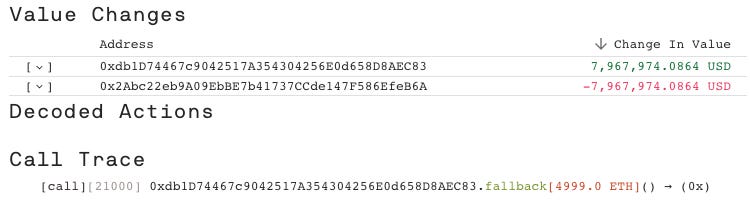
On September 24th, the Huobi Global exploit on the Ethereum Mainnet resulted in a $8 million loss due to the compromise of private keys. The attacker executed the attack in a single transaction by sending 4,999 ETH to a malicious contract. The attacker then created a second malicious contract and transferred 1,001 ETH to this new contract. Huobi has since confirmed that they have identified the attacker and has extended an offer of a 5% white hat bounty reward if the funds are returned to the exchange.

.png)