
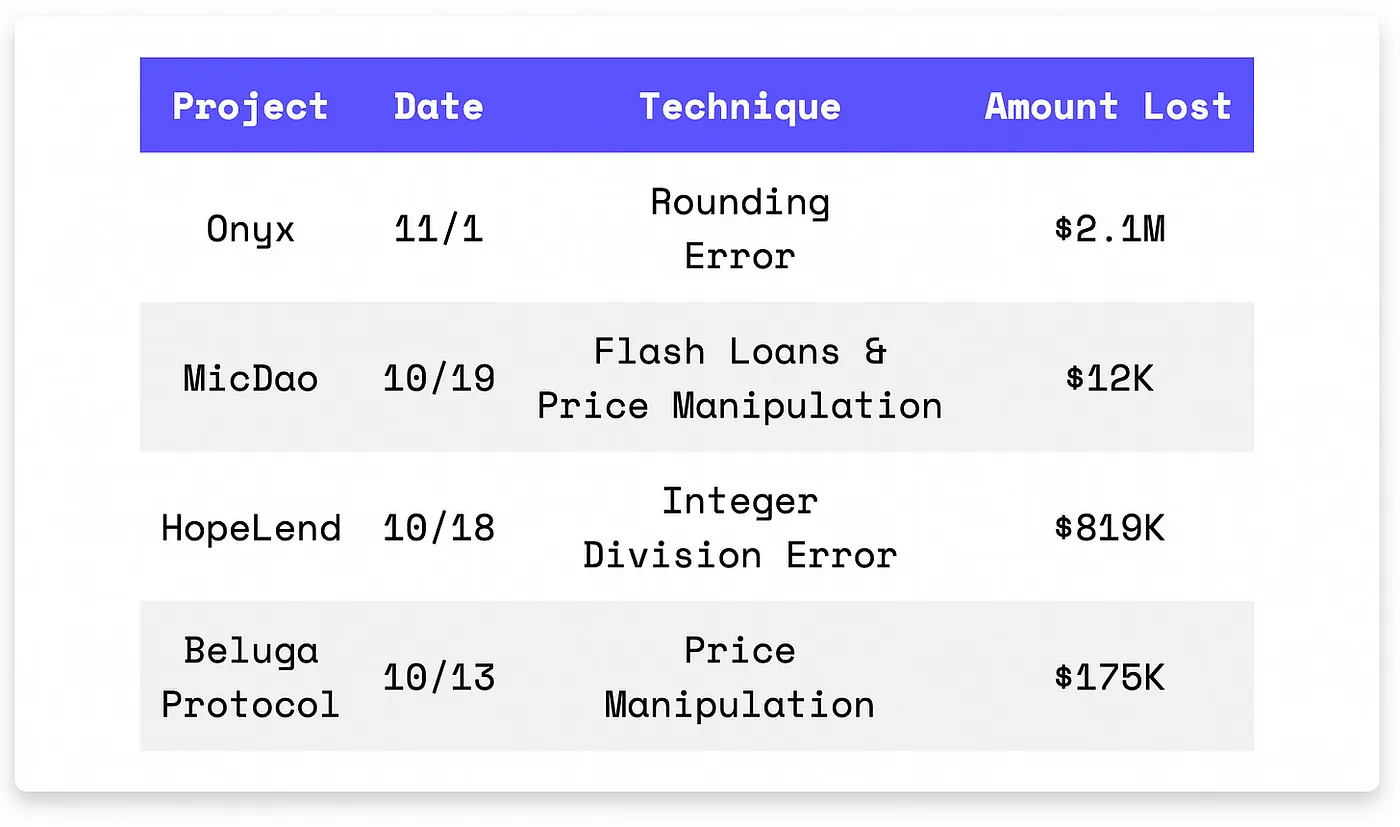
Onyx lost $2.1M to a rounding exploit; HopeLend followed with an $819K hit from a truncated division error. Beluga Protocol and MicDAO repeated the same supply manipulation routine: burn tokens, pump price, exit. Whether it’s integer math or liquidity shell games, these bugs show that basic accounting missteps still drive major losses.
On November 1st, the Onyx exploit on the Ethereum mainnet resulted in a $2.1 million loss due to a rounding error. The hacker used flash loans and donated 4,000 ETH to the Onyx PEPE (oPEPE) Contract in order to manipulate the exchange rate of PEPE tokens. The attack contract donated funds to mint PEPE tokens. Subsequently, the attacker redeemed nearly all PEPE funds, reducing the total supply of PEPE tokens and artificially inflating the exchange rate. Taking advantage of this inflated rate, the attacker borrowed additional funds, repaid the flash loan, and made a profit.

Exploit Contract: 0x526e8E98356194b64EaE4C2d443cC8AAD367336f
Transaction Hash: 0xf7c21600452939a81b599017ee24ee0dfd92aaaccd0a55d02819a7658a6ef635
On October 19th, the MicDao exploit on the BNB chain resulted in a $12K loss due to a price manipulation vulnerability. The root cause was a vulnerability in the private _transfer() function within the MicDao contract. This function burned MicDao tokens whenever triggered. The attacker exploited this by burning tokens, artificially reducing the total supply, and inflating the token price. The attacker then sold the MicDao tokens for profit and converted the funds into BSC.

Exploit Contract (on BNB Chain): 0xf6876f6AB2637774804b85aECC17b434a2B57168
Transaction Hash: 0x24a2fbb27d433d91372525954f0d7d1af7509547b9ada29cc6c078e732c6d075
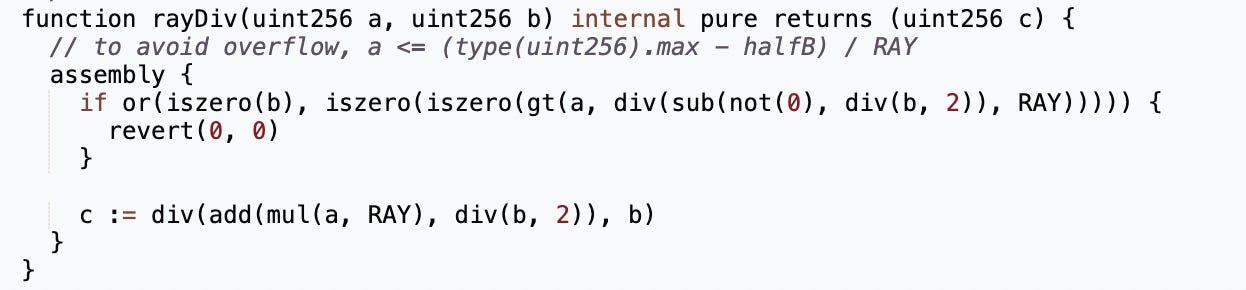
On October 18, the HopeLend exploit on the Ethereum Mainnet resulted in a $819K loss due to an integer division error. The attacker initially borrowed 2,000 WBTC using flash loans from Aave V3, and donated these WBTC tokens to HopeLend’s hEthWBTC lending pool, which had been deployed in early 2023. The root cause of the exploit was the rayDiv() function, which contained a division operation that inadvertently truncated decimal points. This error allowed the manipulation of the hEthWBTC discount rate, enabling the attacker to generate a profit.
Exploit Contract: 0x25126f207db7dc427415ea640ce0187767403907
Transaction Hash: 0x1a7ee0a7efc70ed7429edef069a1dd001fbff378748d91f17ab1876dc6d10392
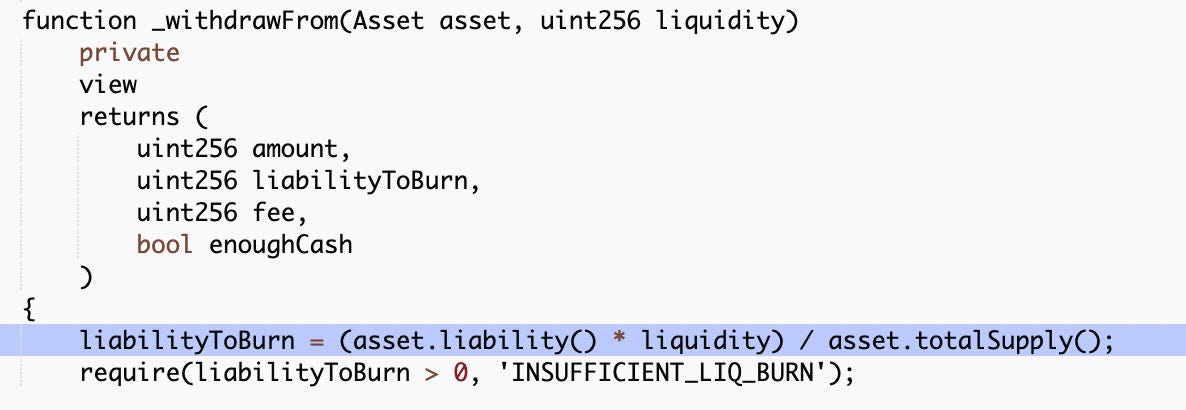
On October 13th, the Beluga Protocol exploit on the Arbitrum Chain resulted in a $175K loss due to a price manipulation vulnerability. The exploit involved initially borrowing 299,067 USDT from Balancer’s Vault and then using these to swap for USDC_E tokens. The attacker then invoked Beluga Pool contract’s withdrawFrom() function, which increased the liabilityToBurn and reduced the token supply. The attacker then sold the USDC_E tokens at an artificially inflated price and made a profit.
Exploit Contract (on Arbitrum Chain): 0x22D909AbE10Cc2F9FfFA4770d8AdCa0A89493eb0
Transaction Hash: 0x57c96e320a3b885fabd95dd476d43c0d0fb10500d940d9594d4a458471a87abe